This is the wiki for products made by Fractal Audio Systems. Maintained by members of the community.
New to the wiki: ICONS!
Difference between revisions of "Amp models list"
| Line 1: | Line 1: | ||
| − | This page lists all | + | This page lists all amplifier models in Fractal Audio’s current generation of guitar processors and plugins, adding essential information. |
| − | + | The list can be different from what you see on your device. Possible reasons: | |
| + | * You're using older firmware | ||
| + | * You're using the AM4 which has a slightly shorter list because (1) models have been consolidated into a single model, and (2) some legacy models have been deprecated (Brit Pre, old Vibrato Verb, one of the Legend models, one of the Chieftain models, Dizzy V4 Blue, Thordendal) | ||
| + | * You're using ICONS where some models have a different name (i.e, Supertweed is FAS Supertweed in ICONS) | ||
| − | + | For each amp model, the matching DynaCab is listed. This is derived from the AM4 with <q>automatic Amp+Cab linking</q> enabled. | |
| − | |||
| − | + | Many models are showcased through the factory presets on your device. Make sure you have the latest ones installed. | |
| − | + | In <q>[http://www.dropbox.com/s/8fvjvrqnryihp86/Yeks_Guide_to_the_Fractal_Audio_Amp_Models.pdf Yek's Guide to the Fractal Audio Amp models]</q> (PDF file), forum member Yek (Alexander van Engelen) discusses the Amp models that were available at the time of writing (2017). Most of the information is still valid. The guide was preceded by a [http://forum.fractalaudio.com/search/1550534/?q=%22Fractal+Audio+AMP+models%22&o=date&c%5Btitle_only%5D=1&c%5Bnode%5D=61&c%5Buser%5D%5B0%5D=10160 series of threads on Fractal Audio's User Forum]. | |
| − | |||
| − | |||
| − | |||
| − | [[ | + | [[image:YeksGuide.png|link=http://www.dropbox.com/s/8fvjvrqnryihp86/Yeks_Guide_to_the_Fractal_Audio_Amp_Models.pdf |150px]] [[image:Book.jpg|link=http://www.dropbox.com/s/8fvjvrqnryihp86/Yeks_Guide_to_the_Fractal_Audio_Amp_Models.pdf |150px]] |
| − | + | __TOC__ | |
| − | + | ==5F1 TWEED CHAMPLIFIER (narrow-panel Fender Tweed Champ, 5F1)== | |
| − | |||
| − | |||
| − | |||
| − | |||
| − | |||
| − | |||
| − | |||
| − | [ | + | [[file:5f1 Fender t.png|300px]] |
| − | + | Cab: | |
| + | * original: Fender 1x8 | ||
| + | * matching DynaCab: 1x8 5F1 Tweed | ||
| − | + | Volume control | |
| − | + | Power tubes: 6V6 | |
| − | + | # "This particular amp exhibits a unique breakup characteristic due to its single-ended design and simple circuit." | |
| + | # " Some of these old amps, and the 5F1 is one of them, will actually produce a sub-octave. It's why some players value them so much because it makes them sound full and warm." | ||
| − | + | ==5F1 TWEED EC CHAMPLIFIER (2011 Fender EC Vibro-Champ)== | |
| − | |||
| − | |||
| − | |||
| − | [[ | + | [[file:EC-Vibro-Champ.jpg|300px]] |
| − | + | Cab: | |
| + | * original: Fender 1x8 | ||
| + | * matching DynaCab: 1x8 5F1 Tweed | ||
| − | + | Volume, Tremolo effect | |
| − | + | Power tubes: 6V6 | |
| − | |||
| − | [http://forum.fractalaudio.com/threads/fractal-audio-amp-models- | + | # "The circuit is slightly different than the original 5F1. It has cathode bypass caps giving it more gain." [http://forum.fractalaudio.com/threads/fractal-audio-amp-models-5f1-tweed-fender-champ-5f1.111067/page-2#post-1508977] |
| + | # "It's a single-ended power amp with negative feedback and bias tremolo. Subtle is the only possibility with this configuration. Bias tremolo works by modulating the quiescent operating point of the power tubes. With a single-ended power amp with negative feedback the gain doesn't change much as you change the operating point, hence the tremolo effect is subtle. Bias tremolo works best on amps with little to no negative feedback." [https://forum.fractalaudio.com/threads/fw-q8-5f1-tweed-ec-4-scene-preset-vid-demo.126829/post-1509387] | ||
| − | == | + | ==5F8 TWEED BRIGHT (Keith Urban's 1959 narrow-panel high-power Fender Tweed Twin, 5F8)== |
| − | + | [[file:5f8-2.jpg|300px]] | |
| − | + | Models: | |
| + | * Normal channel | ||
| + | * Bright channel | ||
| + | * Jumpered channels | ||
| − | + | Keith Urban's #1 Tweed Twin. | |
| − | + | Cab: | |
| − | * | + | * original: Fender 2x12 (P12N). Keith Urban's cab has Two-Rock speakers |
| − | * | + | * matching DynaCab: 2x12 Double Verb |
| − | |||
| − | |||
| − | + | Volume Bright, Volume Normal, Presence, Middle, Bass, Treble | |
| − | + | Power tubes: 6L6 | |
| − | # " | + | # "Based on a 1959 Fender Twin Amp. This particular model is based on Keith Urban’s “#1”. Thank you Keith for allowing us the use of your prized amplifier." |
| − | # | + | # "All the Fender models except the 59 Bassman and 5F8 Tweed don't have cathode followers." [https://forum.fractalaudio.com/threads/axe-fx-iii-firmware-version-5-00-beta-3.148907/page-3#post-1764588] |
| − | |||
| − | |||
| − | # " | ||
| − | |||
| − | |||
| − | # | ||
| − | + | ==5F8 TWEED JUMPED== | |
| − | == | + | ==5F8 TWEED NORMAL== |
| − | == | + | ==6G4 SUPER (1960 brownface Fender Super, 6G4)== |
| − | + | [[file:6G4.jpg|300px]] | |
| − | + | Vibrato channel model | |
| − | + | Cab: | |
| + | * original: Fender 2x10 with Jensen Alnico 25W P10R, 40W P10Q, Oxford 10K5, or Fender 2x12 | ||
| + | * matching DynaCab: 2x10 Super 6G4 | ||
| − | + | Volume, Bass, Treble, Presence, Vibrato effect (not modeled) | |
| − | |||
| − | |||
| − | + | Power tubes: 6L6 | |
| − | + | # "Super 6G4 is a Brownface Fender Super. Concert 6G12 is a Brownface Fender Concert. They are very similar amps and both sound "old". They definitely have that early 60's vibe to them." [https://forum.fractalaudio.com/threads/axe-fx-ii-firmware-17-02-released.93734/#post-1124507] | |
| − | + | ==6G12 CONCERT (1960 brownface Fender Concert, 6G12)== | |
| − | |||
| − | |||
| − | [ | + | [[file:6G12.jpg|300px]] |
| − | + | Vibrato channel model | |
| − | + | Cab: | |
| + | * original: Fender 4x10 with Jensen Alnico 25W P10R or 40W P10Q, ceramic 25W C10R, or Oxford | ||
| + | * matching DynaCab: 4x10 Bassguy RI | ||
| − | + | Volume, Bass, Treble, Presence, Vibrato effect (not modeled) | |
| − | + | Power tubes: 6L6 | |
| − | |||
| − | [ | + | # "Super 6G4 is a Brownface Fender Super. Concert 6G12 is a Brownface Fender Concert. They are very similar amps and both sound "old". They definitely have that early 60's vibe to them." [https://forum.fractalaudio.com/threads/axe-fx-ii-firmware-17-02-released.93734/#post-1124507] |
| − | + | ==59 BASSGUY BRIGHT (1959 narrow-panel Fender Tweed Bassman, 5F6-A)== | |
| − | + | [[file:bassman.jpg|300px]] | |
| − | + | Models: | |
| + | * Normal channel | ||
| + | * Bright channel | ||
| + | * Jumpered channels | ||
| − | + | Cab: | |
| + | * original: Fender 4x10 with Jensen Alnico 25W P10R or 40W P10Q | ||
| + | * matching DynaCab: 4x10 Bassguy RI | ||
| − | + | Volume Normal, Volume Bright, Bass, Middle, Treble, Presence | |
| − | + | Power tubes: 6L6/5881 | |
| − | |||
| − | [[ | + | # "All the Fender models except the 59 Bassman and 5F8 Tweed don't have cathode followers." [https://forum.fractalaudio.com/threads/axe-fx-iii-firmware-version-5-00-beta-3.148907/page-3#post-1764588] |
| + | # "The Bassman was reworked using an original 59 Bassman 5F6-A as a reference. This has a 12AY7 input buffer which has less gain than the reissue which uses a 12AX7A (7025 actually, same thing)." | ||
| + | # ("The Bassman and Deluxe Tweed models are both modeled using a 12AY7 as the input buffer. The Preamp Tube Type parameter only affects the tubes after the input buffer." [https://forum.fractalaudio.com/threads/12ay7-preamp-tube-for-tweed-deluxe-and-bassman-models.175834/post-2135435] | ||
| + | # "The input to the second 12AX7 is a summing node. Both volume controls affect the signal. If you plug into the Bright input the Normal volume control will also control the volume to some degree and change the frequency response." [https://forum.fractalaudio.com/threads/bassman-how-do-the-way-the-2-drive-controls-interact.181986/post-2232557] | ||
| − | + | ==59 BASSGUY JUMPED== | |
| − | + | ==59 BASSGUY NORMAL== | |
| − | + | ==59 BASSGUY RI JUMPED (Fender 59 Bassman LTD Vintage Reissue)== | |
| − | + | [[file:FENDER_BASSMAN_RI.jpg|275px]] | |
| − | + | Jumpered channels model | |
| − | + | Cab: | |
| − | * | + | * original: Fender 4x10 with Jensen Alnico 25W P10R or 40W P10Q |
| + | * matching DynaCab: 4x10 Bassguy RI | ||
| − | + | Volume Normal, Volume Bright, Bass, Middle, Treble, Presence | |
| − | + | Power tubes: 6L6 | |
| − | # | + | See [[Amp_models_list#59_BASSGUY_BRIGHT_.281959_narrow-panel_Fender_Tweed_Bassman.2C_5F6-A.29|59 Bassguy]] |
| − | |||
| − | [ | + | # "There are quite a few differences between a 5F6-A and the reissue: [https://forum.fractalaudio.com/threads/bassman-how-do-the-way-the-2-drive-controls-interact.181986/post-2358853] |
| + | ## 12AX7A vs. 12AY7 input tube. | ||
| + | ## Different tone stack (this is a big one). | ||
| + | ## Different presence network. | ||
| + | ## Different B+ voltage. | ||
| + | ## 6L6s vs 5881s (minimal difference). | ||
| − | ==65 BASSGUY BASS ( | + | ==65 BASSGUY BASS (1965 blackface Fender Bassman head, AB165)== |
[[file:ab165.png|300px]] | [[file:ab165.png|300px]] | ||
| Line 161: | Line 161: | ||
* Normal channel | * Normal channel | ||
| − | + | Cab: | |
| + | * original: Fender 2x12 (Oxford) | ||
| + | * matching DynaCab: 2x12 65 Bassguy | ||
| + | |||
| + | Volume, Bass, Treble, Bright switch (Normal channel only), fixed Presence circuit (Presence should be at 10) | ||
| − | + | Power tubes: 6L6 | |
# "Has a pissed-off Marshall vibe to it." [http://forum.fractalaudio.com/posts/490912] | # "Has a pissed-off Marshall vibe to it." [http://forum.fractalaudio.com/posts/490912] | ||
# "The 65 Bassguy was matched to a 65 Bassman that Dweezil sent me. It's a vicious amp that sounds more like a Plexi than a Fender. It's the infamous AB165 circuit which is very crunchy and bright and does not sound like your typical Fender." [https://forum.fractalaudio.com/threads/am-i-the-only-one-who-noticed-that-some-amps-have-alot-more-gain.51123/page-2#post-658833] | # "The 65 Bassguy was matched to a 65 Bassman that Dweezil sent me. It's a vicious amp that sounds more like a Plexi than a Fender. It's the infamous AB165 circuit which is very crunchy and bright and does not sound like your typical Fender." [https://forum.fractalaudio.com/threads/am-i-the-only-one-who-noticed-that-some-amps-have-alot-more-gain.51123/page-2#post-658833] | ||
| − | # "It's a crazy sounding amp, sounds nothing like your typical Fender | + | # "It's a crazy sounding amp, sounds nothing like your typical Fender." [https://forum.fractalaudio.com/threads/another-v10-preview.62489] |
| − | # "The AB165 uses 7025 preamp tubes (which are relabeled 12AX7). The phase inverter, however, is a 12AT7. The secret to the AB165 is the summing stage. It uses | + | # "The AB165 uses 7025 preamp tubes (which are relabeled 12AX7). The phase inverter, however, is a 12AT7. The secret to the AB165 is the summing stage. It uses an inverting summing amp to sum the Normal and Bass inputs. This stage clips, because of all the local negative feedback, quite hard." [http://forum.fractalaudio.com/posts/] |
| − | |||
| − | |||
| − | |||
==65 BASSGUY NORMAL== | ==65 BASSGUY NORMAL== | ||
| − | == | + | ==1959SLP JUMPED (100W Marshall Super Lead Plexi 1959 reissue)== |
| − | [[file: | + | [[file:SLP.png|300px]] |
| − | + | Models: | |
| − | * | + | * Normal channel |
| + | * Treble (High) channel | ||
| + | * Jumpered channels | ||
| − | + | Cab: | |
| + | * original: Marshall 4x12 (G12M, G12H) | ||
| + | * matching DynaCab: 4x12 1960TV | ||
| − | Volume, Bass, Treble, Presence | + | Volume Normal, Volume Treble, Bass, Middle, Treble, Presence |
| − | # " | + | Power tubes: EL34 |
| + | |||
| + | # "One of the first mods people make to real 'Plexi' Marshalls is to "clip the bright cap". The bright cap varied over the years, supposedly depending on what was lying around in the shop. The model defaults to the bright cap in the circuit. If you turn off Bright you're effectively clipping the bright cap. The bright cap in Marshalls can be very bright and harsh. However, if you crank the Master you might find the extra brightness helps compensate for the power amp getting darker." | ||
| + | # (fizz) "It's the way a Plexi is supposed to sound. That's due to the cathode follower. That raspiness helps it cut through in a mix. I own three of them and they are that fizzy." [https://forum.fractalaudio.com/threads/high-end-fizz-is-this-normal.43598/#post-576475] | ||
| + | # "Don't be afraid to turn the bass all the way down or the treble all the way up. Just like with the actual amp. For example, on the normal channel of a Plexi most people turn the bass way down. Otherwise it's too flubby." | ||
| + | # "The old one (Plexi 100w model) has a 2.7K cathode resistor on the first stage, the new one (1959SLP) has an 820 ohm." [https://forum.fractalaudio.com/posts/1111403] | ||
| + | # "I based the SLP on using it with G12H(55) speakers which have a resonance of 55 Hz. When mounted in a typical cab the resonance will be in the low 70s. There is no right or wrong. Whatever sounds best." [https://forum.fractalaudio.com/posts/1159759] | ||
| + | # "My settings for a "typical" Plexi tone are Bass: 2, Mid: 8, Treble 7.5. Adjust Presence to taste." [https://forum.fractalaudio.com/posts/1179420] | ||
| + | # "What you are hearing is output transformer high frequency resonance. Old Plexis didn't do this because they had good transformers. New transformers are crappy and resonate at the cutoff frequency because they are underdamped. This causes a raspy, fizzy texture to the distortion. The transformer resonance is adjustable but the parameter isn't exposed to the user. When you turn it up you get that same squishy rasp that you are hearing. For the Plexis I have the damping set to flat with no resonance because that's how our vintage Plexis measure. Our 50W is a little underdamped but people complain about raspy high frequencies so I erred on the safe side." [http://forum.fractalaudio.com/threads/dimed-real-plexi-vs-dimed-simulation-q8-01.127161/page-2#post-1513888] | ||
| + | # "When modding Marshalls for higher gain sometimes the modder will decrease the input frequency response to reduce noise and fizziness. You can do this by reducing the high-cut frequency in the input EQ. Or you can use a high-shelf filter which is a little more subtle. Another technique is to put a capacitor across the second-to-last triode stage. This is the "Triode 1 Plate Freq" parameter. Reduce this to around 2 kHz to start which is typical of amps like an SLO100, etc." [https://forum.fractalaudio.com/threads/dialling-in-the-marshalls.143682/post-1707222] | ||
| + | # "There's a 0.68uF cap on the second triode." [https://forum.fractalaudio.com/threads/axe-fx-firmware-version-20-05-public-beta-beta-1.187133/post-2317922] | ||
| + | # "Our reference Plexi 100 has log taper tone pots. If you want a more conventional 100W Plexi sound use the 1959SLP models." [https://forum.fractalaudio.com/threads/plexi-100-very-blanketed-now.205645/#post-2565083] | ||
| − | + | ==1959SLP NORMAL== | |
| − | + | # "There's a 0.68uF cap on the second triode." [https://forum.fractalaudio.com/threads/axe-fx-firmware-version-20-05-public-beta-beta-1.187133/post-2317922] | |
| − | + | ==1959SLP TREBLE== | |
| − | + | # "There's a 0.68uF cap on the second triode." [https://forum.fractalaudio.com/threads/axe-fx-firmware-version-20-05-public-beta-beta-1.187133/post-2317922] | |
| − | |||
| − | + | ==1987X JUMPED (50W Marshall 1987X reissue) == | |
| − | + | [[file:1987X.png|300px]] | |
| − | + | Models: | |
| + | * Normal channel | ||
| + | * Treble channel | ||
| + | * Jumpered channels | ||
| − | + | Cab: | |
| + | * original: Marshall 4x12 (G12M, G12H) | ||
| + | * matching DynaCab: 4x12 1960TV | ||
| − | + | Volume Normal, Volume Treble, Bass, Middle, Treble, Presence | |
| − | + | Power tubes: EL34 | |
| − | + | See [[Amp_models_list#1959SLP_JUMPED_.28100W_Marshall_Super_Lead_Plexi_1959_reissue.29|1959SLP]] | |
| − | |||
| − | |||
| − | |||
| − | |||
| − | [[ | + | # "The 1987x doesn't have the 0.68uF cap on the last triode. Gives it a smoother distortion." [https://forum.fractalaudio.com/posts/1000388] |
| + | # "Our reference amp has no bright cap. Looks like it was that way from the factory. There are no signs it was removed. The location in the circuit board is empty and the solder joints do not appear to have been disturbed." [https://forum.fractalaudio.com/threads/1987x-bright-switch-off-by-default.145332/post-1718899] | ||
| + | # "The 1987X model is based on a reissue 1987. It doesn't have a bright cap. Use one of the Plexi 50W models for the vintage sound of a 1987." [https://forum.fractalaudio.com/threads/axe-fx-iii-firmware-25-00-public-beta-cygnus-x-3.202659/post-2537333] | ||
| − | + | ==1987X NORMAL== | |
| − | + | ==1987X TREBLE== | |
| − | + | ||
| − | + | ==5153 100W BLUE (EVH 5150-III)== | |
| − | |||
| − | |||
| − | |||
| − | |||
| − | |||
| − | |||
| − | |||
| − | [ | + | [[File:5153.png|300px]] |
| − | + | Models: | |
| + | * 100W amp, Green channel | ||
| + | * 100W amp, Blue channel | ||
| + | * 100W amp, Red channel | ||
| + | * 100W Stealth amp, Green channel | ||
| + | * 100W Stealth amp, Blue channel | ||
| + | * 100W Stealth amp, Red channel | ||
| + | * 50W amp, Blue channel | ||
| − | + | Cab: | |
| + | * original: 5150 4x12, 2x12 (G12H, G12EVH) | ||
| + | * matching DynaCab: 4x12 5153, 2x12 5153 Stealth | ||
| − | + | Gain, Low, Mid, High, Volume, Presence, Resonance/Depth (50w and Stealth models only) | |
| − | + | Power tubes: 6L6 | |
| − | [[ | + | # "IMO, it's a very good amp. The build-quality is great and the design is very good. It is similar to the previous versions but voiced a bit different. Personally, I think all of the 5150's have more gain stages than necessary which just makes for unnecessary failure points but the "OMG, this amp has sooo many toobz it must sound awesome" marketing makes it understandable. It's incredibly heavy though." [https://forum.fractalaudio.com/posts/679483] |
| + | # "A 5150 uses a fixed bias with no adjustment. Depending on the tubes used the bias can run from average to cold. The model uses average. Some people like a colder sound. If you prefer your amps biased cold, then reduce the bias parameter to taste." [https://forum.fractalaudio.com/posts/742231] | ||
| + | # "The 50W version has a different input network than the 100W version for that channel. The 50W version has about twice the gain as a result. Otherwise things are pretty similar. You can simulate this using the Input Trim knob." [https://forum.fractalaudio.com/posts/1042144] | ||
| + | # "The red channels (of 50w and 100w models) are identical." [http://forum.fractalaudio.com/threads/5153-50w-blue-red.106463/#post-1273739] | ||
| + | # "Some amps have a fixed depth circuit, e.g. 5153, Freidman BE/HBE, Dirty Shirley, TripTik, Tucana, et. al. In these cases the Depth knob will default to a value that corresponds to the fixed circuit." [https://forum.fractalaudio.com/threads/lets-talk-about-the-depth-control.88747/#post-1071598] | ||
| + | # "The 5150 models are absolutely identical to our reference amp." [https://forum.fractalaudio.com/threads/legacy-amp-models-consider-revisiting-full-honest-request-and-opinion.160349/post-1919792] | ||
| + | # "The Normal Gain input has a very low input impedance, about 44K in addition to cutting the gain in half. Use the Input Impedance feature of the Input block to simulate. Try 32K." [https://forum.fractalaudio.com/threads/why-fractal-is-good-for-my-sanity-and-my-wallet.167246/post-2008937] | ||
| + | # "Another technique is to use negative feedback to the grid. This is done in 5150-based designs which makes the stage clip even harder. The last stage of a 5150 basically looks like a diode clipper. The harder the clipping the more overtones that are created and the better the tone cuts. Without those overtones your sound is lost in the mix." [http://forum.fractalaudio.com/threads/fizz-is-good.67719/#post-833875] | ||
| + | # "A 5150's presence control has almost no effect from 0 to 7. After 7 the treble increases rapidly. The taper of the presence control in a 5150 is a log30 IIRC (maybe log10, I'd have to check my notes). If anything it should be linear. Ideally it should be reverse log. (...) Why they chose a log taper in the 5150 is a mystery. Since the power amp has similarities to a Marshall perhaps Eddie wanted the presence control to behave like his old Marshalls. Another possibility is the designer felt the amp was too bright with all knobs at noon (and a linear taper presence pot) and changed the taper to reduce the brightness." [https://www.thegearpage.net/board/index.php?threads/blind-test-mesa-dual-rectifier-vs-mystery-modeler-update-results-revealed.2208367/post-31639265] | ||
| + | # "Amps with low amounts of negative feedback in the bass region are sensitive to the impedance curve. The 5153 is one of these amps due to its NFB circuit." [https://thegearforum.com/threads/evh-amp-vs-axe-fx-qc-and-tmp.3593/post-133163] | ||
| + | # (about bias) "Rev. D of the schematic which was Jan. 15 2013 specs 30mA per tube. This was changed to 27.5 mA per tube somewhere between then and Dec. 11 2015. There apparently haven't been any changes to that spec since. So in the past 10 years every amp shipped has been at least 27.5 mA." [https://forum.fractalaudio.com/threads/5150-presence-knob.199908/page-5#post-2492348] | ||
| + | # "The Presence control on the real amps is the wrong taper IMO. The amps use a 20A taper. As such the Presence knob doesn't do anything until you turn it up to around 3/4. The 50W version of those amps, however, use a reverse-log taper, which is the correct taper IMO. My belief is they realized the taper was wrong and implemented the fix on the 50W version which was introduced later." [https://forum.fractalaudio.com/threads/5150-presence-knob.199908/post-2491966] | ||
| + | # "Changed Presence control taper on all 6160 and 5153 amp models to replicate the actual amp." | ||
| + | # "That model doesn't use a cathode follower." and "They don't exhibit any nonlinear behavior. Therefore the model doesn't use a cathode follower. Models only use a cathode follower when they exhibit nonlinearity." and "The 5153 is specifically designed so that the cathode follower doesn't do what a cathode follower usually does." [https://forum.fractalaudio.com/threads/axe-fx-iii-firmware-25-04-release.205702/page-6#post-2567387] | ||
| + | # "A 2203 isn't known for string definition. It suffers from considerable bias excursion as do most vintage designs. You can turn down the Master Bias Excursion which will help or use a more modern amp (like a 515x) which is intentionally designed to limit bias excursion. [IMO people who want "string definition" don't want what I call "clutter". Vintage designs exhibit considerable bias excursion. This causes the duty cycle to change and introduces intermodulation distortion (IMD). IMD manifests as a low-frequency rumble (among other things). IMD, however, makes things sound warmer when rolling off the volume. Without some IMD amps can sound sterile, especially at lower gain. Turning down the Master Bias Excursion reduces the amount of IMD. You can also experiment with the Preamp Bias control and Cathode Follower parameters. Cathode followers introduce their own type of "clutter". The 5150 used a plate-driven tone stack with feedback to eliminate the clutter associated with a cathode follower. The 5153 uses a cathode follower but attenuates the signal prior to prevent overdriving the cathode follower thereby eliminating the clutter." [https://forum.fractalaudio.com/threads/high-gain-string-definition.213497] | ||
| − | + | ==5153 100W GREEN== | |
| − | |||
| − | |||
| − | + | ==5153 100W RED== | |
| − | + | ==5153 100W STEALTH BLUE (EVH 5150III 100S 100W)== | |
| − | |||
| − | |||
| − | [ | + | [[File:5153S.jpg|300px]] |
| − | + | # "The Blue channel gain knob affects the Red channel somewhat. I modeled it with the Blue channel gain knob at noon." [https://forum.fractalaudio.com/threads/axe-fx-iii-firmware-23-04-release.199875/post-2491407] | |
| + | # "The Red channel has much more gain but the Gain pot taper is very different. The Red channel has a 5A taper, while the Blue channel has a 30A taper so at noon it will appear as though the Blue channel has more gain." [https://forum.fractalaudio.com/threads/axe-fx-iii-firmware-23-04-release.199875/post-2491406] | ||
| + | # "Every channel in the 100S is different than the OG 5153." [https://forum.fractalaudio.com/threads/axe-fx-iii-firmware-23-04-release.199875/page-9#post-2492343] | ||
| + | # "The 100S Red channel has about three times the gain as the OG. The Blue channel has about 2.5 times more gain. The Green channel has over five times the gain." [https://forum.fractalaudio.com/threads/axe-fx-iii-firmware-23-04-release.199875/page-10#post-2492792] | ||
| − | == | + | ==5153 100W STEALTH GREEN== |
| − | + | ==5153 100W STEALTH RED== | |
| − | + | ==5153 50W BLUE== | |
| − | |||
| − | |||
| − | |||
| − | + | ==AC-20 12AX7 BASS (Morgan AC20 Deluxe)== | |
| − | + | [[file:morgan.jpg|300px]] | |
| − | |||
| − | |||
| − | |||
| − | |||
| − | |||
| − | |||
| − | |||
| − | |||
| − | |||
| − | |||
| − | |||
| − | [[file: | ||
Models: | Models: | ||
| − | * | + | * 12AX7 Bass |
| − | * | + | * 12AX7 Treble |
| + | * EF86 Bass | ||
| + | * EF86 Treble | ||
| − | + | The AM4 has a single model with switches | |
| − | + | Cab: | |
| + | * original: Morgan 1x12 (G12 Alnico Blue) | ||
| + | * matching DynaCab: 1x12 AC20 | ||
| − | + | Volume, Cut, Sun/Moon switch (= Bright switch), Brilliance switch (= Bass Cut), power scaling (not modeled), EF86/12AX7 switch | |
| − | |||
| − | |||
| − | + | Power tubes: EL84 | |
| − | + | # "The AC-20 model is based on the amp with the power scaling at maximum power which effectively disables it (and sounds best IMO)." [https://forum.fractalaudio.com/posts/1079502] | |
| + | # "The AC-20 has power scaling. The Axe-Fx II does not model the power scaling circuit as there is no point in that." [https://forum.fractalaudio.com/threads/power-level-ac-20.89488/#post-1079494] | ||
| + | # "As with the real amp I dial in quite a bit of Hi-Cut." [http://forum.fractalaudio.com/threads/recommend-an-amp-for-p-w.106093/#post-1268874] | ||
| + | # "I think an AC-20 does the Vox thing better than Vox." [https://forum.fractalaudio.com/threads/recognition-and-respect-to-cliff-and-his-morgan-ac20.155040/post-1844685] | ||
| + | # "AC-30's have a poorly designed cathode follower. The bias point is totally wrong and crushes one side of the signal considerably. IMO either the cathode resistor should be 100K or the plate resistor of the preceding stage should be higher, 200K. The clipping is extremely asymmetric. Too much IMO. A little asymmetry is good because it warms things up. Too much causes excessive even-order harmonics which makes things fuzzy and indistinct. The clipping is so asymmetric on an AC-30 that it's almost a half-wave rectifier. You can tweak this by adjusting the Preamp Bias point and/or lowering the Cathode Follower Compression. Or you can lower the Harmonics value which reduces the asymmetric distortion. The downside of that is that it then overdrives the phase inverter causing blocking distortion from excessive bias excursion. Another thing to try is to increase the Grid Clipping value which will add a little headroom. Start with the Bias point. AC-30's are very sensitive to the tube type and part tolerances. A tiny change in the bias point can make a big difference. The default bias point is based on Mullard ECC83 tubes. I prefer the AC-20 because it doesn't have a cathode follower so doesn't suffer from these problems. The cathode follower in an AC-30 doesn't even do all that much. Normally you use a cathode follower to preset a low-impedance source to the tone stack but the tone stack in an AC-30 doesn't present that great of a load anyways." [https://forum.fractalaudio.com/threads/axe-fx-iii-firmware-version-5-02.148983/page-11#post-1767187] | ||
| + | # "One reason I like the AC-20 is that it runs the tubes hotter and exhibits less crossover distortion." [https://forum.fractalaudio.com/threads/papery-buzz-under-some-models.149193/page-2#post-1772639] | ||
| + | # "The Sun/Moon equals the Bright Switch. The Bass/Treble switch would be different amp models. So AC20 EF86 Bass model would be the Bass/Treble switch in the Bass position, the switch on the back in EF86 position and then the Bright switch on the model is the Sun/Moon switch on the amp." [https://forum.fractalaudio.com/threads/axe-fx-iii-firmware-version-10-00.154850/post-1842330] | ||
| + | # "So I was testing the next beta and selected the AC-20. Was hearing a lot of ghost notes compared to the old algorithm (in the debug build I can select between algorithms with a hidden parameter) and figured that couldn't be right. Hooked up the real AC-20 and, sure enough, ghost notes galore at the same settings." [https://forum.fractalaudio.com/threads/axe-fx-iii-firmware-10-0-public-beta.154714/post-1840850] | ||
| + | # "Our reference amp is a head with matching 1x12 cab." [https://forum.fractalaudio.com/threads/recognition-and-respect-to-cliff-and-his-morgan-ac20.155040/post-1844744] | ||
| + | # "The normal channel on a Vox would be closest to the Morgan. The Brilliant channel is a "Top Boost" which means it has a tone stack and a significant midrange cut. The normal channel has no tone stack. You can't compare a a Morgan AC20 to the Brilliant channel of an AC30 and declare that one sounds better than the other. Totally different preamps and, therefore, different sound. Personally I think the AC20 is a better amp. Better made, better quality components, much better transformers. If you want that chimey AC30 sound you put an EQ before it and suck out some mids." [https://forum.fractalaudio.com/threads/how-accurate-is-fractals-amp-modeling.168786/post-2064189] | ||
| − | == | + | ==AC-20 12AX7 TREBLE== |
| − | + | ==AC-20 EF86 BASS== | |
| − | + | ==AC-20 EF86 TREBLE== | |
| − | |||
| − | + | ==ANGLE SEVERE 1 (Engl Savage 120)== | |
| − | + | [[File:savage.png|300px]] | |
| − | + | Models: | |
| + | * Lead channel, Contour switch: off (boosts lower midrange around 500 Hz) | ||
| + | * Lead channel, Contour switch: on (boosts from 1200 Hz and cuts lower midrange) | ||
| − | + | The AM4 has a single model with Contour switch | |
| − | + | Cab: | |
| + | * original: Engl 4x12 (V30, V60) | ||
| + | * matching DynaCab: 4x12 Recto Straight | ||
| − | + | Gain (input sensitivity), Lead (distortion), Lead Boost switch, Contour switch, Bass, Middle, Treble, Rough/Smooth switch (not modeled), Master, Presence, Depth Boost switch | |
| − | + | Power tubes: 6550 | |
| − | # " | + | # "From noon and up it's a presence boost, from noon down it's a presence cut." [http://forum.fractalaudio.com/threads/axe-fx-ii-quantum-rev-1-03-firmware-release.106931/page-12#post-1280997] |
| − | + | # "(...) Engl Savage presence network which reduces negative feedback as the control is turned down causing an increase in volume." [https://forum.fractalaudio.com/threads/axe-fx-iii-16-00-beta-5-cygnus-firmware-public-beta-2.170901/post-2059273] | |
| − | # " | + | # “The Depth control on the amp is a switch. You would set the Depth on the model to either 0 or 10 to duplicate this behavior. Depth being controlled by a switch goes back to Peavey and their patent for a pot to control depth. If you use a pot for depth you had to pay them royalties so amp makers would use a switch to get around this. I believe the patent has expired so newer amps more often have a knob. Also note that older versions of the Savage had a different feedback network that caused the volume to change pretty dramatically as a function of Presence. Newer versions (like our reference amp) have an added resistor that makes the Presence control behave more predictably.” [https://forum.fractalaudio.com/threads/axe-fx-iii-firmware-29-00-public-beta.214333/page-8#post-2690802] |
| − | # | ||
| − | + | ==ANGLE SEVERE 2== | |
| − | == | + | ==ARCHEAN (100W PRS Archon)== |
| − | [[ | + | [[File:Archon.jpg|325px]] |
| − | + | Models: | |
| − | * | + | * Archean Clean: Clean channel |
| + | * Archean: Lead channel, Bright: off | ||
| + | * Archean Bright: Lead channel, Bright: on | ||
| + | |||
| + | Based on 100W amp [https://forum.fractalaudio.com/threads/axe-fx-iii-firmware-release-version-14-01.165716/post-1990412] | ||
| + | |||
| + | Cab: | ||
| + | * original: Celestion V-Type | ||
| + | * matching DynaCab: 4x12 Friedman GB | ||
| + | |||
| + | Master, Bass, Middle, Treble, Bright switch, Volume, Depth, Presence, Output Power (not modeled) | ||
| − | + | Power tubes: 6L6 | |
| − | + | # "You have to crank the MV on the real amp. The preamp is very "dry" so to get the juices flowing the power amp needs to be working hard. This also smooths out that funky midrange." [https://forum.fractalaudio.com/threads/axe-fx-iii-firmware-release-version-14-01.165716/page-10#post-1990153] | |
| + | # "I think part of the reason the real Archon needs to be cranked is because the power supply is too stiff. It's got six (!!!) big caps filtering the B+. That's too much filtering IMO unless you're playing at arena volumes. If I were to make a modification to the amp it would be a switch to disconnect four of those caps so the supply is more bouncy at moderate volumes. Maybe also a tube rectifier to add some more sponge." [https://forum.fractalaudio.com/threads/axe-fx-iii-firmware-release-version-14-01.165716/page-10#post-1990169] | ||
| − | + | ==ARCHEAN BRIGHT== | |
| − | |||
| − | |||
| − | |||
| − | + | ==ARCHEAN CLEAN== | |
| − | == | + | ==ATOMICA HIGH (Cameron Atomica)== |
| − | [[ | + | [[file:atomica.jpg|300px]] |
Models: | Models: | ||
| − | * | + | * Low gain input |
| − | * | + | * High gain input |
| − | |||
| − | + | Cab: | |
| + | * original: cab with G12H speakers | ||
| + | * matching DynaCab: 4x12 5153 | ||
| − | + | Thump/Depth, Presence, Bass, Middle, Treble, Master, Gain, Edge (= Bright switch), 3-way Gain Voice switch | |
| − | + | Power tubes: EL34 | |
| − | |||
| − | # "The | + | # "The Atomica can tolerate high MV because it is a "Jose-style MV". The Jose-style MV imparts a very high source resistance to the tone stack which causes much more insertion loss and therefore lower drive level into the power amp." [https://forum.fractalaudio.com/posts/748843] |
| − | # " | + | # "Cameron amps are basically modified Marshalls. The Atomica is essentially a slightly modified JCM800 with a Jose-style zener clipper." [https://forum.fractalaudio.com/threads/dialling-in-the-marshalls.143682/page-5#post-1706652] |
| − | # " | + | # (fuzzy tone with Bright on) "That's the way those amps sound with the bright switch on. It's due to the location of the drive control. Turn down the Preamp Bias Excursion to reduce it. The problem with those "Mid Stage Drive" designs using a Plexi drive network is that if you bypass the drive pot with a cap (bright cap) you also bypass any grid stoppage and the next stage goes into blocking distortion very easily. There's essentially a straight shot into the grid for all the high frequencies. Friedman probably realized this and that's why there's no bright cap on the BE as the BE is very similar to the Atomica." [https://forum.fractalaudio.com/threads/axe-fx-iii-16-00-beta-4-cygnus-firmware-public-beta.170253/post-2052829] |
| + | # "The Cameron is a genuine Cameron. I don't know the lineage of the Atomica." [https://forum.fractalaudio.com/threads/are-any-of-the-cameron-models-of-mark-cameron-built-amps.199792/#post-2489827] | ||
| + | # "I have an early Mark-built CCV. I'm not sure about the provenance of the Atomica." [https://thegearforum.com/threads/there-is-actually-a-jose-modded-marshall-in-the-fractal.7763/page-2#post-367370]" | ||
| − | + | ==ATOMICA LOW== | |
| − | == | + | ==BAND-COMMANDER (1968 silverface/blackface Fender Bandmaster head, AB763)== |
| − | + | [[file:bandmaster.jpg|300px]] | |
| − | + | Vibrato channel model | |
| − | + | Cab: | |
| + | * original: Fender 2x12 | ||
| + | * matching DynaCab: 2x12 65 Bassguy | ||
| − | + | Vibrato channel: Volume, Bright switch, Treble, Bass, Tremolo effect | |
| − | + | Power tubes: 6L6 | |
| − | + | # "The vibrato channel is loaded down by the vibrato circuit. The normal channel isn't. You can probably get close using the vibrato channel model by increasing the MV trim." [http://forum.fractalaudio.com/threads/maroon-5-axe-fx-iii-awesomeness.146287/page-2#post-1730430] | |
| − | |||
| − | |||
| − | + | ==BIG HAIR (custom model)== | |
| − | + | [[File:Logo small.png]] | |
| − | + | Custom Fractal Audio model | |
| − | + | Matching DynaCab: 4x12 1960TV | |
| − | + | Power tubes: 6L6 | |
| − | [[ | + | # "It was a total guess. I just tuned it by ear. It's just my idea of what 80's hair metal might sound like." [http://forum.fractalaudio.com/posts/700269/] |
| + | # "The FAS models are idealized and have some of the "design flaws" removed or reduced." [https://forum.fractalaudio.com/threads/axe-fx-iii-firmware-10-00-public-beta-2.154782/post-1841528] | ||
| + | # "If I had my way there would be only FAS models but too many people demand reproductions of existing amps." [https://forum.fractalaudio.com/threads/fas-class-a-is-even-better-than-the-real-thing.162257/post-1944014] | ||
| + | # "The FAS models typically remove or minimize the undesirable characteristics of those old amps. Guitar tube amp design was nascent in the 60s and 70s and designers didn't fully understand the impact of overdriving tubes. One of the biggest issues was blocking distortion which is excessive bias excursion. When the grid conducts it shifts the bias point and in those old amps it can shift so much that the tube goes into cutoff prematurely. More modern designs employ grid stoppers and smaller coupling capacitors to reduce bias excursion." [https://forum.fractalaudio.com/threads/fas-class-a-is-even-better-than-the-real-thing.162257/post-1944071] | ||
| − | + | ==BLANKENSHIP LEEDS (Dweezil Zappa's Blankenship Leeds 21)== | |
| − | |||
| − | [[ | + | [[file:blankenship.jpg|300px]] |
| − | + | Cab: | |
| + | * original: 2x10, 1x12, 2x12 (G12M) | ||
| + | * matching DynaCab: 1x12 Div13 CJ11 | ||
| − | + | Volume, Tone, Tremolo effect | |
| − | |||
| − | |||
| − | |||
| − | |||
| − | |||
| − | |||
| − | |||
| − | |||
| − | |||
| − | |||
| − | |||
| − | |||
| − | + | Power tubes: EL84 | |
| − | + | # "Based on a Blankenship Leeds which is a boutique version of an 18W Marshall. This particular amp is known for sounding “big” despite being relatively low power." | |
| + | # "The model was matched to Dweezil's amp. He loaned it to me because it was one of his favorite amps and I can see why. It's a really cool amp." | ||
| + | # "The amp has no hi-cut circuit therefore the control won't do anything. Neither will the Depth." | ||
| + | # "18W Marshalls are kind of a bad design. The phase inverter drives the power tubes too hard which results in excessive bias excursion.” [http://forum.fractalaudio.com/threads/marshall-1974x.121516/#post-1446363] | ||
| + | # "The phase inverter design causes significant bias excursion. That bias excursion, however, causes the amp to sound more open when driven hard (at the expense of crossover distortion)." [https://www.thegearpage.net/board/index.php?threads/is-digital-getting-too-real.2275913/post-32977457] | ||
| − | + | ==BLUDOJAI CLEAN (Bludotone Ojai)== | |
| − | + | [[File:Bludotone 2.jpg|350px]] | |
| − | + | Models: | |
| + | * Clean channel, PAB (Pre-Amp Bypass) off | ||
| + | * Overdrive channel, PAB off | ||
| + | * Overdrive channel, PAB on | ||
| − | + | Cab: | |
| − | + | * original: Bludotone 1x12, 2x12 (G12-65, EVM) | |
| − | + | * matching DynaCab: 4x12 Rumble EV12L | |
| − | + | Volume, Overdrive Drive and Overdrive Level (Overdrive channel only), Treble, Middle, Bass, Master, Presence. Switches: Bright, Mid (not modeled), Rock/Jazz (not modeled). Footswitchable Pre-Amp Bypass (PAB): bypasses the tonestack (Bass/Middle/Treble) | |
| − | + | Power tubes: 6L6 | |
| − | [[ | + | Forum member AustinBuddy, previous owner of the original amp: |
| + | # "The model is of a 100w 6L6 BludoDrive Ojai by Bludotone amps, using Fractal's MIMIC process. The Ojai has the same schematic as the famous "Tan" boutique amp played by Robben Ford. It pairs well with the factory Rumble 4X12 cabinet. On the Ojai there is a bright cap on the Master Volume. As you turn the MV down, it will get thinner. This makes the MV even more sensitive than usual since there’s another interaction going on. To get the most range out of this amp, experiment with Master Volume and listen how it interacts with low or high Drive settings, similar to the real amp. The breakup range/tones between is wide and dynamic and can respond to your playing dynamics, getting crunchier as you dig in and cleaner as you play lighter. The amp's Bass response should increase noticeably as you turn up the Master Volume from the default MV position. Pair it with a G12-65H speaker. Cab Pack 17 has many choices (full disclosure, I produced 5 of the 6 Cabs in that Cab Pack). The BludoMix Cab in factory firmware is a 1x12 Alnico dual port cab, and will sound good but perhaps a tad darker (great for Jazz) on clean sounds than the G12-65H will. Now, if you like, put a Zen drive in front on the BludoClean amp....or a boost...and listen to how that clean channel wakes up fast for grittier leads and touch-responsiveness. For BludoLead, take the Lead default amp values. Put the Master Volume on 5. Put drive at 4-5 and Overdrive at 4-5, and experiment with the tone stack swaps above. If you want the amp to feedback effortlessly on a note, raise the overdrive setting higher combined with the gain, provided you have sufficient volume coming out your speakers to hit your guitar pickups in a reinforcing loop, it will do it! Throw a boost or Zen drive on that, if you like..." [http://forum.fractalaudio.com/threads/dumble-ford-2-again.105028/page-2#post-1267280] | ||
| + | # "The tone stack in the PAB models is a neutral tone stack which is the same as lifting the ground. Put all knobs at noon if you want authentic. Unlike the amp, however, you can actually adjust the tone controls and something will happen. In the virtual realm we can have lifted tone stacks that actually still work." [http://forum.fractalaudio.com/threads/love-3-0-but.147215/page-3#post-1739726] | ||
| + | # "Pre, mid and post aren't absolute locations. They're relative to the particular model. In the Lead model there is a buffer and then three gain stages IIRC. Pre means the tone stack is before the three gain stage in this case. Changing it to Mid would put it after the first gain stage. In the Clean model there is only a buffer and one gain stage. In this case mid means the stack is between the buffer and gain stage. Changing it to pre would put it before the buffer. Since there are only two tubes pre would indicate before the buffer which is not what we want. In the PAB model there is no tone stack so I put a neutral tone stack after the gain stages (with a fixed attenuation after the buffer). This allows the most flexibility. The HRM case the neutral tone stack is replaced by a Marshall tone stack." [http://forum.fractalaudio.com/threads/axe-fx-iii-firmware-version-3-01.147229/page-2#post-1739969] | ||
| + | # "The real amp has Overdrive Volume (sometimes labeled Ratio) and a Master Volume. The models assume the Overdrive Volume is at maximum." [https://forum.fractalaudio.com/threads/axe-fx-iii-firmware-release-version-16-01-cygnus.172911/post-2091820] | ||
| − | + | ==BLUDOJAI LEAD== | |
| − | + | Previously: BLUDOJAI LEAD 1 | |
| − | + | ==BLUDOJAI LEAD PAB== | |
| − | + | Previously: BLUDOJAI LEAD 2 | |
| − | == | + | ==BOGFISH BROWN (Bogner Fish preamp)== |
| − | [[ | + | [[File:fish.png|300px]] |
Models: | Models: | ||
| − | * | + | * Strato channel |
| − | * | + | * Brown channel |
| − | + | Matching DynaCab: 4x12 Friedman V30 | |
| − | Gain, Bass, | + | Master, Gain, Bass, Mid, Treble |
| − | + | Power tubes: EL34 | |
| − | |||
| − | |||
| − | |||
| − | [ | + | # "I used the power amp models from the XTC." [https://forum.fractalaudio.com/threads/bogner-strato-and-brown-poweramp-modeling.76238/#post-931081] |
| − | == | + | ==BOGFISH STRATO== |
| − | ==BRIT | + | ==BRIT 800 2204 HIGH (50W Marshall JCM 800 2204)== |
| − | [[ | + | [[file:2203.png|325px]] |
| − | + | Models: | |
| + | * Low input | ||
| + | * High input | ||
| − | + | Cab: | |
| + | * original: Marshall 4x12 (G12M, G12H, G12-75, V30) | ||
| + | * matching DynaCab: 4x12 1960TV | ||
| − | + | Pre-amp Volume, Bass, Middle, Treble, Presence, Master | |
| − | |||
| − | |||
| − | |||
| − | |||
| − | |||
| − | + | Power tubes: EL34 | |
| − | + | # "It is a very bright model. However, it sounds exactly like the amp it was based on. If it is too bright, you can adjust the various tone controls and parameters to reduce the brightness to your tastes. They are designed to be run loud and the brightness decreases as the MV is increased. The sound of 80's hair metal for sure." [https://forum.fractalaudio.com/threads/afxii-jcm800-model.38498/#post-525964] | |
| + | # "The saturation switch switches in a zener diode clipping stage right before the tone stack. This is the Arrendondo Mod." [http://forum.fractalaudio.com/threads/axe-fx-ii-technical-questions-thread.35997/page-38#post-494304] | ||
| + | # "Rips my head off here. I have to turn the presence way down. Check the MV. Too high and will get muddy." [http://forum.fractalaudio.com/threads/jcm-800-sounds-a-bit-muddy-with-fw-6-0-tips.51063/#post-657800] | ||
| + | # "That "interference" is due to all the treble peaking used in the design. JCM800s have quite a bit of treble boost. When you first attack the string the note is unpitched. It's basically a brief explosion of noise. The treble boosting amplifies the upper frequencies of this noise burst which is what you hear. However, when you playing in a loud mix that treble boosting helps the sound cut. Modern designs use more carefully crafted treble boosting to retain the cut but tame some of the harshness of the attack. This is accomplished typically by putting a capacitor in parallel with the plate resistor(s) which rolls off around a few kHz. This preserves the treble boost in the upper midrange but softens the attack. I believe the SLO100 was one of the first amps to do this. You can see this in the Axe-Fx II as your Triode Freq parameters. You can soften the JCM800 attack by lowering the Triode Freq values. Most modern hi-gain designs use some form of HF rolloff like this. Another reason is that JCM800s use relatively low amounts of negative feedback (which is why they're so loud). This causes a treble boost in the power amp. Increase the Damping parameter to increase the negative feedback." [http://forum.fractalaudio.com/threads/cliff-how-can-i-ever-have-doubted-you.63107/#post-781950] | ||
| + | # "Those amps are all designed to get their character from power amp distortion. If you don't push the power amp all you are hearing is the preamp which is voiced to be trebly. The power amp then compresses the highs and the sound gets fatter." [https://forum.fractalaudio.com/posts/1235311] | ||
| + | # "It's a vertical input Canada export version. I went through several before settling on this one as it was the best sounding by far." [https://forum.fractalaudio.com/threads/jcm-800-question.103215/#post-1235691] | ||
| + | # (about moving Master volume to the post phase inverter) "It's called PPI MV or the "Lar-Mar Mod"." [http://forum.fractalaudio.com/threads/dial-in-popular-mods.119757/#post-1424257] | ||
| + | # "At low MV the source resistance into the PI is low which raises the highpass frequency due to the coupling cap and raises the lowpass frequency due to the Miller capacitance and snubber. As you increase the MV the source resistance increases which decreases both of these things. As you keep raising the MV the source resistance then starts to decrease as you get above 50% of the pot value." [http://forum.fractalaudio.com/threads/setting-the-master-volume.119903/page-2#post-1428935] | ||
| + | # "Some of them are really dull. We have two 50 watters. One is a Canadian export with bat-handle switches and sounds glorious. All nasty and spitty and full of "artifacts". The other is a "regular" one with the rocker switches. It sounds like it has a blanket over it in comparison. Our model is based on the Canadian one. Oh, and I should add that someone removed the bright cap from the Canadian one. Probably because it's so nasty with it in. I installed a new one to bring it back to it's original glory. The key to JCM800's is to crank the MV to overcome the brightness of the preamp." [http://forum.fractalaudio.com/threads/help-requested-new-afx-xl-and-digital-distortion-in-the-sound.123815/page-2#post-1478884] | ||
| + | # "Our reference amp had the bright cap removed by a previous owner. I put it back in. I like it on, even with a bright guitar." [http://forum.fractalaudio.com/threads/jcm800-with-our-without-bright-switch.131049/#post-1552301] | ||
| + | # "When modding Marshalls for higher gain sometimes the modder will decrease the input frequency response to reduce noise and fizziness. You can do this by reducing the high-cut frequency in the input EQ. Or you can use a high-shelf filter which is a little more subtle. Another technique is to put a capacitor across the second-to-last triode stage. This is the "Triode 1 Plate Freq" parameter. Reduce this to around 2 kHz to start which is typical of amps like an SLO100, etc." [https://forum.fractalaudio.com/threads/dialling-in-the-marshalls.143682/post-1707222] | ||
| + | # "The reference amp used for our model is a Canadian Export version (with the "bat handle" power switches). We have two JCM800s and this particular amp sounds way better than the regular one with the rocker type power switches. It's not as harsh with a warmer high end." [https://forum.fractalaudio.com/threads/nux-mg300-vs-fm3-comparison.165102/post-1980841] | ||
| + | # "We have two of them. One sounds amazing, the other not so much. The model is based, naturally, on the amazing sounding one." [https://forum.fractalaudio.com/threads/buttons-functioning-as-on-amps.170531/post-2052806] | ||
| + | # "JCM800s sound better with a hot bias IMO. The problem is the plate voltage is too high so when you set the bias higher the dissipation goes up and tube life is shortened. IMO they should've made the plate voltage around 420V. That would allow a hotter bias with longer tube life at the expense of slightly less volume but JCM800s are ungodly loud anyways so..." [https://forum.fractalaudio.com/threads/why-your-amp-doesnt-sound-like-our-amp.172907/post-2091305] | ||
| + | # "The 2204 models have a 10K dropping resistor between the B+ and PI. The 2203 models have 20K. The 2203 has about 17% more preamp gain than the 2204 as a result." [https://forum.fractalaudio.com/threads/brit-800-2204-vs-2203-thoughts.200705/post-2508569] | ||
| + | # (Low model) "Preamp gain is very low in these amps. Turn the Master Volume up. I usually run it at 10." [https://forum.fractalaudio.com/threads/brit-800-2203-low-and-brit-800-2204-low-almost-no-volume.208166/#post-2598865] | ||
| + | # "A JCM800 sounds best when it is getting its distortion from a combination of preamp and power amp distortion." [https://forum.fractalaudio.com/threads/setting-the-master-volume.119903/page-5#post-2618859] | ||
| + | # "The factory value for the bright cap in a JCM800 is 1nF (1000pF)." [https://forum.fractalaudio.com/threads/what’s-the-deal-with-the-bright-cap-setting.216177/#post-2717240] | ||
| + | # "I have four JCM800s. Every one has a 1000pF bright cap." [https://forum.fractalaudio.com/threads/what’s-the-deal-with-the-bright-cap-setting.216177/#post-2717251] | ||
| − | + | ==BRIT 800 2204 LOW== | |
| − | + | ==BRIT 800 2203 HIGH (100W Marshall JCM 800 2203 JMP)== | |
| − | |||
| − | |||
| − | [[ | + | [[file:JCM8002203.jpg|300px]] |
| − | + | Model: | |
| + | * Low input | ||
| + | * High input | ||
| − | + | Fractal Audio's 2203 is an unmodified unit with metal toggle switches and faded brown grille cloth. It has vertical inputs and drake transformers. | |
| − | |||
| − | |||
| − | |||
| − | + | Cab: | |
| + | * original: Marshall 4x12 (G12M) | ||
| + | * matching DynaCab: 4x12 1960TV | ||
| − | + | Presence, Bass, Middle, Treble, Master Volume, Pre-Amp Volume | |
| − | + | Power tubes: EL34 | |
| − | [[ | + | See [[Amp_models_list#BRIT_800_2204_HIGH_.2850W_Marshall_JCM_800_2204.29|Brit 800]] |
| − | + | # "It's a vertical input model." [https://forum.fractalaudio.com/threads/marshall-jmp-100w.198803/post-2481704] | |
| − | + | # [https://forum.fractalaudio.com/threads/marshall-jmp-100w.198803 Forum discussion] | |
| − | + | # [https://wiki.fractalaudio.com/wiki/images/0/05/JCM8002203.jpg Picture of the modeled amp] | |
| − | + | # "The reference amp I just received had no bright cap. It wasn't snipped out. It may have been removed by unsoldering it but if they did they cleaned up as there is no residual flux on the terminals. This is the second JCM800 I've encountered with no bright cap. I installed a bright cap in it because every schematic shows a bright cap and the model is based on the amp w/ the bright cap installed. Other tidbits about it: B+ is a bit on the low side, around 450V. Feedback is 100K from 4-ohm tap. Transformers are same as US/UK versions. OT has 4/8/16 taps but 16-ohm tap is not connected. Preamp measures virtually identical to my 2204." [https://thegearforum.com/threads/leons-new-video-comparing-2203-in-different-modelers.3866/#post-146022] | |
| − | + | # (Low model) "Preamp gain is very low in these amps. Turn the Master Volume up. I usually run it at 10." [https://forum.fractalaudio.com/threads/brit-800-2203-low-and-brit-800-2204-low-almost-no-volume.208166/#post-2598865] | |
| − | + | # "A JCM800 sounds best when it is getting its distortion from a combination of preamp and power amp distortion." [https://forum.fractalaudio.com/threads/setting-the-master-volume.119903/page-5#post-2618859] | |
| − | |||
| − | + | ==BRIT 800 2203 LOW== | |
| − | + | ==BRIT 800 #34 (50W Marshall JCM 800 with Santiago #34 modifications)== | |
| − | + | [[File:Logo small.png]] | |
| − | |||
| − | |||
| − | |||
| − | |||
| − | |||
| − | + | Custom Fractal Audio model | |
| − | + | Matching DynaCab: 4x12 1960TV | |
| − | + | Power tubes: EL34 | |
| − | + | See [[Amp_models_list#BRIT_800_2204_HIGH_.2850W_Marshall_JCM_800_2204.29|Brit 800]] | |
| − | + | # "Based on the “Santiago #34” modifications." | |
| + | # "The Brit 800 #34 does a better Slash than the AFS100 IMO. The AFS100 models are based on the actual amp but I think my version of #34 sounds more like AFD. I based the model on information I've collected over the years about the mods that were done." [http://forum.fractalaudio.com/threads/axe-fx-ii-quantum-rev-7-00-firmware-release.124944/page-5#post-1486357] | ||
| + | # "The Brit 800 #34 has a ton of treble boost and will squeal with certain guitars and/or certain IRs and/or certain types of amplification. Nature of the beast. No other amp has anywhere near the amount of treble boost. The AFD100 amp that Marshall produced years later (that was supposed to be a #34 copy) has nowhere near the amount of treble boost and has a huge snubber cap on the PI (which rolls off the treble). My gut tells me that they did this because they feared there would be too many reports of pickup squeal (or the amps would be too unstable at high gain)." [http://forum.fractalaudio.com/threads/squealing-like-mad.132058/#post-1563723] | ||
| + | # "A JCM800 sounds best when it is getting its distortion from a combination of preamp and power amp distortion." [https://forum.fractalaudio.com/threads/setting-the-master-volume.119903/page-5#post-2618859] | ||
| − | ==BRIT | + | ==BRIT 800 MOD (50W Marshall JCM 800 with modifications)== |
| − | + | [[File:Logo small.png]] | |
| − | + | Custom Fractal Audio model | |
| − | + | Matching DynaCab: 4x12 1960TV | |
| − | |||
| − | + | Power tubes: EL34 | |
| + | |||
| + | See [[Amp_models_list#BRIT_800_2204_HIGH_.2850W_Marshall_JCM_800_2204.29|Brit 800]] | ||
| − | # " | + | # "Based on popular modified Marshall JCM800. These mods make the amp “heavier” and less strident." |
| − | + | # "It has an extra gain stage and a 1uF bypass cap on the last triode." [https://forum.fractalaudio.com/threads/modeling-questions.199009/post-2528944] | |
| − | + | ==BRIT 800 STUDIO 20 (Marshall Studio Classic SC20H)== | |
| − | + | [[File:JCM800 STUDIO 20.jpg|300px]] | |
| − | + | Singe channel model | |
| − | + | Matching DynaCab: 4x12 1960TV | |
| − | |||
| − | + | Gain, Bass, Middle, Treble, Presence, Master | |
| − | + | Power tubes: EL34 | |
| − | # | + | See [[Amp_models_list#BRIT_800_2204_HIGH_.2850W_Marshall_JCM_800_2204.29|Brit 800]] |
| − | [ | + | # "That little JCM800 Studio is a cool amp. It doesn't sound like its big brothers but it's got its own thing going on that's interesting. Sort of like Marshall meets Vox." [https://forum.fractalaudio.com/threads/axe-fx-iii-firmware-28-00-release.211568/page-2#post-2646293] |
| − | ==BRIT | + | ==BRIT AFS100 1 (Marshall AFD100SCE)== |
[[file:AFD.jpg|300px]] | [[file:AFD.jpg|300px]] | ||
| − | + | Models: | |
| − | * | + | * Amp in mode "#34" |
| + | * Amp in mode "AFD" | ||
| − | + | Cab: | |
| + | * original: Marshall 4x12 (V30) | ||
| + | * matching DynaCab: 4x12 Friedman V30 | ||
| − | # | + | Gain, Bass, Middle, Treble, Presence, Master, #34/AFD switch, Depth (Brit Super model only) |
| − | + | Power tubes: 6550 | |
| − | [[ | + | # "I have an actual Slash signature model and spent a lot of time measuring, listening and comparing." [http://forum.fractalaudio.com/threads/axe-fx-ii-quantum-rev-2-01-firmware-release.111657/page-8#post-1337247] |
| + | # "The Brit 800 #34 does a better Slash than the AFS100 IMO. The AFS100 models are based on the actual amp but I think my version of #34 sounds more like AFD. I based the model on information I've collected over the years about the mods that were done." [http://forum.fractalaudio.com/threads/axe-fx-ii-quantum-rev-7-00-firmware-release.124944/page-5#post-1486357] | ||
| + | # "The Brit 800 #34 has a ton of treble boost and will squeal with certain guitars and/or certain IRs and/or certain types of amplification. Nature of the beast. No other amp has anywhere near the amount of treble boost. The AFD100 amp that Marshall produced years later (that was supposed to be a #34 copy) has nowhere near the amount of treble boost and has a huge snubber cap on the PI (which rolls off the treble). My gut tells me that they did this because they feared there would be too many reports of pickup squeal (or the amps would be too unstable at high gain)." [http://forum.fractalaudio.com/threads/squealing-like-mad.132058/#post-1563723] | ||
| + | # "The amount of treble peaking needed for an amp at a given drive is highly dependent on the guitar. For example my guess is that the AFD100 was designed around a Les Paul. With my Suhr it's much too bright because that's a very bright guitar. So one of the first things I do with the AFS100 model is turn down the bright cap a bit." [https://forum.fractalaudio.com/threads/firmware-1-11.140004/page-2#post-1660177] | ||
| + | # "Reference amp is a Slash AFD100 Signature Special Collector's Edition #76. Hand-signed by Slash with COA." [https://forum.fractalaudio.com/threads/axe-fx-iii-firmware-19-00-beta-3.180388/post-2207142] | ||
| + | # "Default MV is quite high in that model which will mask the effect of the Presence control since the power amp is distorting heavily. I find that amp sounds best with the power amp driven hard). Turn the MV down and you'll notice the Presence control will have much more effect." [https://forum.fractalaudio.com/threads/axe-fx-firmware-version-21-00.189017/post-2343032] | ||
| − | + | ==BRIT AFS100 2== | |
| − | + | ==BRIT BROWN (custom model: Plexi "Brown Sound")== | |
| − | [[ | + | [[File:Logo small.png]] |
| − | + | Custom Fractal Audio model | |
| − | + | Matching DynaCab: 4x12 5153 | |
| − | |||
| − | + | Power tubes: EL34 | |
| − | # " | + | # "The Brit Brown was built by ear." [https://forum.fractalaudio.com/threads/evhs-original-plexi-and-the-fas-brit-brown-amp.81986/#post-995265] |
| − | # " | + | # "Brit Brown is my personal take on what the ultimate "Brown" plexi should sound like. It's based on a 100W SLP with Arredondo mods and a few little voicing tweaks." [https://forum.fractalaudio.com/posts/1152917] |
| − | # " | + | # "The FAS models are idealized and have some of the "design flaws" removed or reduced." [https://forum.fractalaudio.com/threads/axe-fx-iii-firmware-10-00-public-beta-2.154782/post-1841528] |
| − | # " | + | # "If I had my way there would be only FAS models but too many people demand reproductions of existing amps." [https://forum.fractalaudio.com/threads/fas-class-a-is-even-better-than-the-real-thing.162257/post-1944014] |
| − | # " | + | # "The FAS models typically remove or minimize the undesirable characteristics of those old amps. Guitar tube amp design was nascent in the 60s and 70s and designers didn't fully understand the impact of overdriving tubes. One of the biggest issues was blocking distortion which is excessive bias excursion. When the grid conducts it shifts the bias point and in those old amps it can shift so much that the tube goes into cutoff prematurely. More modern designs employ grid stoppers and smaller coupling capacitors to reduce bias excursion." [https://forum.fractalaudio.com/threads/fas-class-a-is-even-better-than-the-real-thing.162257/post-1944071] |
| + | # "There's a 0.68uF cap on the second triode." [https://forum.fractalaudio.com/threads/axe-fx-firmware-version-20-05-public-beta-beta-1.187133/post-2317922] | ||
| − | + | ==BRIT JM45 (Marshall JTM 45)== | |
| − | + | [[file:JTM.png|300px]] | |
| − | |||
| − | [[file: | ||
Models: | Models: | ||
| − | * | + | * Treble (High) channel |
| − | * | + | * Jumpered channels |
| − | |||
| − | + | Cab: | |
| + | * original: Marshall 4x12 (G12M, G12H) | ||
| + | * matching DynaCab: 4x12 1960TV | ||
| − | + | Volume Normal, Volume High Treble, Bass, Middle, Treble, Presence | |
| − | |||
| − | |||
| − | + | Power tubes: EL34 | |
| − | + | # "They had no Master Volumes so people rarely got the Drive past 3.00 since it would melt your face. Without the specter of having your skin flayed off as is afforded by a model of the amp, the temptation is to turn the Drive way up. When you do this the low notes get very muddy. Single notes can form an almost perfect square wave which will sound like a synthesizer." [http://forum.fractalaudio.com/threads/jm45-and-jm45-jump-sound-horrible-for-low-e-and-a-strings-not-a-bug.76286/#post-931633] | |
| + | # "Our reference amp has a 100 pF bright cap. Many JTM45s did not but I think they sound better with one. A JTM45 with a bright cap is similar to a Superlead. If you want the Channel 1 sound with an Axe-Fx use the Brit JM45 Jump model and turn the Treble Drive knob all the way down." [http://www.thegearpage.net/board/index.php?threads/fractal-vs-helix-the-comparison-series-made-by-yours-truly.1757067/page-2#post-22868763] | ||
| + | # "When modding Marshalls for higher gain sometimes the modder will decrease the input frequency response to reduce noise and fizziness. You can do this by reducing the high-cut frequency in the input EQ. Or you can use a high-shelf filter which is a little more subtle. Another technique is to put a capacitor across the second-to-last triode stage. This is the "Triode 1 Plate Freq" parameter. Reduce this to around 2 kHz to start which is typical of amps like an SLO100, etc." [https://forum.fractalaudio.com/threads/dialling-in-the-marshalls.143682/post-1707222] | ||
| + | # "The very first models used a 5881, after that KT66 then EL34." [https://forum.fractalaudio.com/threads/jtm45-bug.164255/post-1969445] | ||
| + | # (negative feedback) "I've seen JTM45s with 27K off the 16-ohm tap. That's a lot of feedback. In this case you would then double the feedback on top of the 3.3 so 9.9 or so." [https://forum.fractalaudio.com/threads/negative-feedback.188769/post-2340464] | ||
| − | == | + | ==BRIT JM45 JUMPED== |
| − | == | + | ==BRIT JVM OD1 GREEN (Marshall JVM410H)== |
| − | [[file: | + | [[file:jvm.png|300px]] |
Models: | Models: | ||
| − | * | + | * OD1 Green |
| − | * | + | * OD1 Orange |
| − | * | + | * OD1 Red |
| − | * | + | * OD2 Green |
| − | * | + | * OD2 Orange |
| − | * | + | * OD2 Red |
| − | + | Cab: | |
| + | * original: Marshall 4x12 G12T75 [https://thegearforum.com/threads/santiago-alvarez-electronics-engineer-jvm-yjm-afd.477/page-22#post-349437] | ||
| + | * matching DynaCab: 4x12 1960TV | ||
| − | + | Master, Bass, Middle, Treble, Gain, Presence, Resonance/Depth, Reverb effect (not modeled) | |
| − | + | Power tubes: EL34 | |
| − | # " | + | # "IMO, the reason the JVM sounds good is the plate cap on the second-to-last triode. That smooths out the tone considerably. The second-to-last triode is associated with "Triode 1 Freq" in the advanced parameters. You can adjust this to simulate adding a cap to the plate. The other thing that helps the tone is the 220K plate resistor on the last triode. This shifts the bias point down vs. a "classic" Marshall. Unfortunately the bias points aren't exposed to the user." [https://forum.fractalaudio.com/threads/holy-crap-the-new-jvm-sounds-great.44628/#post-588030] |
| − | # (about the | + | # "The JVM has a huge plate resistor on the cathode follower, the JS does not." [https://forum.fractalaudio.com/threads/jvm-sounding-weird.150157/page-2#post-1785256] |
| − | # " | + | # (about OD 1 Orange and Red compression): |
| − | # " | + | #* "Real amp does this. Poor cathode follower design." |
| − | # " | + | #* (why doesn't this happen with the Green channel) "Because the Green channel only has one tone stack hanging off the cathode follower." |
| − | # | + | #* (why doesn't this happen with the OD2 channels) "OD1 has a different tone stack. The gains are the same. The models are very accurate." [https://forum.fractalaudio.com/threads/jvm-410-model-issue.156087] |
| + | # "With an amp like the JVM it's very easy to saturate the virtual power amp. The real amp has two masters, a channel master and a global master. So the level in to the power amp is the product of those two masters. The model only has one so if you set the MV the same as the channel master and the global master isn't at 10 then you'll be overdriving the model's power amp much more than the amp. Just lowering the MV a touch will make the amp brighter for a given Presence value." [https://forum.fractalaudio.com/threads/5150-presence-knob.199908/page-6#post-2492390] | ||
| + | # "Our reference amp has 47K resistors in series with the treble pot. These resistors reduce the maximum treble. The schematic does not show these. However, the JVM410HJS (Satriani model) schematic shows these and the JS version does have these. My guess is that Marshall started using the same control board for both versions at some point to simplify things, reduce inventory, etc. (..) The JVM410 is also problematic because the internal layout is poor. The output transformer is on the wrong side of the chassis and causes the output to couple into the input. There's a shield in there but there's still a ton of crosstalk. The net effect is that it causes resonances that are dependent upon the Master Volume. You can test this yourself. Hook the amp to a load-box. Listen to the output at the FX Send (or Preamp Out). Turn the MV up and down and the tone will change dramatically." [https://forum.fractalaudio.com/threads/marshall-jvm410hjs-real-amp-versus-axe3.197259/page-5#post-2669930] | ||
| + | # "Our reference amp is a a late-model production amp that has never been modded." [https://forum.fractalaudio.com/threads/marshall-jvm410hjs-real-amp-versus-axe3.197259/page-5#post-2669952] | ||
| + | # “The JVM is a cool amp but cleans are not its strength. There are many clean models that can give you something better.” [https://forum.fractalaudio.com/threads/jvm410h-clean.213321/#post-2673993] | ||
| − | + | ==BRIT JVM OD1 ORANGE== | |
| − | == | + | ==BRIT JVM OD1 RED== |
| − | == | + | ==BRIT JVM OD2 GREEN== |
| − | == | + | ==BRIT JVM OD2 ORANGE== |
| − | == | + | ==BRIT JVM OD2 RED== |
| − | == | + | ==BRIT PRE (Marshall JMP-1 preamp)== |
| − | + | [[image:Cliff JMP-1.jpg|300px]] | |
| − | + | OD channel model | |
| − | + | This model is not available on the AM4, because it has been superseded by the later JMPRE-1 models. | |
| − | |||
| − | |||
| − | |||
| − | |||
| − | |||
| − | |||
| − | + | Volume, Gain, Bass, Mid, Treble, Presence, Bass Shift (not modeled) | |
| − | + | Power tubes: EL34 | |
| − | + | # "The two channels have preset tone stacks. Then there is a digitally controlled 4-band graphic EQ which is the B/M/T and Presence. This technique gets around the problem of trying to digitally control a tone stack. The Triaxis uses LDRs in place of potentiometers. The Soldano X-99 uses motorized pots. Both techniques being expensive. So the JMP-1 uses a fixed tone stack and then a digitally controlled graphic EQ. The Axe-Fx model of the JMP-1 is "better" in the sense that the tone controls control the tone stack rather than a graphic EQ. You then have the separate graphic EQ to further tailor the sound. What I didn't do, and why people probably feel the model differs, is "normalize" the tone controls so that with B/M/T at noon the tone stacks match. On the Axe-Fx you might need to set the Bass to 3, Mid to 7, etc. to get the tone to match. I just used a standard Marshall tone stack whereas the JMP-1 uses a standard Marshall tone stack but the pots are replaced with fixed resistors but those values don't necessarily correspond to the pots at noon." [https://forum.fractalaudio.com/posts/1228348] | |
| + | # "The JMP-1 tone controls have more range than the actual preamp. The preamp has about +/- 8 dB for each tone control while the model has the standard +/- 12 dB." | ||
| + | # "Brit Pre is a legacy model from the original Axe-Fx. It's not as accurate but some people really liked it so we kept it and created new models for the Ares/Cygnus platform." [https://forum.fractalaudio.com/threads/axe-fx-iii-firmware-release-version-19-02-public-beta.181521/post-2224791] | ||
| − | + | ==BRIT SILVER (Marshall Silver Jubilee, previously: Lerxst Omega)== | |
| − | |||
| − | |||
| − | |||
| − | |||
| − | |||
| − | [ | + | [[file:Silver Jubilee.jpg|300px]] |
| − | + | Lead channel with Gain pushed in | |
| − | + | Cab: | |
| + | * original: Marshall 4x12 (V30) | ||
| + | * matching DynaCab: 4x12 Lerxst | ||
| − | + | Presence, Bass, Middle, Treble, Gain, Master | |
| − | + | Power tubes: EL34 | |
| − | + | # (before 24.03) "Our reference amp for the Silver Jubilee is actually not a Silver Jubilee. It's a Lerxst Omega that Alex Lifeson gave me." [https://forum.fractalaudio.com/threads/axe-fx-iii-16-00-beta-5-cygnus-firmware-public-beta-2.170901/post-2058221] | |
| + | # "The model is now based on a Silver Jubilee. The Lerxst is actually almost identical except for the taper of the mid control. In a Silver Jubilee the mid pot is log, in the Lerxst it's linear. Guess Alex likes mids... So if you want the sound of the old model turn up the mids." [https://forum.fractalaudio.com/threads/axe-fx-iii-firmware-24-03-release.200627/post-2504840] | ||
| + | # "It's the lead channel w/ the gain knob pushed in. The pull rhythm clip thing is this amp is an enigma. If implies that it's only active in the rhythm channel but it affects the lead channel too." [https://forum.fractalaudio.com/threads/axe-fx-iii-firmware-24-03-release.200627/post-2504798] | ||
| − | == | + | ==BRIT SUPER (Marshall AFD100 schematics)== |
| − | [[file: | + | [[file:AFD.jpg|300px]] |
| − | + | Marshall AFD100 in AFD mode, based on schematics only | |
| − | |||
| − | + | Power tubes: EL34 | |
| − | + | See [[#BRIT AFS100 1 (Marshall AFD100SCE)|Brit AFS100]] | |
| − | # " | + | # "Brit Super model is based on the Marshall AFD100." [https://forum.fractalaudio.com/threads/great-sound-with-my-splawn-nitro-4cm-im-blown-away.55549/#post-700713] |
| − | + | ==BUDDAH DUOMASTER (Budda Twinmaster)== | |
| − | + | [[File:Budda Twinmaster.jpg|250px]] | |
| − | + | Cab: | |
| + | * original: 1x15 Budda Phat 15, 1x12 Budda Phat 12 | ||
| + | * matching DynaCab: 2x12 Double Verb | ||
| − | + | Bass, Treble, Volume | |
| − | |||
| − | + | Power tubes: EL84 | |
| − | # " | + | # "I bought a Budda Twinmaster, pulled it apart and traced the circuit since I couldn't find a schematic for it anywhere. Funky amp. Paraphase phase inverter. Weird Bridge-T sorta tone stack. I'm convinced the feedback is connected to the wrong node but I quadruple-checked and my schematic is definitely correct. I think it was probably a mistake but then they said "Hmmm, but it sounds good so don't fix it"." [https://forum.fractalaudio.com/threads/axe-fx-iii-16-00-beta-12-cygnus-firmware-public-release-candidate.172027/post-2075782] |
| − | # " | + | # "The Buttery model was REPLACED by a Budda Twinmaster model. Totally different model." [https://forum.fractalaudio.com/threads/axe-fx-iii-16-00-beta-12-cygnus-firmware-public-release-candidate.172027/post-2076481] |
| − | + | ==CA3+ CLEAN (Custom Audio Amplifiers 3+ SE preamp)== | |
| − | |||
| − | |||
| − | |||
| − | + | [[file:CAE.png|300px]] | |
| − | |||
| − | |||
| − | |||
| − | [[file: | ||
Models: | Models: | ||
* Clean channel | * Clean channel | ||
| − | * | + | * Rhythm channel |
| − | * | + | * Lead channel |
| − | + | Matching DynaCab: 4x12 Friedman V30 | |
| − | + | Gain, Bass, Middle, Treble, Master, Bright switch. Active tube EQ: Treble and Bass | |
| − | + | Power tubes: EL34 | |
| − | |||
| − | |||
| − | |||
| − | |||
| − | |||
| − | + | # "The CA3+SE model is basically an OD100." [https://forum.fractalaudio.com/threads/is-the-suhr-od-100-in-the-axe.75090/#post-918169] | |
| − | # | + | # "An OD100 is the head version of a CAE 3+." |
| − | + | # "That's a "James" tone-stack. You can find simulations on-line but typically you would get close using shelving filters with frequencies of 100 and 1000 Hz." [http://forum.fractalaudio.com/threads/cae-3-se-global-eq-anybody-know-the-freqs.33103/#post-461976] | |
| − | + | ==CA3+ LEAD== | |
| − | == | + | ==CA3+ RHYTHM== |
| − | == | + | ==CAMERON CCV 1A (Cameron CCV-100)== |
| − | + | [[file:ccv.jpg|300px]] | |
| − | [ | + | Models: |
| + | * (1A) Channel 1, less gain | ||
| + | * (1B) Channel 1, more gain | ||
| + | * (2A) Channel 2, Bright 1 switch left, Bright 2 switch left, Gain Style switch left | ||
| + | * (2B) Channel 2, Bright 1 switch left, Bright 2 switch right, Gain Style switch left | ||
| + | * (2C) Channel 2, Bright 1 switch left, Bright 2 switch left, Gain Style switch right | ||
| + | * (2D) Channel 2, Bright 1 switch left, Bright 2 switch right, Gain Style switch right [https://forum.fractalaudio.com/threads/just-a-heads-up.97371/#post-1168902] | ||
| − | + | Matching DynaCab: 4x12 Friedman GB | |
| − | |||
| − | |||
| − | + | Channel 1: Punch (= Resonance/Depth), Presence, Master, Bass, Middle, Treble and Gain, 3-way Voicing switch (resonance), 3-way Dark switch (presence), 3-way Gain Style switch (“Jose Master” gain/clipping), 3-way Bright switch (less noticeable at higher gain settings) | |
| − | + | Channel 2: Punch (= Resonance / Depth), Presence, Solo Master, Master, Bass, Middle, Treble, two Gain controls, 3-way Gain Style switch, two Bright switches, Drive switch | |
| − | |||
| − | |||
| − | |||
| − | + | The 2C and 2D models have lower output because of the Sat switch position. | |
| − | |||
| − | |||
| − | |||
| − | |||
| − | |||
| − | + | Power tubes: EL34 | |
| − | + | # "The amp was modeled with the Voicing switch in the middle position. The "Dark" switch is the Negative feedback control. Set Negative Feedback to 3.6 to reproduce the switch in the middle position. Set it to 9.8 to reproduce the switch in the right position. 5.0 for left position (default). The amp has a dozen switches and, frankly, there isn't a lot of difference between some of the settings. The Drive switch sounds virtually identical whether left or right. I don't like it in the middle." [https://forum.fractalaudio.com/threads/just-a-heads-up.97371/#post-1168912] | |
| + | # (Drive knob) "Our reference amp has a linear taper pot so the behavior is very abrupt. The model matches the amp extremely accurately (as do all G3 models)." [https://forum.fractalaudio.com/threads/fw-18-01-camron-ccv-not-a-bug.97385/#post-1168811] | ||
| + | # "It's a bit of a quirky amp and kind of a one-trick pony but, man, what a trick." [https://forum.fractalaudio.com/threads/fw-18-01-camron-ccv-not-a-bug.97385/#post-1168922] | ||
| + | # "Yes, it's actually not a very high gain amp. The topology is very similar to a JCM800." [https://forum.fractalaudio.com/threads/fw-18-01-camron-ccv-not-a-bug.97385/#post-1169347] | ||
| + | # "The key to the CCV sound is the Sat Switch." [https://forum.fractalaudio.com/posts/1169015] | ||
| + | # "Camerons have linear taper MV and you need it with them because the signal level into the power amp is very low due to the Jose topology." [https://forum.fractalaudio.com/threads/mv-poll.170996/post-2059425] | ||
| + | # "Humans perceive high frequency thermal noise as hiss. The more gain the more hiss. Diezel's have a lot of filtering. Large grid stoppers, plate capacitors, etc. This reduces the bandwidth which lowers the hiss. Camerons are pretty much wide open. Small grid stoppers or bypass caps on the grid stoppers, no plate caps, etc." [https://forum.fractalaudio.com/threads/why-lower-gain-cameron-ccv-amp-model-feels-more-noisy-than-much-higher-gain-herbie-3.188658/post-2339783] | ||
| + | # "The Cameron is a genuine Cameron. I don't know the lineage of the Atomica." [https://forum.fractalaudio.com/threads/are-any-of-the-cameron-models-of-mark-cameron-built-amps.199792/#post-2489827] | ||
| + | # "I have an early Mark-built CCV. I'm not sure about the provenance of the Atomica." [https://thegearforum.com/threads/there-is-actually-a-jose-modded-marshall-in-the-fractal.7763/page-2#post-367370] | ||
| + | # "The presence capacitor is very large compared to a typical Plexi. Therefore the presence control lets a lot more midrange through as you turn it up." [https://forum.fractalaudio.com/threads/cameron-ccv.214447/#post-2691079] | ||
| − | == | + | ==CAMERON CCV 1B== |
| − | + | ==CAMERON CCV 2A== | |
| − | + | ==CAMERON CCV 2B== | |
| − | + | ||
| − | + | ==CAMERON CCV 2C== | |
| − | + | ==CAMERON CCV 2D== | |
| − | + | ==CAPT HOOK 1A (Hook Captain 34)== | |
| − | [ | + | [[file:capt34.jpg|300px]] |
| − | + | Models: | |
| + | * (1A) Channel 1, EQ Bypass off, Boost switch off | ||
| + | * (1B) Channel 1, EQ Bypass switch engaged (no Bass/Middle/Treble), Boost switch on | ||
| + | * (2A) Channel 2, Edge switch off | ||
| + | * (2B) Channel 2, Edge switch on | ||
| + | * (3A) Channel 3, Edge switch off | ||
| + | * (3B) Channel 3, Edge switch on | ||
| − | + | Cab: | |
| + | * original: Hook 2x12 or 4x12 (V30, G12H, G12-65, WGS) | ||
| + | * matching DynaCab: 2x12 5153 Stealth | ||
| − | + | Channel 1: Gain (with Pull function), Level, Bass, Mid, Treble, Boost switch (not modeled), EQ bypass switch, Bright switch. Shared: Presence and Balls | |
| − | + | Channels 2 and 3: Gain, Level, Bass, Mid, Treble, Boost switch, Edge switch (changes tone stack). Shared: Presence and Balls | |
| − | |||
| − | + | Power tubes: EL34 | |
| − | + | # "This amp uses a mu follower which yields a complex distortion with smooth decay. To simulate the Boost switch use the Boost switch in the amp block as it has the same amount of gain." [https://forum.fractalaudio.com/posts/1426113] | |
| + | # "A mu follower is similar to a cascode configuration except the output is off the cathode instead of the plate. So the output impedance is lower." [http://forum.fractalaudio.com/threads/the-hook.120307/#post-1432379] | ||
| + | # (mimic Pull Gain on clean channel) "Just set the Tonestack Type to Hook Clean 2." [http://forum.fractalaudio.com/threads/axe-fx-ii-quantum-rev-5-00-firmware-released.120358/page-10#post-1433059] | ||
| + | # "The Capt. Hook's "thing" is that it's basically a JCM800 with the cathode follower replaced by a mu-follower. A mu-follower doesn't compress and distort like a cathode follower does. This results in the amp sounding more open and smoother." [http://forum.fractalaudio.com/threads/recommended-adjustment.133602/page-2#post-1579933] | ||
| + | # "The Hook Clean 1 is a Fender style tonestack which has a lot more insertion loss than the others." [https://forum.fractalaudio.com/threads/axe-fx-ii-quantum-rev-5-00-firmware-released.120358/page-10#post-1433058] | ||
| + | # "The Hook uses a "mu follower" instead of a cathode follower. Cathode followers have low output impedance but distort quite easily. Mu followers address some of the problems of cathode followers." [https://forum.fractalaudio.com/threads/dialling-in-the-marshalls.143682/page-7#post-1708218] | ||
| − | + | ==CAPT HOOK 1B== | |
| − | == | + | ==CAPT HOOK 2A== |
| − | + | ==CAPT HOOK 2B== | |
| − | + | ==CAPT HOOK 3A== | |
| − | |||
| − | + | ==CAPT HOOK 3B== | |
| − | + | ==CAR AMBLER (Carr Rambler)== | |
| − | + | [[file:rambler.jpg|300px]] | |
| − | |||
| − | |||
| − | |||
| − | + | Cab: | |
| + | * original: Carr 1x12 (Eminence Elsinore) | ||
| + | * matching DynaCab: 1x12 Car Ambler | ||
| − | + | Volume, Treble, Middle, Bass, Pentode/Triode (not modeled), Reverb effect (not modeled), Tremolo effect | |
| − | + | Power tubes: 6L6 | |
| − | + | # "It's basically a Deluxe Reverb preamp with a cathode bias 6L6 power amp and no negative feedback. Sort of a Fender-meets-Vox thing." [https://forum.fractalaudio.com/threads/carr.78974/#post-960532] | |
| − | |||
| − | + | ==CAROL-ANN OD-2 (Carol-Ann OD-2)== | |
| − | + | [[file:od2.jpg|300px]] | |
| − | + | Overdrive channel model | |
| − | |||
| − | + | Cab: | |
| + | * original: EV-12L, Classic Lead 80, Scholz | ||
| + | * matching DynaCab: 1x12 Scholz | ||
| − | + | Master, Pre Gain, Drive, Bass, Middle, Treble, Presence, Sparkle (not modeled), Shift switch (not modeled) | |
| − | + | Power tubes: 6L6 | |
| − | + | # "CAs are definitely dark amps. Sound great though." [https://forum.fractalaudio.com/threads/axe-fx-iii-16-00-beta-10-cygnus-firmware-public-beta-7.171198/post-2066490] | |
| − | + | # "If you like the base Dumble sound but want a little more gain without the fuzziness of a Fuchs try the Carol-Ann models." [https://forum.fractalaudio.com/threads/fuchs-ods-in-cygnus.172291/post-2081523] | |
| − | + | Alan Phillips: | |
| + | # "In the real world the OD2 is very very fussy on speaker choice too. The real world speakers of choice are EVM12L in a 1x12 rear ported and 2x12 with Celestion Classic Lead 80's. I found the 12L emulation did a pretty good job. Some of the others sounded so artificial with that model. Like a Rockman. Coupled with the right cab the emulated model does a good job of representing the basic tonal signature of the amp". | ||
| + | # "It's not a competitive model, it's a live demo of an OD2 as tweaked by me. Damn sight better than sound clips for auditioning to guys that haven't got the ability to get to a Dealer. Clearly it doesn't give you the full experience of the full amp, but is a good tonal taster. I repaired a Soldano SLO for him one day and when he came over my house to pick it up we just decided it would be a good idea to put a CA model in there. Having the actual builder involved kind of closes the loop fully. I'm happy to endorse that model because I put a lot of hours testing it and putting together a ton of technical information, fourier analysis graphs, frequency response graphs, schematics etc that would make validation of a mathematical model much easier. In reality even though the power amp and the preamp are modeled the pre-amp got the most effort. As I said in another thread, I tuned that by putting the axe in to the actual power amp of an OD2 and running that side by side with a full OD2. The final tweaks were made like that using parametric eq blocks that were hard coded in to the model. You could call that the icing on the cake and basically put the same level of tuning into the model as I do with a actual OD2. The only difference was I was using a GUI, not resistors and capacitors." | ||
| + | # "The OD2 and to some degree the OD3 uses HRM style gain staging with a Plexi PI and power amp. Thats common knowledge, I've talked about it in depth many times. I really liked the idea of driving the tonestack from a common cathode stage as opposed to a cathode follower like a Marshall because it got rid of some of the artifacts I don't like with say a JCM-800. Yes that's something that Dumble came up with that I have to give him major props for. I wanted an amp that would have a little more gain than a JCM-800 but with the character of a Plexi without any fizz or harsh upper mid/lower treble frequencies. Remember this was BEFORE anyone had even degooped or documented a Bluesmaster style circuit and the only thing Shad was building was his post count at AmpGarage asking about Dumble circuits. I do find it amazing it took other guys years to catch on with moving the pots to the front. It does require a bit more thought than just moving the pots as the ranges of those trimmers Dumble used is impractical when used as front panel controls (which they were not really intended to be). I do also agree with you that from a pure tone standpoint having nothing on the front panel is always going to be better. The JB100 model is basically an OD2 with the entire OD circuit on the board with predefined filters made up of quality components without adjustment through fragile trimmers. The OD2 was never designed to be put side by side in a Dumble clone fest in some guys living room with everyone playing their best Ford licks, it was designed to be used on stage for guys who played in cover/blues/wedding/classic rock bands. The seperate eq and the tube driven effects loop were added for that situation. I have always tried to avoid that association as much as possible because the average Dumble lover is typically looking for a particular set of tones that may or may not be found in this amp. Early customer interaction with guys like yourself made me want to make sure people knew it was not a tonal clone of a Dumble to avoid returns/misunderstandings. The OD-2 is not the best amp for those tones, I totally agree with you, but a Dumble or clone doesn't really do fast dampened power chords like the OD-2 will do either. On the other hand, it is much more suited for blues and classic rock, not the Ford/Carlton thing. Bear in mind that its function and tone that the average player is looking for, not a particular design architecture. The fact I did use an HRM style circuit obviously (and unfortunately) placed me in the Dumble category. However, 2500 amps later its not really seen that way any more as the CA's have always had their own thing going on tonally that is very much more in a modified Marshall vein. The newer models like the Triptik 2 have absolutely nothing in common with any Dumble, not even a common cathode driven tonestack. For anyone that has played a number of real Dumbles, there is a certain thing (I hear it more in the clean channel) that is uniquely his signature. There's a certain swirl to the clean tone that is always present in his amps. However the amp doesn't overdrive anywhere close to like what I like when pushed hard. For me I would rather focus on that tone in a Plexi Marshall, but who knows what the original guy he modified this for wanted. All of this hopefully explains why I have always shied away from the Dumble comparison thing, I was truly and honestly never trying to clone a Dumble." [https://www.thegearpage.net/board/index.php?threads/fuchs-ods-classic-whats-the-word.1845787/page-4#post-24506473] | ||
| − | + | ==CAROL-ANN TRIPTIK CLASSIC (Carol-Ann Triptik)== | |
| + | [[file:triptik.jpg|350px]] | ||
| − | + | Models: | |
| − | + | * Clean channel | |
| − | + | * Classic channel | |
| − | + | * Modern channel | |
| − | |||
| − | + | Cab: | |
| − | * | + | * original: Carol-Ann 1x12 (Scholz Classic) |
| − | + | * matching DynaCab: 1x12 Scholz | |
| − | |||
| − | * | ||
| − | + | Input Level, Drive on channels 2 and 3, Bass, Middle, Treble, Presence, Master, Classic/Modern voice switch | |
| − | + | Power tubes: EL34 | |
| − | # " | + | # "This TripTik is badass. Dumble meets Marshall with a sprinkle of 5150 power amp." [https://forum.fractalaudio.com/threads/since-10-06-came-out.70996/#post-870346] |
| − | # "I | + | # "I think what people like about this amp is the same reason people like the BE/HBE. These amps share the same aggressive low-cut on the input and then add bass back in the power amp. This gives clear bass response without getting flubby." |
| − | + | # (speaker) "It's a Scholz Classic." [https://forum.fractalaudio.com/threads/axe-fx-ii-firmware-15-00-released.87350/page-7#post-1057172] | |
| − | + | # "Some amps have a fixed depth circuit, e.g. 5153, Freidman BE/HBE, Dirty Shirley, TripTik, Tucana, et. al. In these cases the Depth knob will default to a value that corresponds to the fixed circuit." [https://forum.fractalaudio.com/threads/lets-talk-about-the-depth-control.88747/#post-1071598] | |
| − | # " | + | # "CAs are definitely dark amps. Sound great though." [https://forum.fractalaudio.com/threads/axe-fx-iii-16-00-beta-10-cygnus-firmware-public-beta-7.171198/post-2066490] |
| − | # " | + | # "If you like the base Dumble sound but want a little more gain without the fuzziness of a Fuchs try the Carol-Ann models." [https://forum.fractalaudio.com/threads/fuchs-ods-in-cygnus.172291/post-2081523] |
| − | # " | ||
| − | |||
| − | # " | ||
| − | [ | + | Alan Phillips from Carol-Ann: |
| + | # (Classic mode): "On the real amp, you would set the Input level at 2 O'clock and the Gain at 1 to 2 O'clock to get a great classic rock rhythm tone. It's not overly different in character to the modern setting, less gain and less low end essentially." | ||
| + | # "It does classic rock extremely well and has one of the best clean channels I've ever designed." [https://www.thegearpage.net/board/index.php?threads/carol-ann-od2r-the-best.1908068/#post-25776544] | ||
| − | == | + | ==CAROL-ANN TRIPTIK CLEAN== |
| − | == | + | ==CAROL-ANN TRIPTIK MODERN== |
| − | == | + | ==CAROL-ANN TUCANA CLEAN (Carol-Ann Tucana 3)== |
| − | + | [[file:tucana.jpg|300px]] | |
| − | + | Models: | |
| + | * Clean channel | ||
| + | * Lead channel | ||
| − | + | Cab: | |
| − | * | + | * original: G12M, Classic Lead 80, Scholz |
| + | * matching DynaCab: 1x12 Scholz | ||
| − | + | Input Level, Bass, Mid, Treble, Gain (Overdrive channels), Master (all channels), Presence | |
| − | + | Power tubes: KT88 | |
| − | [ | + | # "One of the best amps in the world IMO. I have a Dumble and a Trainwreck and various other boutique amps and the Tucana is better than all of them." [https://forum.fractalaudio.com/posts/1153214] |
| + | # "Some amps have a fixed depth circuit, e.g. 5153, Freidman BE/HBE, Dirty Shirley, TripTik, Tucana, et. al. In these cases the Depth knob will default to a value that corresponds to the fixed circuit." [https://forum.fractalaudio.com/threads/lets-talk-about-the-depth-control.88747/#post-1071598] | ||
| + | # "CAs are definitely dark amps. Sound great though." [https://forum.fractalaudio.com/threads/axe-fx-iii-16-00-beta-10-cygnus-firmware-public-beta-7.171198/post-2066490] | ||
| + | # "If you like the base Dumble sound but want a little more gain without the fuzziness of a Fuchs try the Carol-Ann models." [https://forum.fractalaudio.com/threads/fuchs-ods-in-cygnus.172291/post-2081523] | ||
| − | + | Carol-Ann: | |
| + | # "Now I can only speak for the actual amp, but my preference of speaker is a Celestion Creamback 65, though I gig these regularly with a 2x12 with Celestion T75's. Its pretty forgiving on speakers compared with some models. The foot controller and bias monitor are two of the wonderful features of the actual amp, but are both moot in the model......unless Cliff wants to model the effects of real world mains power fluctuations from place to place, but the 'green zone' of the bias monitor is 62-65% plate idle dissipation power and it measures and compensates for plate voltage and screen power , which means the real amp runs best at a slightly cooler bias. The bias monitor just allows you to set that consistently from venue to venue regardless of the main power." [https://forum.fractalaudio.com/posts/1035178] | ||
| + | # "It's very very difficult for anyone to get a bad tone out of the real amp. It's designed that way, the range and limits on the controls, even the biasmon system makes it difficult for even a very inexperienced player to FU. The real amp has a more British overtone to it due to the fact I am British and I designed it. The gain staging, overdrive voicing and output stage are night and day to ANYTHING Mesa, any owner of the real amp would attest to that." [https://forum.fractalaudio.com/posts/1049358] | ||
| + | # "The Tuc 3 is very very tolerant of most cabs and speakers, unlike say the OD2. I feel people need to approach this model very simply. Don't mess with extended parameters, basically don't try and redesign it. Use a reliable Celestion based cabinet model. I have a fantastic 4x12 with 2 old greenbacks and two old v30s that is the best cab I've played the real amp through. In actual levels of gain with the two adjustable gain controls, the amp has a maximum gain level very similar to the Triptik, the setting of these two controls with respect to each other is critical." [https://forum.fractalaudio.com/posts/1049367] | ||
| + | # "Real world, it has the same amount of actual gain as the Triptik. Way more than most people would need for recording or live playing. Input gain on 10 o clock, gain on 2 o clock is a 70s /80s lead tone, put the input level up to 2 o click and it's a very sustained lead tone or a very modern heavy rhythm tone." [https://forum.fractalaudio.com/posts/1049530] | ||
| + | # "You don't need to crank the real amp to get a ton of overdrive. I actually designed the original for myself and I play in a rock cover band. There's nowhere I would ever be able to get the amp to the point of pushing the power tubes in to overdrive. You gain stage a design based on its application. For a design that needs a lot of overdrive at a low volume, you do most of that and the harmonic makeup in the preamp. The Tucana falls in to this category. The master volumes in a 500 seat club rarely get above 10 O Clock on the real amp and at that point there's still tons of clean headroom left. Of course the power amp adds to the harmonic content, but it adds very little overdrive. Another interesting point to note is that the Tucana has a high pass filter in the power amp feedback loop, which gives you a nice tight low end because the bass is subjected to more gain. For an amp designed to be pushed hard in to power tube overdrive, this should be omitted as all bets are off in the feedback loop when you hit the rails. In other words that filter requires headroom to function properly, as does the presence control of any amp where it's a component of the feedback loop." [https://forum.fractalaudio.com/posts/1050147] | ||
| − | + | ==CAROL-ANN TUCANA LEAD== | |
| − | + | ==CITRUS A30 CLEAN (Orange AD30HTC)== | |
| − | |||
| − | + | [[File:ad30.jpg|300px]] | |
| − | + | Models: | |
| + | * Clean channel | ||
| + | * Dirty channel | ||
| − | + | Cab: | |
| + | * original: Orange 2x12 (V30) | ||
| + | * matching DynaCab: 4x12 Citrus | ||
| − | + | Gain, Master, Bass, Middle, Treble | |
| − | + | Power tubes: EL84 | |
| − | + | ==CITRUS A30 DIRTY== | |
| − | + | ==CITRUS BASS 200 (Orange AD200B bass amp)== | |
| − | |||
| − | [[ | + | [[file:orangebass.jpg|300px]] |
| − | + | Cab: | |
| + | * original: Orange bass cab | ||
| + | * matching DynaCab: 1x15 Heart Key | ||
| − | + | Volume, Gain, Bass, Middle, Treble | |
| − | + | Power tubes: 6550 | |
| − | + | ==CITRUS RV50 (Orange Rockerverb 50 MK II)== | |
| − | + | [[File:rockerverb50.jpg|300px]] | |
| − | + | Dirty channel model | |
| − | + | Cab: | |
| + | * original: Orange 4x12 (V30) | ||
| + | * matching DynaCab: 4x12 Citrus | ||
| − | + | Dirty channel: Volume, Gain, Treble, Middle, Bass, Reverb effect (not modeled) | |
| − | |||
| − | |||
| − | + | Power tubes: EL34 | |
| − | + | # "The model is based on a MKII." [https://forum.fractalaudio.com/posts/1109941] | |
| + | # "The power amp in a Rockerverb has very little negative feedback so it will boost the highs more than most power amps." [https://forum.fractalaudio.com/threads/sorting-out-the-high-end.117233/#post-1398890] | ||
| + | # "It's not a super high gain amp. It's called a Rockerverb not a Metalverb. It's only got four gain stages and there's significant padding between stages." [https://forum.fractalaudio.com/threads/axe-fx-iii-16-00-beta-12-cygnus-firmware-public-release-candidate.172027/post-2077006] | ||
| + | # (Gain) "It's a ganged pot so it behaves strangely." [https://forum.fractalaudio.com/threads/axe-fx-iii-firmware-release-version-16-01-beta-1-public-beta.172736/post-2088693] | ||
| − | + | ==CITRUS TERRIER (Orange Tiny Terror)== | |
| − | |||
| − | |||
| − | |||
| − | |||
| − | |||
| − | |||
| − | |||
| − | |||
| − | |||
| − | [ | + | [[File:tinyterror.jpg|300px]] |
| − | + | Cab: | |
| + | * original: Orange 1x12 or 2x12 (G12H) | ||
| + | * matching DynaCab: 2x12 Texas Star | ||
| − | + | Volume, Gain, Tone (High Cut), 7w/15w switch (not modeled) | |
| − | + | Power tubes: EL84 | |
| − | + | # "The actual amp has no tone stack and a single tone control. The tone control is actually a high cut control in the power amp and is therefore replicated by the Hi Cut parameter." | |
| − | + | # "It's inaudible when clean." [https://forum.fractalaudio.com/posts/1063208] | |
| − | |||
| − | + | ==CLASS-A 15W TB (Vox AC15 Top Boost)== | |
| − | + | [[file:ac15.jpg|300px]] | |
| − | + | Top Boost channel model | |
| − | |||
| − | |||
| − | |||
| − | |||
| − | + | Cab: | |
| + | * original: Vox 1x12 (G12M, Alnico) | ||
| + | * matching DynaCab: 1x12 AC20 | ||
| − | + | Volume, Cut, Bass, Treble | |
| − | + | Power tubes: EL84 | |
| − | [[ | + | ==CLASS-A 30W (Vox AC30)== |
| + | |||
| + | [[file:ac30.jpg|300px]] | ||
Models: | Models: | ||
| − | * | + | * AC-30: Normal channel of AC30HW head, Bright switch disabled |
| − | * | + | * AC-30 Bright |
| + | * AC-30 Brilliant: Brilliant channel of a vintage AC30 (probably) | ||
| + | * AC-30 Hot: Top Boost channel of AC30HW head in "Hot" mode (no tone stack) | ||
| + | * AC-30 TB: Top Boost channel of AC30HW head in "Cool" mode (regular, with tone stack) | ||
| − | |||
| − | + | [[file:AC30HW_controls.png|800px]] | |
| − | + | Cab: | |
| − | + | * original: Vox 2x12 (Alnico, G12M) | |
| − | + | * matching DynaCab: 2x12 Class-A 30W | |
| − | |||
| − | |||
| − | |||
| − | |||
| − | |||
| − | + | Volume, Bright switch (Normal channel), Treble, Bass (Top Boost channel), Hot/Cool switch (Top Boost channel), Tone Cut, Master (Hot model only) | |
| − | + | Power tubes: EL84 | |
| − | [[ | + | # "An AC30 has no power amp feedback so it doesn't have presence or depth controls. It has a "Cut" control which is basically an adjustable snubber on the phase inverter." [https://forum.fractalaudio.com/threads/7-18-firmware-need-help-witch-ac30-and-cabs-block-settingd.19793/post-338285] |
| + | # "Note that the particular AC-30 used for the model has this scratchy high end. (...) It's a hand-wired version and that can lead to this type of sound as the parasitics cause boosting of the very high frequencies when the amp is driven hard." [https://forum.fractalaudio.com/posts/970333] | ||
| + | # "The bright cap value is normalized to a Drive pot of 1M. An AC30 has a 500K pot so the value will read out as half the actual value. IOW, it's displaying 60 pF which is equivalent to 120 pF." [https://forum.fractalaudio.com/posts/1064264] | ||
| + | # "The Hot model models the AC-30HW model set to Hot. This bypasses the EQ for more gain. For authenticity, leave all tone controls at noon." | ||
| + | # "AC30's have no negative feedback on the power amp. This means the output voltage follows the speaker impedance. Therefore you get a boost at the low frequency resonance of the speaker which causes the low end to get loose when you crank it." [http://forum.fractalaudio.com/threads/crunchy-ac-30-tb-need-some-help-tightening-up-the-low-end.117675/#post-1404022] | ||
| + | # "AC-30's have a poorly designed cathode follower. The bias point is totally wrong and crushes one side of the signal considerably. IMO either the cathode resistor should be 100K or the plate resistor of the preceding stage should be higher, 200K. The clipping is extremely asymmetric. Too much IMO. A little asymmetry is good because it warms things up. Too much causes excessive even-order harmonics which makes things fuzzy and indistinct. The clipping is so asymmetric on an AC-30 that it's almost a half-wave rectifier. You can tweak this by adjusting the Preamp Bias point and/or lowering the Cathode Follower Compression. Or you can lower the Harmonics value which reduces the asymmetric distortion. The downside of that is that it then overdrives the phase inverter causing blocking distortion from excessive bias excursion. Another thing to try is to increase the Grid Clipping value which will add a little headroom. Start with the Bias point. AC-30's are very sensitive to the tube type and part tolerances. A tiny change in the bias point can make a big difference. The default bias point is based on Mullard ECC83 tubes. I prefer the AC-20 because it doesn't have a cathode follower so doesn't suffer from these problems. The cathode follower in an AC-30 doesn't even do all that much. Normally you use a cathode follower to preset a low-impedance source to the tone stack but the tone stack in an AC-30 doesn't present that great of a load anyways." [https://forum.fractalaudio.com/threads/axe-fx-iii-firmware-version-5-02.148983/page-11#post-1767187] | ||
| + | # "The reference AC30 is an AC30HWHD." [https://forum.fractalaudio.com/threads/axe-fx-iii-firmware-version-5-07.150305/page-6#post-1788283] | ||
| + | # "Our Vox models are based on a fairly new AC30HWHD head. The model matches that particular amp very well. Will it match an AC30 from a different era exactly? Probably not." [https://forum.fractalaudio.com/threads/how-accurate-is-fractals-amp-modeling.168786/post-2027668] | ||
| + | # "The normal channel on a Vox would be closest to the Morgan. The Brilliant channel is a "Top Boost" which means it has a tone stack and a significant midrange cut. The normal channel has no tone stack. You can't compare a a Morgan AC20 to the Brilliant channel of an AC30 and declare that one sounds better than the other. Totally different preamps and, therefore, different sound. Personally I think the AC20 is a better amp. Better made, better quality components, much better transformers. If you want that chimey AC30 sound you put an EQ before it and suck out some mids." [https://forum.fractalaudio.com/threads/how-accurate-is-fractals-amp-modeling.168786/post-2064189] | ||
| + | # "So-called Class-A amps (like the AC30) don't actually exhibit much power supply sag because, well, they're Class-A (or nearly). The tubes are biased hot so when one tube is conducting more the other is conducting less and the net supply current doesn't change much. Contrast this with Class-AB where when one tube conducts the other goes into cutoff causing a net increase in supply current and concomitant supply sag. What Class-A amps do exhibit is "cathode squish". The capacitor on the cathodes charges up and shifts the bias point. This reduces the gain and acts as a sort of compressor. It's a unique compression and the amp "opens up" at the same time and crossover distortion increases." [https://www.thegearpage.net/board/index.php?threads/does-this-sound-like-an-ac30-to-you.2325505/post-34009664] | ||
| + | # "An AC-30 has no negative feedback which is why it sounds the way it does." [https://forum.fractalaudio.com/threads/help-me-dial-in-the-ac30.192021/post-2387421] | ||
| + | # "In a tube power amp the lows and highs distort first because they are boosted by the speaker impedance. This causes the sound to become more midrangey and focused. Then as the signal decays the sound becomes fuller and less midrangey. It's literally one of the most important things in the way a tube amp operates and is responsible for its unique and pleasing overdrive behavior and why they became the gold-standard. This is also what makes an AC30 so unique. AC30s have no negative feedback so the lows and highs are fully boosted by the speaker impedance. When you drive them hard they get focused. When you back off the volume the become full and chimey." [https://thegearforum.com/threads/fender-tone-master-pro.3286/page-184#post-145948] | ||
| + | # (Brilliant model) "It has a tone stack." [https://forum.fractalaudio.com/threads/axe-fx-iii-firmware-25-00-release.203482/page-3#post-2545489] | ||
| − | == | + | ==CLASS-A 30W BRIGHT== |
| − | + | ==CLASS-A 30W BRILLIANT== | |
| − | + | ==CLASS-A 30W HOT== | |
| − | |||
| − | |||
| − | + | ==CLASS-A 30W TB== | |
| − | + | ==COMET 60 (Komet 60)== | |
| − | + | [[file:komet60.jpg|300px]] | |
| − | |||
| − | + | Single channel model | |
| − | + | Cab: | |
| + | * original: Komet's 2x12 has Classic Lead 80 | ||
| + | * matching DynaCab: 2x12 Lead 80 | ||
| − | + | Volume, Treble, Middle, Bass, Presence, Hi Cut, Touch Response switch: Fast/Gradual (not modeled) | |
| − | + | Power tubes: EL34 | |
| − | + | # "The Komet is definitely a unique amp. Sort of like a Fender preamp into a Marshall power amp. Unique tone stack." [https://forum.fractalaudio.com/threads/new-amps-in-10-06.70362/#post-863547] | |
| − | |||
| − | |||
| − | + | ==COMET CONCOURSE (Komet Concorde)== | |
| − | + | [[file:kometconcorde.jpg|300px]] | |
| − | + | Single channel model | |
| − | + | Cab: | |
| + | * original: Komet's 2x12 has Classic Lead 80 | ||
| + | * matching DynaCab: 2x12 Lead 80 | ||
| − | + | Volume, Treble, Middle, Bass, Presence, Hi Cut, Touch Response switch: Fast/Gradual (not modeled) | |
| − | + | Power tubes: EL34 | |
| − | + | # "The Komet is definitely a unique amp. Sort of like a Fender preamp into a Marshall power amp. Unique tone stack." [https://forum.fractalaudio.com/threads/new-amps-in-10-06.70362/#post-863547] | |
| − | |||
| − | |||
| − | |||
| − | |||
| − | |||
| − | |||
| − | + | ==CORNFED M50 (Cornford MK50 II)== | |
| − | + | [[file:CORNFORD.png|350px]] | |
| − | + | Overdrive channel model | |
| − | + | Cab: | |
| + | * original: Cornford 4x12 (V30) | ||
| + | * matching DynaCab: 4x12 Friedman V30 | ||
| − | + | Gain, Overdrive, Bass, Middle (500Hz), Treble, Master, Presence, Resonance/Depth | |
| − | + | Power tubes: EL34 | |
| − | == | + | ==DAS METALL (Diezel VH4 schematics)== |
[[File:vh4.jpg|300px]] | [[File:vh4.jpg|300px]] | ||
| − | + | Matching DynaCab: 4x12 Recto Straight | |
| − | + | Power tubes: 6L6 | |
| − | + | See [[#DIZZY V4 BLUE 2 (Diezel VH4)|Dizzy V4]] | |
| − | + | ==DELUXE 6G3 (brownface Fender Deluxe, 6G3)== | |
| − | + | Bright channel model | |
| − | |||
| − | |||
| − | |||
| − | + | Matching DynaCab: 2x10 Super 6G4 | |
| − | Volume, | + | Volume, Tone |
| − | + | Power tubes: 6V6 | |
| − | |||
| − | |||
| − | |||
| − | |||
| − | + | Info to be added | |
| − | + | [https://www.guitarplayer.com/gear/the-1962-fender-6g3-deluxe-could-be-all-the-amp-you-ever-need GuitarPlayer article] | |
| − | = | + | https://www.youtube.com/watch?v=dpZ-r3eSVjE |
| − | = | + | https://www.youtube.com/watch?v=MlsY1XeFF4w |
| − | + | https://www.youtube.com/watch?v=-pgamUAnpAo | |
| − | + | # The Fat switch controls the value of a capacitor in the tone stack. The 6G3 does not have a tone stack so the switch is not applicable. The Bright switch and Bright cap control the value of a capacitor across the Drive pot. The 6G3 does not have a conventional drive circuit so these are not applicable. [https://forum.fractalaudio.com/threads/axe-fx-iii-firmware-31-01-beta.217019/page-11#post-2735374] | |
| − | |||
| − | + | ==DELUXE TWEED (1957 narrow-panel Fender Tweed Deluxe, 5E3)== | |
| − | + | [[file:deluxe.jpg|300px]] | |
| − | + | Models: | |
| + | * Bright input | ||
| + | * Jumpered inputs | ||
| − | + | Cab: | |
| − | + | * original: Fender 1x12 (Jensen P12R or C12N, or Celestion Alnico Blue) | |
| − | + | * matching DynaCab: 1x12 Deluxe Tweed | |
| − | |||
| − | + | Volume Normal, Volume Bright, Tone | |
| − | + | Power tubes: 6V6 | |
| − | [[ | + | # "Based on a Fender 5E3 Deluxe. Note that this amp only has a single tone control. This is modeled by the Treble control in the Axe-Fx II. The Bass and Mid controls are functional and recreate the amp when set to noon. Also note that this amp suffers from extreme blocking distortion at or near maximum gain. This is common in very old designs. As it is virtually unplayable like this, the model uses a somewhat reduced level of grid conduction to lower the amount of blocking distortion and make the amp more playable at high Drive settings." |
| + | # "The G3 version of the 5E3 Deluxe Tweed model is a hoot. Totally unpredictable, nasty, gnarly and raunchy. I couldn't stop playing it yesterday. Just like the real amp you have to be careful with your volume control and how you approach the amp so that you keep it right on the edge of playability. So cool." [https://forum.fractalaudio.com/posts/1144722] | ||
| + | # "The Deluxe Tweed amp model is a 5E3. The 1x12 Deluxe Tweed Mix cab is the IR." [http://forum.fractalaudio.com/threads/59-deluxe.106336/page-2#post-1272464] | ||
| + | # "Yup, that's the key. Crank the treble almost all the way up." [http://forum.fractalaudio.com/threads/59-deluxe.106336/page-3#post-1273603] | ||
| + | # "The actual amp has no grid stopper resistor on the second stage and therefore has LOTS of blocking distortion." [https://forum.fractalaudio.com/threads/axe-fx-iii-firmware-version-5-00-beta-3.148907/page-3#post-1764588] | ||
| + | # "IMO the designs are poor because... wait for it... they exhibit a papery buzz. The problem with most cathode biased Class A amps is, 1: they aren't really Class A (more like hot Class AB) and 2: They go into Class B operation when they are overdriven. The cathode capacitor charges up and the bias point shifts dramatically. This causes lots of crossover distortion (papery buzz). It's worse on lower notes because lower notes have more energy and charge the cap more. The is probably the reason Leo Fender switched to fixed bias amps with negative feedback. Fixed bias is just that, the bias point is fixed so the amp doesn't shift into Class B operation when overdriven (not as much anyways, depends on the bias circuit, grid stoppers, etc.). Negative feedback linearizes the amp and reduces the crossover distortion (at the expense of gain). That's why the buzzing went away when you increased negative feedback. Crossover distortion is a unique sound. For cleaner sounds it tends to be objectionable. For overdriven sounds some find it desirable. EVH ostensibly liked his amps biased cold to get some crossover distortion. There are even some amps that have circuits to intentionally generate crossover distortion. Some distortion pedals also do this. Lowering the Cathode Resistance reduces the crossover distortion as it keeps the amp in Class A operation longer but the tubes run hotter and don't last as long. This is not a problem with our virtual amps though. I forget the actual values but I'm pretty certain if you look at the Cathode Resistance value for those amps it's pretty high. This means the amps are biased somewhat cold to begin with and shift to very cold as soon as overdriven." [https://forum.fractalaudio.com/threads/papery-buzz-under-some-models.149193/page-2#post-1772639] | ||
| + | # (fuzzy lows) "That's what those amps do. Always been that way. Just to be sure I just compared the Deluxe Verb model with the reference amp and it's correct. Those are old designs. Simple circuits with minimal frequency shaping. As such there's a lot of bass going into the power amp. That coupled with the resonance magnification of the speaker impedance causes frequencies around the resonance (in the 50-100 Hz region) to distort early. The low E string is 82 Hz so it's right in that zone." [https://forum.fractalaudio.com/threads/axe-fx-iii-firmware-10-00-public-beta-2.154782/post-1842156] | ||
| + | # "When you dime the controls and whack a big chord the sound "goes away" a bit just like the real amp and then comes back a bit later." [https://forum.fractalaudio.com/threads/you-guys-gals-are-in-for-another-treat.169535/post-2042185] | ||
| + | # "The 5E3 model is now "jumped" so it has both Normal and Bright drives. You can get all sorts of different distortion textures by playing with the two drives in conjunction with the tone control. As with the real amp everything now interacts. One of the beta testers was remarking that his 5E3 clone sounded more "choked" in comparison to the model. I said "I bet your clone has the wrong type of tube in V1. It's supposed to be a 12AY7 but many clones have a 12AX7A in V1." He checked and, sure enough, 12AX7A in V1." [https://forum.fractalaudio.com/threads/cygnus-beta-first-impressions.169942/post-2045461] | ||
| + | # "I've added a non-jumped version of the 5E3 with both volume knobs. Now we can wait for the inevitable "When I turn the Bright Drive all the way down the Normal Drive doesn't do anything" comments." [https://forum.fractalaudio.com/threads/axe-fx-iii-16-00-beta-4-cygnus-firmware-public-beta.170253/post-2051108] | ||
| + | # "Amp doesn't have a bright cap." [https://forum.fractalaudio.com/threads/deluxe-tweed-bright-switch.173082/post-2094005] | ||
| + | # "Some of the undesirable characteristics are what makes a particular amp unique. For example a Deluxe 5E3 is characterized by significant blocking distortion. Without that it doesn't sound like a Deluxe and you can't do the Neil Young thing." [https://www.thegearpage.net/board/index.php?threads/is-digital-getting-too-real.2275913/post-32977457] | ||
| + | # " If you plug into a real Deluxe the "unused" control effects the sound." [https://forum.fractalaudio.com/threads/axe-fx-iii-firmware-release-version-17-00.177099/post-2159734] | ||
| + | # "I finished the 57 Tweed Deluxe today and it's glorious. Clean to "Cinammon Girl" with the volume knob. I never appreciated that amp until I spent some serious time with it." [https://forum.fractalaudio.com/threads/you-guys-gals-are-in-for-another-treat.169535/post-2042068] | ||
| + | # "The Bassman and Deluxe Tweed models are both modeled using a 12AY7 as the input buffer. The Preamp Tube Type parameter only affects the tubes after the input buffer." [https://forum.fractalaudio.com/threads/12ay7-preamp-tube-for-tweed-deluxe-and-bassman-models.175834/post-2135435] | ||
| + | # "The model is based on plugging into the Bright input. The Normal input gain control affects the Bright input and the effect is most noticeable as turn it up towards 10." [https://forum.fractalaudio.com/threads/axe-fx-iii-firmware-29-01-public-beta-2-beta-4.214999/page-7#post-2700639] | ||
| − | + | ==DELUXE TWEED JUMPED== | |
| − | |||
| − | + | ==DELUXE VERB NORMAL (1965 blackface Fender Deluxe Reverb, AB763)== | |
| − | + | [[file:deluxereverb.jpg|300px]] | |
| − | + | Models: | |
| + | * Normal channel | ||
| + | * Vibrato channel | ||
| − | + | Cab: | |
| + | * original: Fender 1x12 with a Jensen C12(K), EVM 12L, or JBL D120. Or Fender 2x10 with Jensen C10N or C10Q, or a Jensen 25W Alnico P10R | ||
| + | * matching DynaCab: 1x12 Deluxe Verb | ||
| − | + | Volume, Bass, Treble, Reverb effect, Vibrato effect (not modeled) | |
| − | + | Power tubes: 6V6 | |
| − | + | # "A DR is numbered 1-10 so 3 on a DR is around 2.2 on the Axe-Fx. The model is based on the Vibrato input #1 which has more gain than the normal input. To simulate plugging into the #2 jack (which has half the gain) set Input Trim to 0.5." [https://forum.fractalaudio.com/posts/1260148] | |
| − | + | # "We got our reference Deluxe Reverb out of storage today, hooked it up and measured and compared. Gain measures spot-on and A/B testing sounds identical. With a Suhr Modern guitar with stock pickups both the amp and the model were starting to break up around 3 (which equals 2.2 on the Axe-Fx since the knobs start at zero not one). A Deluxe Reverb breaks up easily since it has 6V6 power tubes. The preamp is virtually identical to a Twin Reverb but 6V6s break up earlier than 6L6s. For a given voltage into the power amp a 6V6 has about 70% of the headroom compared to a 6L6." [https://forum.fractalaudio.com/posts/1262483] | |
| − | + | # "The values for the Deluxe Reverb model are based on measurements of an actual 65 Deluxe Reverb, not some hypothetical values on some spec sheet." [http://forum.fractalaudio.com/threads/speaker-page-does-any-of-this-make-sense.110373/#post-1322466] | |
| − | + | # (fuzzy lows) "That's what those amps do. Always been that way. Just to be sure I just compared the Deluxe Verb model with the reference amp and it's correct. Those are old designs. Simple circuits with minimal frequency shaping. As such there's a lot of bass going into the power amp. That coupled with the resonance magnification of the speaker impedance causes frequencies around the resonance (in the 50-100 Hz region) to distort early. The low E string is 82 Hz so it's right in that zone." [https://forum.fractalaudio.com/threads/axe-fx-iii-firmware-10-00-public-beta-2.154782/post-1842156] | |
| − | + | # "We have two Deluxe Reverbs, a vintage 1965 Deluxe Reverb that the model is based on and a Reissue. The vintage one sounds great, the reissue doesn't quite sound as good. It's biased too cold. The comparison was between the model and the Reissue because the vintage amp is worth a small fortune and I only use that when actually working on models. It stays in climate controlled storage otherwise." [https://forum.fractalaudio.com/threads/axe-fx-iii-firmware-10-00-public-beta-2.154782/post-1842188] | |
| + | # "Reissue: the preamp tubes that ship in those are junk (Groove Tubes). The way I model an amp is to start out theoretically based on the schematic. It's usually pretty accurate. On our Deluxe Reverb model the real amp had much less gain than predicted. I was racking my brain trying to figure it out. Finally I decided to replace all those Groove Tubes with a different brand and, voila'. the amp now had the same gain as predicted." [https://thegearforum.com/threads/leons-new-video-comparing-2203-in-different-modelers.3866/page-5#post-148603] | ||
| + | # "The DR is my go-to clean-to-edge-of-breakup amp and I just verified the model against it a few days ago. It's extremely accurate." [https://thegearforum.com/threads/fractal-audio-firmware-update-thread.673/page-117#post-152618] | ||
| + | # "The amp's measured gain, and resulting distortion, agrees nearly exactly with predictions. It's also worth noting that the amp has new tubes and before the tubes were replaced the gain was about 20% less than predicted. Deluxe Reverbs distort quite easily on the Vibrato channel. If you want clean use the Normal channel. If you want really clean use the Normal channel and set the Input Trim to 0.5 to simulate using the Low input." [https://thegearforum.com/threads/does-the-fractal-deluxe-reverb-sound-broken-to-anyone-else.5269/page-5#post-214886] | ||
| + | # "One of my favorite things to do is dime the Drive and Treble on the Deluxe Reverb Vibrato and turn the Bass way down." [https://forum.fractalaudio.com/threads/have-you-dimed-your-fender-amp-today.208284/#post-2600181] | ||
| + | # "Our reference Deluxe Reverb measured about 20% less gain before the tubes were replaced. This was partially due to the use of Groove Tubes in the reference amp. Groove Tubes tend to have a lower mu than a "normal" 12AX7A. The Groove Tubes were replaced with a different brand with a measured mu of approx 100 (as it should be)." [https://forum.fractalaudio.com/threads/not-quite-like-the-real-amp.209204/#post-2613715] | ||
| + | # "You'd be amazed how "Plexi" a Deluxe Reverb can sound. Turn the bass down, volume and treble all the way up and put it into a 4x12." [https://thegearforum.com/threads/us-deluxe-reverb-mild-drive-pedal-what-took-me-so-freakin-long.8146/page-2#post-334670] | ||
| + | # “Take a Deluxe Reverb. Gain on 10, Treble on 10, Bass at 0. Nasty.” [https://thegearforum.com/threads/fractal-icons-plugin.10851/page-21#post-461613] | ||
| − | + | ==DELUXE VERB VIBRATO== | |
| − | + | ==DIAMANTE FIRE (22W Diamond Del Fuego)== | |
| − | + | [[File:FUEGO.jpg|300px]] | |
| − | |||
| − | |||
| − | |||
| − | |||
| − | |||
| − | + | 22W Class-A amplifier with two channels, designed by Roy Blankenship, based on a '60s Class-A 18W Marshall | |
| − | + | Modeled channel: not disclosed | |
| − | + | Cab: | |
| + | * original: single GH12H, V30 | ||
| + | * matching DynaCab: 1x12 Hot Kitty | ||
| − | + | Volume, Tone, Tremolo effect (on one of the channels) | |
| − | + | Power tubes: EL84 | |
| − | [[ | + | Fractal Audio: |
| + | # "Nasty little thing." [https://forum.fractalaudio.com/threads/axe-fx-iii-firmware-version-20-01-public-beta-2-beta-5.184958/post-2280269] | ||
| + | # "Yeah, it's a cool little amp. It's got some different component values than the Leeds which gives a different vibe." [https://forum.fractalaudio.com/threads/axe-fx-iii-firmware-version-20-01-public-beta-2-beta-5.184958/post-2280439] | ||
| − | + | [https://kitarablogi.com/2011/12/10/review-diamond-del-fuego-english-summary/ Review and sound clips] | |
| − | |||
| − | [ | + | [https://www.youtube.com/watch?v=Sn_evdKRhgQ Amp factory tour] |
| − | + | [http://www.diamondamplification.com Diamond Amplification] | |
| − | + | ==DIRTY SHIRLEY 1 (40W Friedman Dirty Shirley)== | |
| − | |||
| − | |||
| − | |||
| − | |||
| − | [ | + | [[File:dirtyshirley.jpg|325px]] |
| − | + | Models: | |
| + | * Earlier version of the amp with different component values, a little more aggressive than the regular model | ||
| + | * Current version of the amp | ||
| + | |||
| + | Cab: | ||
| + | * original: Friedman 4x12 (V30, G12M, G12-65, G12H) | ||
| + | * matching DynaCab: 4x12 Friedman GB | ||
| − | + | Gain, Master, Bass, Middle, Treble, Presence | |
| − | + | Power tubes: 5881 | |
| − | # " | + | # "If you want more clarity in the low mids (...) reduce Negative Feedback. Friedman's designs are a bit odd in that he takes the feedback off the speaker jack rather than off a transformer tap. (...) The amp will sound tighter and clearer in the low mids." [http://forum.fractalaudio.com/threads/underrated-amp-models.109894/page-2#post-1316362] |
| − | # "The | + | # "The design is weird as the negative feedback is taken off the speaker jack. So if you use a 16-ohm speaker you get more feedback (and much more bass) than if you use an 8-ohm speaker. (...) It's too much bass for me so I turn down the Depth and reduce Negative Feedback a bit." [http://forum.fractalaudio.com/threads/question-about-the-friedman-amp-presets.110511/#post-1322655] |
| − | # " | + | # "I always lower the negative feedback. Friedman amps are a bit strange because the negative feedback is taken off the speaker jack instead of one of the transformer taps. The matching cabs are 16 ohms but if you use an 8-ohm cab you'll get 30% less feedback." [http://forum.fractalaudio.com/threads/couple-of-observations-about-the-friedmans-in-7-02.126030/page-2#post-1504343] |
| − | # " | + | # "They are very dark amp when used with the matching 16-ohm cabinet. The feedback is off the speaker jack (don't ask me why, doesn't make sense). This results in a lot of negative feedback at high frequencies which makes the sound dark. The amp is modeled assuming a 16-ohm load. If you use them into an 8-ohm cabinet they're brighter. To simulate this lower the negative feedback by 1/sqrt(2). This results in a negative feedback value of 3." [https://forum.fractalaudio.com/threads/axe-fx-iii-16-00-beta-4-cygnus-firmware-public-beta.170253/post-2052720] |
| + | # "At first I didn't like it but for some genres it works. The old version (new model) has a 2.2 nF cap on the cathode follower while the newer version has 4.7 nF. The larger cap smooths out the distortion. The cathode bypass cap values are different as well which changes the midrange response." [http://forum.fractalaudio.com/threads/axe-fx-ii-quantum-rev-7-00-public-beta-2.124097/page-18#post-1477587 ] | ||
| + | # "Some amps have a fixed depth circuit, e.g. 5153, Freidman BE/HBE, Dirty Shirley, TripTik, Tucana, et. al. In these cases the Depth knob will default to a value that corresponds to the fixed circuit." [https://forum.fractalaudio.com/threads/lets-talk-about-the-depth-control.88747/#post-1071598] | ||
| + | # "Dirty Shirley 1 is actually the latest version of the amp." [https://forum.fractalaudio.com/threads/axe-fx-iii-16-00-beta-4-cygnus-firmware-public-beta.170253/post-2048948] | ||
| + | # "Dirty Shirley 2 is the brighter of the two (has a 2.2nF cathode cap instead of 4.7nF)." [https://forum.fractalaudio.com/threads/axe-fx-iii-16-00-beta-4-cygnus-firmware-public-beta.170253/post-2052814] | ||
| + | # "They are dark amps." [https://forum.fractalaudio.com/threads/cygnus-dirty-shirley-dark.173450/post-2100020] | ||
| − | + | ==DIRTY SHIRLEY 2== | |
| − | + | [[File:dirtyshirley.jpg|300px]] | |
| − | + | ==DIV/13 CJ (Divided By 13 CJ 11)== | |
| − | + | [[File:cj11.jpg|300px]] | |
| − | + | Models: | |
| − | + | * Mid Gain Boost: off | |
| − | + | * Mid Gain Boost: on | |
| − | + | The AM4 has a single model with Mid Boost switch | |
| − | + | Cab: | |
| + | * original: Divided by 13 (G12M) | ||
| + | * matching DynaCab: 1x12 Div13 CJ11 | ||
| − | + | Volume (pull: Mid Gain boost), Treble, Bass, Master | |
| − | + | Power tubes: 6V6 | |
| − | # " | + | # "It is a bassy amp. Works best with single coils." [http://forum.fractalaudio.com/threads/13-goodness-st-michael-blues.56060/#post-706664] |
| − | + | # "You increase the LOW CUT FREQ to reduce the fuzziness on bass notes but then it won't sound like the real thing." [https://forum.fractalaudio.com/posts/724268] | |
| − | # | + | |
| − | # " | + | ==DIV/13 CJ BOOST== |
| − | |||
| − | + | ==DIV/13 FT37 HIGH (Divided By 13 FTR 37)== | |
| − | + | [[File:ftr37.jpg|300px]] | |
| − | + | Models: | |
| + | * Low: channel 1, Mid Gain Boost: off | ||
| + | * High: channel 1, Mid Gain Boost: on | ||
| − | + | The AM4 has a single model with Mid/Gain Boost switch | |
| − | + | Cab: | |
| − | + | * original: Divided by 13 (G12H and Alnico) | |
| − | + | * matching DynaCab: 2x12 Chiefman | |
| − | + | Volume (pull: Mid Gain Boost), Treble, Bass | |
| − | + | Power tubes: 6V6 | |
| − | + | ==DIV/13 FT37 LOW== | |
| − | + | ==DIZZY V4 BLUE 2 (Diezel VH4)== | |
| − | + | [[File:VH4 DIEZEL BLUE.png|325px]] | |
| − | |||
| − | |||
| − | |||
| − | + | Models: | |
| + | * Blue faceplate, channel 2 Crunch | ||
| + | * Blue faceplate, channel 3 Mega | ||
| + | * Blue faceplate, channel 4 Lead | ||
| + | * Silver faceplate, channel 2 Crunch | ||
| + | * Silver faceplate, channel 3 Mega | ||
| + | * Silver faceplate, channel 4 Lead | ||
| − | + | The AM4 doesn't have Dizzy V4 Blue models | |
| − | + | Cab: | |
| + | * original: Diezel 4x12 (V30, G12-100) | ||
| + | * matching DynaCab: 4x12 Recto Straight | ||
| − | + | Power tubes: KT77 | |
| − | + | Gain, Volume, Bass, Mid, Treble, Presence (4kHz), Deep (80Hz), Bright switch (not on channels 3 and 4) | |
| − | |||
| − | |||
| − | |||
| − | |||
| − | [ | + | # "The reason Diezels compress so much is due to the cathode follower design. You can reduce the compression in the models by lowering the Compression parameter in the Cathode Follower section." [https://forum.fractalaudio.com/threads/axe-fx-iii-firmware-release-version-14-00.165157/post-1981183] |
| + | # "The bright switch on channel 2 in the Silver version is not a conventional bright switch. It switches in a treble peaker later in the circuit. The model models the amp with the bright switch on." [https://forum.fractalaudio.com/threads/cygnus-dizzy-amps-bug.173361/post-2102309] | ||
| + | # "Humans perceive high frequency thermal noise as hiss. The more gain the more hiss. Diezel's have a lot of filtering. Large grid stoppers, plate capacitors, etc. This reduces the bandwidth which lowers the hiss. Camerons are pretty much wide open. Small grid stoppers or bypass caps on the grid stoppers, no plate caps, etc." [https://forum.fractalaudio.com/threads/why-lower-gain-cameron-ccv-amp-model-feels-more-noisy-than-much-higher-gain-herbie-3.188658/post-2339783] | ||
| − | == | + | ==DIZZY V4 BLUE 3== |
| − | + | ==DIZZY V4 BLUE 4== | |
| − | + | ==DIZZY V4 SILVER 2== | |
| − | + | [[File:VH4 DIEZEL SILVER.png|325px]] | |
| − | + | ==DIZZY V4 SILVER 3== | |
| − | |||
| − | == | + | ==DIZZY V4 SILVER 4== |
| − | + | ==DOUBLE VERB NORMAL (1966 blackface Fender Twin Reverb)== | |
| − | + | [[file:twin.jpg|300px]] | |
| − | + | Models: | |
| − | + | * Normal: based on 1966 blackface Fender Twin Reverb, tuned by Andy Fuchs, AB763 circuit, Normal channel | |
| − | + | * Vibrato: based on the Vibrato channel of the same amp | |
| − | + | * Silverface: based on the Vibrato channel of a 1971 100 watts “Silverface” | |
| − | + | Cab: | |
| + | * original: Fender 2x12 with original speakers | ||
| + | * matching DynaCab: 2x12 Double Verb | ||
| − | + | Volume, Bass, Middle, Treble, Bright switch, Reverb effect (not modeled), Vibrato effect (not modeled) | |
| − | + | Power tubes: 6L6 | |
| − | + | # (make the Twin cleaner) "Reduce MV (or MV Trim). The biggest reason Silverface Twins were cleaner is because the PI had less gain. Reducing the MV or MV Trim will simulate the lower gain." [https://forum.fractalaudio.com/posts/910015] | |
| + | # (original Double Verb model) "The Twin Reverb that the model is based on breaks up like that. The model is MIMIC'd and is extremely accurate. It's a Blackface Twin which breaks up easy compared to later Twins. Furthermore, as with all models, it is modeled on the "Hi" input. If you don't want it to break up as easy turn Input Trim to 0.5 to simulate using the "Low" input, reduce Input Drive and MV as necessary. You may want to turn the Bright Switch off as well. People who want squeaky clean usually turn the Bright Switch off on these amps. However, you'd be surprised that a Twin isn't nearly as clean as you think. It's just so damn loud that you get the sensation that it's clean because a light touch on the strings creates a lot of volume." [https://forum.fractalaudio.com/posts/968763] | ||
| + | # "The model is extremely accurate and is based on a 1966 Blackface Twin Reverb. Part of the reason the Blackface era are so sought after is because they distort. They are NOT clean amps by any stretch." [http://forum.fractalaudio.com/threads/twin-issue.119594/#post-1422765] | ||
| + | # "A Dual Showman with the AB763 circuit has one less gain stage than a Twin Reverb so it will have less gain. There are two gain stages. The Vibrato channel of an AB763 Twin Reverb has three gain stages. An AA769 Dual Showman Reverb on the Vibrato channel will have similar gain as it has three gain stages. The circuit number, i.e. AB763, does not mean that the circuits are identical. It refers to the circa of the design. An AB763 Dual Showman is not the same circuit as an AB763 Twin Reverb." [http://forum.fractalaudio.com/threads/twin-issue.119594/page-2#post-1423069] | ||
| + | # "The Super Reverb is really just a 50W version of a Twin Reverb with different speakers." [https://forum.fractalaudio.com/threads/wanted-amps-to-model.56753/page-4#post-713267] | ||
| − | + | ==DOUBLE VERB SILVERFACE (1971 silverface Fender Twin Reverb)== | |
| − | |||
| − | |||
| − | + | ==DOUBLE VERB VIBRATO (1966 blackface Fender Twin Reverb)== | |
| − | == | + | ==DWEEZIL'S BASSGUY (Dweezil Zappa's 1965 blackface Fender Bassman, AB165)== |
| − | + | Model of 1965 Bassman Bass channel, modded by Blankenship | |
| − | + | Cab: | |
| + | * original: Fender 2x12 (Oxford) | ||
| + | * matching DynaCab: 4x12 1960TV | ||
| − | + | Volume, Negative feedback, fixed Presence circuit (Presence should be at 10) | |
| − | |||
| − | |||
| − | + | Power tubes: 6L6 | |
| − | + | See [[#65 BASSGUY BASS (1965 blackface Fender Bassman head, AB165)|65 Bassguy]] | |
| − | [[ | + | # "It's Dweezil's Blankenship modified Bassman. Dweezil's Bassman has two channels like a regular Bassman. The Normal channel is "normal" and corresponds to the 65 Bassguy Nrml model. The Bass Instrument channel is modified and that's the basis for the new model (Dweezil's B-man). It has a boatload of gain and sounds more like a Plexi than a Fender." [http://forum.fractalaudio.com/threads/axe-fx-ii-quantum-rev-3-00-public-beta.113410/page-5#post-1356686] |
| + | # "Just finished matching this modded 65 Bassman that Dweezil sent me. It's a crazy sounding amp, sounds nothing like your typical Fender. It was modded by Roy Blankenship." [https://forum.fractalaudio.com/threads/another-v10-preview.62489] | ||
| + | # "The 65 Bassguy was matched to a 65 Bassman that Dweezil sent me. It's a vicious amp that sounds more like a Plexi than a Fender. It's the infamous AB165 circuit which is very crunchy and bright and does not sound like your typical Fender." [https://forum.fractalaudio.com/threads/am-i-the-only-one-who-noticed-that-some-amps-have-alot-more-gain.51123/page-2#post-658833] | ||
| + | # "The actual amp has no tone stack so for maximum authenticity all tone controls would be at noon (but don't be afraid to tweak them). In the actual amp the Treble control is re-purposed as a Negative Feedback control. Experiment with different values of Negative Feedback. Lower values are looser." [http://forum.fractalaudio.com/threads/help-with-trying-out-a-new-amp-block-dweezils-b-man.114154/#post-1365573] | ||
| − | + | ==ENERGYBALL (Engl Powerball)== | |
| − | + | [[File:powerball.jpg|300px]] | |
| − | |||
| − | |||
| − | |||
| − | |||
| − | |||
| − | + | Lead channel model | |
| − | + | Cab: | |
| + | * original: Engl 4x12 (V30, V60) | ||
| + | * matching DynaCab: 4x12 Recto Straight | ||
| − | + | Lead channel: Gain, Lo/Hi Lead switch, Bass, Mid-Open, Mid-Focused, Treble, Open/Focused switch (boosts 300-500 Hz) mode, Presence, Depth Punch | |
| − | + | Power tubes: 6L6 | |
| − | # " | + | # (Cygnus) "The model was completely redone." [https://forum.fractalaudio.com/threads/axe-fx-iii-16-00-beta-12-cygnus-firmware-public-release-candidate.172027/post-2079284] |
| − | |||
| − | |||
| − | |||
| − | + | <BR> | |
| − | + | <HR> | |
| − | + | <font color=Blue>Regarding the following EURO models: | |
| − | + | # "People think Bogners are dark but they really aren't. The reason they seem that way is the pot tapers. Most people assume knobs should be set somewhere around noon. If you do this on a Bogner it's like turning the treble way down on a Marshall. Close your eyes and adjust the tone controls with your ears. Don't be afraid to turn them way up or way down." [https://forum.fractalaudio.com/posts/1031334] | |
| + | # "Human nature is to put the knobs near noon. We are reticent to deviate much from noon. Amp designers exploit this and use different tapers to change the sound of their amps WITH THE KNOBS AT NOON. A prime example are Bogner amps. Everyone says "Bogner amps are dark". No they aren't. But he uses a Log10A taper for the treble pot. It's a standard Marshall tone stack. Usually a linear taper pot is used for the treble. The treble knob at 5.0 (noon) on a Bogner is equivalent to the treble knob at 1.0 on a Marshall. People put the knob at 5.0 and go "wow, this amp is dark". No it isn't. If you turned the treble up to 8 or 9 it would sound a lot like a Plexi but humans are reticent to turn the knobs to extremes. Amp designers know this and exploit it to give their amps a "signature sound"." [https://forum.fractalaudio.com/posts/1047275] | ||
| + | # "Bogner's are notoriously "slow" due to the low B+ voltage. Main reason I can't get along with them. You can try increasing the Variac." [https://forum.fractalaudio.com/threads/fast-pick-attack-amp.170370/post-2049711] | ||
| + | # "Most amps use a linear taper for the treble pot. Bogners use a log taper. So when the knob is at noon on a Bogner it's similar to 8 o'clock on most amps." [https://forum.fractalaudio.com/threads/axe-fx-iii-16-00-beta-11-cygnus-firmware-public-beta-8.171486/post-2067364] | ||
| − | + | </font> | |
| − | |||
| − | |||
| − | + | ==EURO BLUE (Bogner Ecstasy 20th Anniversary)== | |
| − | + | [[File:ecstasy.png|325px]] | |
| − | + | Models: | |
| + | * Blue channel, structure: Vintage | ||
| + | * Blue channel, structure: Modern | ||
| + | * Red channel, structure: Vintage | ||
| + | * Red channel, structure: Modern | ||
| − | + | Cab: | |
| + | * original: Bogner 2x12 or 4x12 (V30) | ||
| + | * matching DynaCab: 4x12 Friedman V30 | ||
| − | + | Gain, Master, Bass, Middle, Treble, Presence, Bright switch, Structure switch (gain reduction), Old/New Style switch (not modeled), Excursion switch, Gain switch, Plexi Mode (not modeled) | |
| − | |||
| − | |||
| − | |||
| − | + | Power tubes: EL34 (earlier models were based on the 6L6 version) | |
| − | + | # "My actual XTC has a Log10 pot for the treble which is an odd choice. The problem with a log-taper pot is that the treble does almost nothing for the first 50%. So you can't use your eyes if you want to copy the tone." [https://forum.fractalaudio.com/threads/part-ii-things-learned-comparing-axe-fx-to-bogner-blue-chan.31706/#post-449541] | |
| + | # "Our reference amp is a 20th anniversary and N is Bright Off, B1 is 150 pF and B2 is 1000 pF for both channels. The models default to B1. Change the Bright Cap value to 1 nF to emulate B2. Or better yet use your ears to select a value that sounds best." [http://forum.fractalaudio.com/threads/bogner-ecstasy-pre-amp-eq-b1-n-b2.109077/#post-1305047] | ||
| + | # (Class A) "Turn up Power Tube Grid Bias. In real life that is tough on tubes as it makes them run very hot." [https://forum.fractalaudio.com/threads/replicating-the-bogner-ecstasy-class-a-mode.145294/#post-1718463] | ||
| + | # "The tonestack tapers in the Ecstasy model match the amp." [https://forum.fractalaudio.com/threads/5150-presence-knob.199908/page-9#post-2492617] | ||
| + | # "Excursion is Depth. Adjust to taste." [https://forum.fractalaudio.com/threads/euro-blue-and-red-excursion-switch.201955/post-2525380] | ||
| + | # "The Ecstacy uses a switch with three fixed resistor values. The model uses a pot instead. The model is based on a 20th Anniversary addition. It is different than a 101." [https://forum.fractalaudio.com/threads/euro-blue-and-red-excursion-switch.201955/post-2525522] | ||
| + | # "The values for the L, M and T are 1M, 180K, 0 ohms. The capacitor does not change." [https://forum.fractalaudio.com/threads/euro-blue-and-red-excursion-switch.201955/page-2#post-2527379] | ||
| − | + | ==EURO BLUE MODERN== | |
| − | + | ==EURO RED== | |
| − | + | ==EURO RED MODERN== | |
| − | |||
| − | |||
| − | |||
| − | == | + | ==EURO UBER (Bogner Uberschall)== |
| − | [[ | + | [[file:uber.png|300px]] |
| − | + | High gain channel model | |
| − | + | Cab: | |
| + | * original: Bogner 4x12 Uberkab (G12-T75 and V30) | ||
| + | * matching DynaCab: 4x12 Recto Straight | ||
| − | + | Gain, Master, Bass, Middle, Treble, Presence, Depth (only on Twin-Jet Uberschall, not modeled) | |
| − | |||
| − | |||
| − | |||
| − | |||
| − | + | Power tubes: EL34 | |
| − | + | # "The feedback circuit is responsible for the behavior of the Presence and Depth controls. Certain Bogners and Diezels have a unique type of feedback circuit. There are no new parameters and nothing to do except twist the Presence and Depth knobs to your desired tone. Note that an Uberschall doesn't have a Depth knob. The default Depth value when you select the Euro Uber model is equivalent to the amp's fixed depth circuit." [https://forum.fractalaudio.com/posts/1159760] | |
| + | # "My Uber is a very early one and probably different than later models. It has the feedback of the 4-ohm tap whereas I've heard later versions have the feedback off the 8-ohm tap. To simulate this increase the Negative Feedback." [https://forum.fractalaudio.com/threads/bogner-uberschall-help.185084/post-2282705] | ||
| + | # "That model does the chugga-chugga better than Thomas the Tank Engine." [https://forum.fractalaudio.com/threads/axe-fx-firmware-version-21-00-release-candidate-beta-7.188382/post-2336626] | ||
| + | # "The Uber has massive amounts of negative feedback and an RLC resonant network in the feedback. If the speaker impedance is highly resonant at the same frequency as the network (as is the Recto Straight) then the power amp becomes an oscillator if you turn the Presence down enough. I suspect the real amp would behave the same way but I'm simply not inclined at this time to lug a Recto cab up here to prove it. You can do the following: | ||
| + | ## Reduce Depth | ||
| + | ## Reduce Negative Feedback | ||
| + | ## Use a different speaker impedance curve." [https://forum.fractalaudio.com/threads/euro-uber-presence-bug.200892/#post-2508072] | ||
| − | + | ==FAS 6160 (custom model)== | |
| − | + | [[File:Logo small.png]] | |
| − | |||
| − | |||
| − | + | Custom Fractal Audio model | |
| − | + | Matching DynaCab: 4x12 5153 | |
| − | + | Power tubes: 6L6 | |
| − | |||
| − | + | # "Based on the PVH 6160 model but more open and less fizzy than the original amp. Also, a virtual choke has replaced the resistor found on the original’s power supply filter. This results in a bouncier feel." | |
| − | |||
| − | |||
| − | + | <HR> | |
| − | + | <font color=Blue>Regarding the following custom FAS models: | |
| − | + | # "If I had my way there would be only FAS models but too many people demand reproductions of existing amps." [https://forum.fractalaudio.com/threads/fas-class-a-is-even-better-than-the-real-thing.162257/post-1944014] | |
| − | + | # "The FAS models are idealized and have some of the "design flaws" removed or reduced." [https://forum.fractalaudio.com/threads/axe-fx-iii-firmware-10-00-public-beta-2.154782/post-1841528] | |
| − | + | # "The FAS models typically remove or minimize the undesirable characteristics of those old amps. Guitar tube amp design was nascent in the 60s and 70s and designers didn't fully understand the impact of overdriving tubes. One of the biggest issues was blocking distortion which is excessive bias excursion. When the grid conducts it shifts the bias point and in those old amps it can shift so much that the tube goes into cutoff prematurely. More modern designs employ grid stoppers and smaller coupling capacitors to reduce bias excursion." [https://forum.fractalaudio.com/threads/fas-class-a-is-even-better-than-the-real-thing.162257/post-1944071] | |
| − | |||
| − | |||
| − | |||
| − | |||
| − | |||
| − | |||
| − | + | </font> | |
| − | + | ==FAS BASS (custom model)== | |
| − | + | [[File:Logo small.png]] | |
| − | |||
| − | |||
| − | |||
| − | |||
| − | |||
| − | |||
| − | |||
| − | |||
| − | |||
| − | |||
| − | |||
| − | + | Custom Fractal Audio model | |
| − | + | Matching DynaCab: 1x15 Portabass | |
| − | + | Power tubes: 6550 | |
| − | |||
| − | |||
| − | |||
| − | |||
| − | |||
| − | |||
| − | |||
| − | |||
| − | |||
| − | |||
| − | |||
| − | |||
| − | |||
| − | + | ==FAS BROOTALZ (custom model)== | |
| − | + | [[File:Logo small.png]] | |
| − | + | Custom Fractal Audio model | |
| − | + | Matching DynaCab: 4x12 515 Stealth | |
| − | + | Power tubes: 6550 | |
| − | + | # "This amp was an accident. I was working on the Savage model and accidentally used the input stage from an SLO100. So it's the front end of an SLO100 with the back end of a Savage. It's probably an SLO100 power amp too but I'd have to check." [https://forum.fractalaudio.com/posts/1020502] | |
| + | # "Brootalz uses the Engl Savage presence network which reduces negative feedback as the control is turned down causing an increase in volume." [https://forum.fractalaudio.com/threads/axe-fx-iii-16-00-beta-5-cygnus-firmware-public-beta-2.170901/post-2059273] | ||
| − | == | + | ==FAS BROWN (custom model)== |
| − | + | [[File:Logo small.png]] | |
| − | + | Custom Fractal Audio model | |
| − | + | Matching DynaCab: 4x12 1960TV | |
| − | + | Power tubes: EL34 | |
| − | == | + | ==FAS BUTTERY (custom model)== |
| − | + | [[File:Logo small.png]] | |
| − | + | Custom Fractal Audio model. In the original Cygnus release, it was replaced by an authentic Budda Twinmaster model. It returned in firmware 17 for the Axe-Fx III and later, and firmware for the FM3 and FM9. | |
| − | + | Matching DynaCab: 2x12 Double Verb | |
| − | |||
| − | + | Power tubes: EL84 | |
| − | + | # "I did the Buttery model by ear. I listened to some clips of Buddas (Matchbox 20... excellent!) and tweaked the model until I thought it sounded like one. Screwed around a little with the tube bias points until it had the right balance of harmonics and called it a day." | |
| + | # "It's still the "ear tuned" version. I bought the amp but because it was so popular as-is I didn't dare change it." [https://forum.fractalaudio.com/threads/question-for-cliff-regarding-the-buttery-model.90943/#post-1095174] | ||
| + | # "Buttery is a virtual amp model that was created by ear. There is no physical, real amp that exists upon which it was based. It's like the FAS models. They exist solely in the virtual world. They all still benefit from the Quantum stuff though as they use the same underlying algorithms for the tube modeling. The amp model, regardless of how accurate it is (and it's probably grossly inaccurate as I never compared it to any actual amp) is very popular and that's why it was never matched to any real amp." [http://forum.fractalaudio.com/threads/question-for-cliff-regarding-the-buttery-model.90943/page-2#post-1283301] | ||
| + | # "Yeah, Buttery was a legacy model from the first Axe-Fx." [https://forum.fractalaudio.com/threads/axe-fx-iii-16-00-beta-12-cygnus-firmware-public-release-candidate.172027/post-2075782] | ||
| + | # "The previous model wasn't based on any real amp. It was a "FAS Original". [https://forum.fractalaudio.com/threads/axe-fx-iii-16-00-beta-12-cygnus-firmware-public-release-candidate.172027/post-2076487] | ||
| − | + | ==FAS CLASS-A (custom model)== | |
| − | |||
| − | |||
| − | |||
| − | [ | + | [[File:Logo small.png]] |
| − | + | Custom Fractal Audio model | |
| − | + | Matching DynaCab: 2x12 Class-A 30W | |
| − | + | Power tubes: EL84 | |
| − | |||
| − | |||
| − | + | # "A “Blackface” preamp into a cathode-biased 6L6 power amp with no negative feedback. This was a happy accident when originally modeling the Carr Rambler in the beta version of this release. Several mistakes were made in the model prior to MIMIC’ing the amp but the model was so well liked that we decided to make it into its own custom amp model." | |
| − | + | ==FAS CRUNCH (custom model)== | |
| − | [ | + | [[File:Logo small.png]] |
| − | + | Custom Fractal Audio model | |
| − | + | Matching DynaCab: 4x12 1960TV | |
| − | + | Power tubes: EL34 | |
| − | + | # "Our take on the ultimate British-sounding amp. More dynamic and open than a Plexi, but with more gain." | |
| − | + | # "My take on the ultimate Plexi." [https://forum.fractalaudio.com/threads/axe-fx-ii-firmware-9-public-beta.59414/page-22#post-744829] | |
| − | + | ==FAS EXPRESS (custom model)== | |
| − | + | [[File:Logo small.png]] | |
| − | + | Custom Fractal Audio model | |
| − | + | Matching DynaCab: 4x12 Friedman GB | |
| − | + | Power tubes: EL34 | |
| − | + | See [[#WRECKER EXPRESS (Trainwreck Express)|Wrecker Express]] | |
| − | |||
| − | |||
| − | |||
| − | [ | + | # "Based on hypothetical modifications to a Trainwreck Express." |
| + | # "It has a master volume. That's one of the "mods"." [https://forum.fractalaudio.com/threads/axe-fx-iii-firmware-version-11-02-public-beta-5-beta_4.157025/post-1875792] | ||
| + | # (Trainwreck Express) "That amp exhibits a lot of blocking distortion (in the phase inverter) due to its design. You can reduce this via either the PI Bias Excursion or Master Bias Excursion parameters. Another option is to use the FAS Express model which puts some resistors between the last triode stage and the PI to reduce the bias excursion." [https://forum.fractalaudio.com/threads/blocking-distortion-found-in-trainwreck-express.182895/post-2247268] | ||
| − | + | ==FAS HOT ROD (custom model)== | |
| − | + | [[File:Logo small.png]] | |
| − | |||
| − | + | Custom Fractal Audio model | |
| − | + | Matching DynaCab: 4x12 1960TV | |
| − | + | Power tubes: EL34 | |
| − | + | # "FAS Hot Rod is my version of what a modded Marshall should be. I find the BE/HBE a little too boomy and scooped. Bogners are too dark. Splawns don't have enough compression. Etc. So it's my take on a hot-rodded Marshall tone." [http://forum.fractalaudio.com/threads/axe-fx-ii-quantum-rev-1-02-firmware-release.106477/page-4#post-1274103] | |
| − | + | ==FAS LEAD 1 (custom model)== | |
| − | + | [[File:Logo small.png]] | |
| − | |||
| − | |||
| − | |||
| − | + | Custom Fractal Audio model | |
| − | + | Matching DynaCab: 4x12 V30 5153 Stealth | |
| − | + | Power tubes: 6L6 | |
| − | + | ==FAS LEAD 2 (custom model)== | |
| − | + | [[File:Logo small.png]] | |
| − | + | Custom Fractal Audio model | |
| − | + | Matching DynaCab: 4x12 V30 5153 Stealth | |
| − | + | Power tubes: EL34 | |
| − | + | ==FAS MODERN (custom model)== | |
| − | |||
| − | [[ | + | [[File:Logo small.png]] |
| − | + | Custom Fractal Audio model | |
| − | + | Matching DynaCab: 4x12 Recto Straight | |
| − | + | Power tubes: 6L6 | |
| − | |||
| − | |||
| − | [ | + | # "This model is my interpretation of the ideal modern metal tone. In the digital realm we are not constrained by the limitations that face tube amp designers so we are free to implement designs that would be nearly impossible with a tube amp. The Axe-Fx II modeling includes a variety of general purpose filters that I can place anywhere in the signal path. So I put some second-order filters in there to tighten up the tone. Implementing second-order filters in a real tube amp is difficult and costly so is rarely seen." [https://forum.fractalaudio.com/posts/715029] |
| + | # "It's loosely based on a Recto but with tighter bass." [https://forum.fractalaudio.com/threads/fw-6-0-rectifier-obsevation.51197/#post-658849] | ||
| + | # (MESA Rectifier) "Personally I hate the 39K resistor. It biases the stage much too cold for my tastes. It prevents blocking distortion but there are better ways to do it IMO. The FAS Modern model is similar but biases the stage more towards the center." [https://forum.fractalaudio.com/threads/new-amp-models.159097/post-1901438] | ||
| − | == | + | ==FAS MODERN II (custom model)== |
| − | [[ | + | [[File:Logo small.png]] |
| − | + | Custom Fractal Audio model | |
| − | |||
| − | |||
| − | |||
| − | |||
| − | + | Matching DynaCab: 4x12 Recto Straight | |
| − | Power tubes: | + | Power tubes: 6L6 |
| − | # " | + | # "This is a tighter version of the popular FAS Modern model with a 5150-style bass boost in the tone stack." |
| − | |||
| − | |||
| − | |||
| − | + | ==FAS MODERN III (custom model)== | |
| − | + | [[File:Logo small.png]] | |
| − | + | Custom Fractal Audio model | |
| − | + | Matching DynaCab: 4x12 Recto Straight | |
| − | + | Power tubes: 6L6 | |
| − | + | ==FAS RHYTHM (custom model)== | |
| − | + | [[File:Logo small.png]] | |
| − | |||
| − | |||
| − | + | Custom Fractal Audio model | |
| − | + | Matching DynaCab: 4x12 1960TV | |
| − | Power tubes: | + | Power tubes: 6L6 |
| − | # " | + | # "Combines the best features of the British (Marshall) and USA (Mesa) crunch models." |
| − | |||
| − | + | ==FAS SKULL CRUSHER (custom model)== | |
| − | + | [[File:Logo small.png]] | |
| − | + | Custom Fractal Audio model | |
| − | + | Matching DynaCab: 4x12 Recto Straight | |
| − | + | Power tubes: 6L6 | |
| − | |||
| − | |||
| − | |||
| − | |||
| − | + | # "The nastiest, most brutal amp model to ever escape from the seventh circle." | |
| − | + | ==FAS STEALTH BLUE (custom model)== | |
| − | + | [[File:Logo small.png]] | |
| − | + | Custom Fractal Audio model. This is a model of the EVH 5153 Stealth's Blue channel from firmware 23.04 for the Axe-Fx III, without some of the later (more authentic) modeling improvements. It has a sound of its own. | |
| − | |||
| − | + | Matching DynaCab: 4x12 Recto Straight | |
| − | + | See [[#5153 100W STEALTH BLUE (EVH 5150III 100S 100W)|5153 Stealth Blue]] | |
| − | + | Power tubes: 6L6 | |
| − | + | <HR> | |
| + | FAS SUPERTWEED: see [[Amp_models_list#SUPERTWEED_.28custom_model.2C_ICONS:_FAS_Supertweed.29|Supertweed]] | ||
| + | <HR> | ||
| − | == | + | ==FAS WRECK (custom model)== |
| − | [[File: | + | [[File:Logo small.png]] |
| − | + | Custom Fractal Audio model | |
| − | |||
| − | + | Matching DynaCab: 4x12 Friedman GB | |
| − | + | Power tubes: EL34 | |
| − | [ | + | See [[#WRECKER EXPRESS (Trainwreck Express)|Wrecker Express]] |
| − | + | # "Based on the original WRECKER 1 model from the Axe-Fx Ultra." | |
| + | # "FAS Wreck model is better than any Trainwreck or Wreck-style amp IMO. All the good bits without the bad stuff." [https://forum.fractalaudio.com/threads/brad-paisley-z-wreck-with-blue-and-gold-2x12-cabinet.163617/post-1961880] | ||
| − | + | ==FOX ODS (Fuchs Overdrive Supreme 50)== | |
| − | + | [[file:fuchs.jpg|300px]] | |
| − | + | The amp has been modeled with Pre-Amp Bypass engaged (no tone controls): | |
| − | * | + | * ODS: Deep switch off |
| − | * | + | * ODS Deep: Deep switch on |
| − | + | The AM4 has a single model, based on the amp with PAB engaged, with a Mid Boost switch | |
| − | + | Cab: | |
| + | * original: Fuchs 2x12 (Eminence) | ||
| + | * matching DynaCab: 4x12 Rumble EV12S | ||
| − | + | Gain, High (pull: mid boost), Mid (pull: gain boost), Low, Input, Brite switch, Deep switch, Rock/Jazz switch (not modeled), Master, Accent (= Presence), Pre-Amp Bypass | |
| − | Power tubes: | + | Power tubes: 6L6 |
| − | # " | + | # "Supposedly a Dumble ODS clone but our reference amp has way more gain than our Dumble." [https://forum.fractalaudio.com/posts/1174814] |
| − | + | # "The topology of the Fuchs is pure Dumble. The difference is that there is less padding between stages 2 and 3 (IIRC). So it's a high-gain Dumble. Personally I don't think the Dumble topology lends itself to that much gain but I didn't design the amp. If you like the base Dumble sound but want a little more gain without the fuzziness of a Fuchs try the Carol-Ann models." [https://forum.fractalaudio.com/threads/fuchs-ods-in-cygnus.172291/post-2081523] | |
| − | # "The | + | |
| − | + | ==FOX ODS DEEP== | |
| − | + | ||
| + | ==FRIEDMAN BE 2010 (Friedman BE)== | ||
| − | [ | + | [[File:BE.jpg|300px]] |
| − | + | Current models: | |
| − | + | * BE 2010: 2010 Friedman BE-100 (probably the "Marsha" edition) | |
| + | * BE C45: later BE-100, C45 switch engaged | ||
| + | * BE V1: later BE-100, voice: left | ||
| + | * BE V1 Fat: later BE-100, voice: left, FAT switch engaged | ||
| + | * BE V2: later BE-100, voice: middle (brightest) | ||
| + | * BE V3: later BE-100, voice: right | ||
| + | * HBE 2010: 2010 Friedman BE-100 (probably the "Marsha" edition), HBE mode | ||
| + | * HBE C45: later BE-100, C45 switch engaged | ||
| + | * HBE V1: later BE-100, voice: left | ||
| + | * HBE V1 Fat: later BE-100, voice: left, FAT switch engaged | ||
| + | * HBE V2: later BE-100, voice: middle (brightest) | ||
| + | * HBE V3: later BE-100, voice: right | ||
| − | + | The AM4 has consolidated models with switches | |
| − | + | Previous models: | |
| − | + | * BE: based on old Marsha model, BE mode | |
| − | * | + | * BE C45: based on Mark Day's BE-100, C45 switch engaged |
| − | * | + | * BE V1: based on Mark Day's BE-100, voice: right (less mids) |
| + | * BE V2: based on Mark Day's BE-100, voice: left (more mids) | ||
| + | * HBE: based on old Marsha model, HBE mode | ||
| + | * HBE 2018: based on 2018 BE-100, HBE mode | ||
| + | * HBE 2018 C45: based on 2018 BE-100, HBE mode, C45 switch engaged | ||
| + | * HBE V1: based on Mark Day's BE-100, HBE mode, voice: right (less mids) | ||
| + | * HBE V2: based on Mark Day's BE-100, HBE mode, voice: left (more mids) | ||
| − | + | Cab: | |
| + | * original: Friedman 4x12 (V30 and/or G12M) | ||
| + | * matching DynaCab: 4x12 Friedman V30 | ||
| − | + | Gain, Master, Bass, Middle, Treble, Presence, Bright (clean channel only). BE-100 Deluxe: Thump control. Switches: FAT, C45 (treble boost), SAT (model: SAT), 3-position Voice switch (changes the top-end response of the dirty channels), Negative feedback switch | |
Power tubes: EL34 | Power tubes: EL34 | ||
| − | # "The | + | # (before Cygnus) "The old model is an original, hand-built "Marsha". It's MUCH darker than Mark's newer BE/HBE. In fact it's so dark and boomy I emailed Dave to make sure the amp was built correctly. Turns out the snubber cap is the wrong value. But even with the snubber cap corrected it's still very dark and boomy which made me question as to whether there are other components that are incorrect. So we decided to redo the model based on Mark's amp which is the amp that was the demo model at Tone Merchants." [http://forum.fractalaudio.com/threads/the-new-hbe.112717/#post-1348497] |
| + | # (before Cygnus) "The models are based on two different amps. The V1 and V2 are based on Mark Day's BE100. The other models are based on our original "Marsha". Like most boutique amp makers Friedman's designs have evolved over time with changes to the circuit. The original Marsha we have is dark and bassy with lots of lowpass filtering. The newer amp is brighter and tighter. For now note that V1/V2 refer to the newer amp and represent the position of the Voicing switch." [http://forum.fractalaudio.com/threads/which-are-the-new-be-hbe-models.114510/#post-1369754] | ||
| + | # "The BE/HBE has a fixed depth circuit that gives a lot of bass boost. The model defaults the Depth to match this." [https://forum.fractalaudio.com/posts/833169] | ||
| + | # "Some amps have a fixed depth circuit, e.g. 5153, Freidman BE/HBE, Dirty Shirley, TripTik, Tucana, et. al. In these cases the Depth knob will default to a value that corresponds to the fixed circuit." [https://forum.fractalaudio.com/threads/lets-talk-about-the-depth-control.88747/#post-1071598] | ||
| + | # "When you watch a video Dave himself turns the bass way up. Steve Stevens and Jerry Cantrell turn the bass way up too. If I did that with my guitar it would be a muddy mess. Puzzling to me because the BE has a fixed depth circuit and a significant amount of negative feedback so there is quite a bit of bass boost in the power amp as well." [https://forum.fractalaudio.com/threads/friedman-be-100-hbe-channel-vs-the-axe-fx-3-hbe-model.144911/#post-1714308] | ||
| + | # "C45 is a treble boost on the input. Put a filter block before the amp as follows: Type: Tilt EQ - Freq: 700 Hz - Gain: 4.5 dB" [http://forum.fractalaudio.com/threads/friedman-hbe-with-c45-switch.110686/#post-1324975] | ||
| + | # [http://forum.fractalaudio.com/threads/friedman-be-100-hbe-channel-vs-the-axe-fx-3-hbe-model.144911 Discussion about the Bass control] | ||
| + | # "The BE has very light power supply filtering like old Plexis." [https://forum.fractalaudio.com/threads/axe-fx-iii-firmware-release-version-14-01.165716/post-1990715] | ||
| + | # "That's the way the HBE channel sounds. The problem with the design is that the drive control is located between the 3rd and 4th gain stages. Too far back IMO. This causes a lot of distortion and also a lot of bias excursion before the drive control with no way to control it. In most amps the drive control is located after the first stage (input buffer). Some amps have a second drive control, typically called an Overdrive, located further downstream which allows you to balance the pre- and post distortion. One way to deal with it is to decrease the Input Trim and increase the Input Drive. You can also try reducing the Master Bias Excursion but that won't get rid of the pre-drive control distortion. A lot of people like this sound though. It has a certain stringy quality that many people find desirable." [https://forum.fractalaudio.com/threads/axe-fx-iii-16-00-beta-10-cygnus-firmware-public-beta-7.171198/post-2062927] | ||
| + | # "There are now three "Voicings": V1, V2 and V3 corresponding to the three positions of the Voice switch." [https://forum.fractalaudio.com/threads/axe-fx-iii-16-00-beta-11-cygnus-firmware-public-beta-8.171486] | ||
| + | # Based on latest version of amp. There are now three "Voicings": V1, V2 and V3 corresponding to the three positions of the Voice switch." [https://forum.fractalaudio.com/threads/axe-fx-iii-16-00-beta-11-cygnus-firmware-public-beta-8.171486/post-2067182] | ||
| + | # "All the Friedman models are now based on the latest amp. Our reference amp was made in 2018 and has the feedback off the 4-ohm tap." [https://forum.fractalaudio.com/threads/axe-fx-iii-16-00-beta-4-cygnus-firmware-public-beta.170253/post-2047861] | ||
| + | # "Our reference amp is a 2018 model year. It has NFB off the speaker jack." [https://forum.fractalaudio.com/threads/axe-fx-iii-firmware-28-00-release.211568/page-3#post-2646363] | ||
| + | # "The BE100 design has changed over the years. Dave is constantly fiddling with things. The original "Marsha" (which became the BE100 after the cease-and-desist) had the Gain control after the second stage. Later versions have the gain control after the third stage so even if you turn the gain down you may still get some distortion. There were also numerous changes to component values, feedback tap, etc., etc. Our models are authentic recreations of the two particular versions we have. Whether those versions match your particular version is unknown." [https://forum.fractalaudio.com/threads/friedman-amps-in-axefx3-vs-helix.197851/post-2458958] | ||
| + | # "Here's the story with the Friedman models: The BE/HBE have the gain pot before the last gain stage. This is a poor design choice IMO because you're always getting distortion even if you turn the gain down. Bad gain-staging IOW. Before the Cygnus firmware I was more about "make it sound good" rather than accuracy. Hence, non-authentic pot tapers, etc. So I moved the gain pot forward a stage because it sounded better to me that way. I left the treble peaker before the last stage and just moved the gain pot forward. More like a classic Marshall. But as our products became more and more popular the cries of "it doesn't sound exactly like my amp" became more frequent. So Cygnus became all about authenticity. There are still some remnants of Ares left over (i.e., pot tapers) that we have been correcting over time as we discover them but now the models behave like the amps and my tweaks to make things "sound better" have been removed, for better or worse." [https://thegearforum.com/threads/fractal-talk.2745/post-151874] | ||
| + | # "The BE tone stack is almost identical to a Marshall. The reason the BE is smoother is there are several caps sprinkled about that roll off the highs. The snubber cap is also twice as big as a Marshall which rolls off the highs in the power amp more. The feedback network has a fixed Depth cap which boosts the lows. It's also strange in that the feedback is taken off the speaker jack rather than a tap on the transformer. So if you use a 16-ohm cab it will sound different than using an 8-ohm load (even more bassy)." [https://thegearforum.com/threads/fractal-talk.2745/page-495#post-296102] | ||
| + | # "Added Negative Feedback control to UI for Friedman BE/HBE models since this is now a control on the actual amp." | ||
| + | # "The newer BE-100s have the feedback off the 4-ohm tap. This corresponds to a Negative Feedback setting of about 3.87." [https://thegearforum.com/threads/the-be100-model-thread.10825/#post-458759] | ||
| + | # (firmware 32) "Fixed wrong B+ voltage in Friedman BE/HBE models (due to wrong dropping resistor value). These models have been remastered accordingly. The default Negative Feedback has been changed to being commensurate with being taken from the 4-ohm tap. Note that the first-generation BE-100 had the feedback off the speaker jack. This was then changed to the 4-ohm tap. The latest version has a three-way switch to select between 4/8/16-ohm taps. Audition presets and adjust as necessary." | ||
| − | [http://forum.fractalaudio.com/threads/ | + | Previous comments on negative feedback: |
| + | # "If you want more clarity in the low mids from the BE/HBE reduce Negative Feedback. Friedman's designs are a bit odd in that he takes the feedback off the speaker jack rather than off a transformer tap. The mating cab for a BE/HBE is 16 ohms which means lots of feedback. But if you connect the amp to an 8 ohm load there is about 30% less feedback. The amp will sound tighter and clearer in the low mids." [http://forum.fractalaudio.com/threads/underrated-amp-models.109894/page-2#post-1316362] | ||
| + | # "The design is weird as the negative feedback is taken off the speaker jack. So if you use a 16-ohm speaker you get more feedback (and much more bass) than if you use an 8-ohm speaker. The model is based on using the matching cab. It's too much bass for me so I turn down the Depth and reduce Negative Feedback a bit." [http://forum.fractalaudio.com/threads/question-about-the-friedman-amp-presets.110511/#post-1322655] | ||
| + | # "I always lower the negative feedback. Friedman amps are a bit strange because the negative feedback is taken off the speaker jack instead of one of the transformer taps. The matching cabs are 16 ohms but if you use an 8-ohm cab you'll get 30% less feedback." [http://forum.fractalaudio.com/threads/couple-of-observations-about-the-friedmans-in-7-02.126030/page-2#post-1504343] | ||
| + | # (firmware 28) Updated default Negative Feedback value for Friedman BE/HBE models. On the actual amp the negative feedback comes off the speaker jack (for some weird reason). Previously the amp models assumed an 8-ohm cabinet which would make the feedback effectively off the 8-ohm tap. However, the matching cabinet is 16 ohms and using a 16-ohm cabinet results in more negative feedback and a “tighter” tone so we’re now using that as a default value as people seem to prefer that. The models were also “remastered” as a result." | ||
| − | == | + | ==FRIEDMAN BE C45== |
| − | == | + | ==FRIEDMAN BE V1== |
| − | + | ==FRIEDMAN BE V1 FAT== | |
| − | + | ==FRIEDMAN BE V2== | |
| − | |||
| − | |||
| − | + | ==FRIEDMAN BE V3== | |
| − | + | ==FRIEDMAN HBE 2010== | |
| − | + | ==FRIEDMAN HBE C45== | |
| − | + | ==FRIEDMAN HBE V1== | |
| − | + | ==FRIEDMAN HBE V1 FAT== | |
| − | |||
| − | |||
| − | |||
| − | + | ==FRIEDMAN HBE V2== | |
| − | == | + | ==FRIEDMAN HBE V3 == |
| − | == | + | ==FRIEDMAN SMALL BOX (Friedman Smallbox)== |
| − | [[ | + | [[File:smallbox.jpg|300px]] |
| − | + | Channel 2 model | |
| − | |||
| − | + | Channel 1 (Plexi sound) has not been modeled | |
| − | + | Cab: | |
| + | * original: Friedman 3x12 (V30 and/or G12M) | ||
| + | * matching DynaCab: 4x12 Friedman GB | ||
| − | + | Gain, Master, Bass, Middle, Treble, Presence, Bright switch (channel 1 "Plexi" only) | |
| − | + | Power tubes: EL34 | |
| − | + | # "The schematic shows a 2.2 nF coupling cap off the first stage but the actual amp has a 4.7 nF. 2.2 nF would mean less bass. I can only assume the amp was built to the latest specs. If an amp model is "G3'd" it is deadly accurate. I go through the amps and check the values of each component, measure the voltages, compare the frequency response to the model, etc., etc., etc. If the model is too bassy for you then you would find the real amp too bassy, or at least our particular reference model." [http://forum.fractalaudio.com/threads/friedman-sm-box-smallbox.99488/#post-1193341] | |
| + | # "If you want more clarity in the low mids (...) reduce Negative Feedback. Friedman's designs are a bit odd in that he takes the feedback off the speaker jack rather than off a transformer tap. (...) The amp will sound tighter and clearer in the low mids." [http://forum.fractalaudio.com/threads/underrated-amp-models.109894/page-2#post-1316362] | ||
| + | # "The design is weird as the negative feedback is taken off the speaker jack. So if you use a 16-ohm speaker you get more feedback (and much more bass) than if you use an 8-ohm speaker. (...) It's too much bass for me so I turn down the Depth and reduce Negative Feedback a bit." [http://forum.fractalaudio.com/threads/question-about-the-friedman-amp-presets.110511/#post-1322655] | ||
| + | # "I always lower the negative feedback. Friedman amps are a bit strange because the negative feedback is taken off the speaker jack instead of one of the transformer taps. The matching cabs are 16 ohms but if you use an 8-ohm cab you'll get 30% less feedback." [http://forum.fractalaudio.com/threads/couple-of-observations-about-the-friedmans-in-7-02.126030/page-2#post-1504343] | ||
| − | + | ==FRYETTE D60 LESS (Fryette Deliverance 60 Series II)== | |
| − | + | [[file:fryette.jpg|300px]] | |
| − | * | + | |
| + | Models: | ||
| + | * "Less" mode | ||
| + | * "More" mode | ||
| − | + | The AM4 has a single model with Less/More switch | |
| − | + | Cab: | |
| + | * original: Fryette 4x12 P50E (Fane F70G) | ||
| + | * matching DynaCab: 4x12 Friedman V30 | ||
| − | + | Gain 1, Gain 2, Master, Bass, Middle, Treble, Presence, Depth, More/Less switch, Normal/Bright voicing (not modeled) | |
| − | + | Power tubes: KT88 | |
| − | |||
| − | [ | + | # (firmware 24.04) "The D60 was updated to "Series II" specs." [https://forum.fractalaudio.com/threads/axe-fx-iii-firmware-24-04-release.201076/#post-2510625] |
| − | == | + | ==FRYETTE D60 MORE== |
| − | + | ==GIBTONE SCOUT (Gibson GA17RVT Scout)== | |
| − | + | [[file:gibson.jpg|300px]] | |
| − | |||
| − | + | Cab: | |
| + | * original: Gibson 1x10 | ||
| + | * matching DynaCab: 1x10 BF Princetone | ||
| − | Volume, | + | Volume, Tremolo, Reverb effect (not modeled) |
| − | Power tubes: | + | Power tubes: 6AQ5 |
| − | + | ==HERBIE CH2+ (Diezel Herbert)== | |
| − | [ | + | [[File:herbert.jpg|300px]] |
| − | + | Models: | |
| + | * original Herbert, channel 2+ (based on Marshall JC800) | ||
| + | * original Herbert, channel 2- (based on Marshall Plexi) | ||
| + | * original Herbert, Channel 3 (based on Diezel VH4) | ||
| + | * Black-panel Herbert MK III, Channel 2+ | ||
| − | + | Cab: | |
| + | * original: Diezel 4x12 (V30, G12-K100) | ||
| + | * DynaCab match: 4x12 Recto Straight | ||
| − | + | Gain (not on channel 1), Bass, Middle (1 kHz), Treble, Master, Presence (> 3kHz), Deep (120Hz), Mid-Cut (not modeled), Gain Boost switch (not modeled) | |
| − | |||
| − | + | Power tubes: KT77 | |
| − | + | # "The reason Diezels compress so much is due to the cathode follower design. You can reduce the compression in the models by lowering the Compression parameter in the Cathode Follower section." [https://forum.fractalaudio.com/threads/axe-fx-iii-firmware-release-version-14-00.165157/post-1981183] | |
| + | # (Mid Cut) "Use a Peak EQ filter at 400 Hz with a Q of 1.4. Decrease its Gain until the desired scoop is achieved. Play with the Q to set the width of the scoop." [https://forum.fractalaudio.com/posts/1144887] | ||
| + | # "Humans perceive high frequency thermal noise as hiss. The more gain the more hiss. Diezel's have a lot of filtering. Large grid stoppers, plate capacitors, etc. This reduces the bandwidth which lowers the hiss. Camerons are pretty much wide open. Small grid stoppers or bypass caps on the grid stoppers, no plate caps, etc." [https://forum.fractalaudio.com/threads/why-lower-gain-cameron-ccv-amp-model-feels-more-noisy-than-much-higher-gain-herbie-3.188658/post-2339783] | ||
| + | # (MKIII) "I like it a lot more than the old version of the amp. The original Herbert is too dark, fuzzy, compressed and muddy IMO. Sounds great playing alone but when I play along with a recording it just gets lost. The new Herbert is tighter and sits in the mix better." [https://forum.fractalaudio.com/threads/axe-fx-firmware-version-21-00-release-candidate-2-beta-8.188778/post-2340412] | ||
| − | + | ==HERBIE CH2-== | |
| − | + | ==HERBIE CH3== | |
| − | |||
| − | + | ==HERBIE MK3 (Diezel Herbert MKIII)== | |
| − | == | + | ==HIPOWER BRILLIANT (Hiwatt DR103)== |
| − | [[ | + | [[file:hiwatt.jpg|300px]] |
Models: | Models: | ||
| − | * | + | * Normal channel |
| − | * | + | * Brilliant channel |
| − | * | + | * Jumpered channels |
| − | + | ||
| − | * | + | Cab: |
| − | * | + | * original: Hiwatt 4x12 (Fane) |
| − | + | * DynaCab match: 4x12 Lerxst | |
| − | |||
| − | Volume | + | Normal Volume, Bright Volume, Master, Bass, Middle, Treble, Presence |
Power tubes: EL34 | Power tubes: EL34 | ||
| − | # " | + | # "I have a 1974 Hiwatt DR-103. The model is based on that. It is one of the Harry Joyce, Hylight era models. Still has the original tubes. Closet find and sounds glorious." [https://forum.fractalaudio.com/posts/497513] |
| − | + | # "They're matched to a "closet find" '74 Hiwatt. And by closet find I mean it looks like new and still has the original tubes. An incredible amp (that cost me a small fortune)." [https://forum.fractalaudio.com/threads/version-6-0-is-great.51000/page-2#post-657533] | |
| − | + | # "Real ones are sterile. They're more like Hi-Fi amps than guitar amps." [https://forum.fractalaudio.com/threads/axe-fx-iii-firmware-27-04-public-beta.210760/page-4#post-2635513] | |
| − | |||
| − | |||
| − | |||
| − | |||
| − | # " | ||
| − | # " | ||
| − | |||
| − | + | ==HIPOWER JUMPED== | |
| − | == | + | ==HIPOWER NORMAL== |
| − | == | + | ==HOT KITTY (Bad Cat Hot Cat 30)== |
| − | + | [[file:hotcat.jpg|300px]] | |
| − | + | High gain channel model | |
| − | + | Cab: | |
| + | * original: BadCat 1x12 (proprietary Celestion) | ||
| + | * DynaCab match: 1x12 Hot Kitty | ||
| − | + | Gain, Edge (not modeled), Level, Bass, Treble, Mid-range switch (not modeled), Brilliance/Cut, Master | |
| − | + | Power tubes: EL34 | |
| − | + | # "Brilliance is their name for Hi-Cut. I set the Edge control to where I thought it sounded best. It essentially does the same thing as the Bright knob though less precise." | |
| − | + | # "The amp has a Hi Cut but it's labeled Brilliance. It's wired backwards so turning it CW gets brighter." [http://forum.fractalaudio.com/threads/hotkitty-1-05-is-nasty-as-hell.107651/page-2#post-1289111] | |
| + | # "Those amps make a lot of IMD. The real amp does the same thing but you wouldn't normally use a subwoofer with one." [http://forum.fractalaudio.com/threads/axe-fx-ii-quantum-rev-7-00-public-beta-2.124097/page-14#post-1477200] | ||
| − | + | ==JAZZ 120 (Roland Jazz Chorus 120)== | |
| − | + | [[File:jc120.jpg|300px]] | |
| − | + | Cab: | |
| + | * original: Roland 2x12 ("silver" AlNiCo) | ||
| + | * DynaCab match: 2x12 Double Verb | ||
| − | + | Volume, Bass, Mid, Treble, Bright switch. Not modeled: Distortion, Chorus effect, Reverb effect | |
| − | |||
| − | + | Power tubes: transistor | |
| − | == | + | ==JMPRE-1 CLEAN 1 (Marshall JMP-1 preamp)== |
| − | [[ | + | [[image:Cliff JMP-1.jpg|300px]] |
Models: | Models: | ||
| − | * Clean | + | * Clean 1 |
| − | * Clean | + | * Clean 1, Bass Shift |
| − | * | + | * Clean 2 |
| − | * | + | * Clean 2, Bass Shift |
| − | + | * OD1 mode | |
| + | * OD1 mode, Bass Shift | ||
| + | * OD2 mode | ||
| + | * OD2 mode, Bass Shift | ||
| + | |||
| + | The AM4 has consolidated models with Bass Shift switch | ||
| + | |||
| + | DynaCab match: 4x12 1960TV | ||
| − | + | Volume, Gain, Bass, Mid, Treble, Presence (preamp), Bass shift, Depth, P.A. Presence (power amp) | |
| − | + | Power tubes: EL34 | |
| − | + | # "The power amp is based on a typical Marshall 100 watts power amp of the same era." | |
| + | # [before firmware 19.02 for the Axe-Fx III] "The JMP-1 tone controls have more range than the actual preamp. The preamp has about +/- 8 dB for each tone control while the model has the standard +/- 12 dB." | ||
| + | # "Actually a JMP-1 is unique in that the tone controls do not interact. Most guitar amps use a passive "tone stack" where the controls interact. The JMP-1 has a fixed passive tone stack followed by an active 4-band EQ." [https://forum.fractalaudio.com/threads/is-the-brit-pre-good-enough.132950/#post-1573028] | ||
| + | # (Def Leppard) "The amp model you are looking for is "JMPre-1 OD1". Some cabs you might like to try with that amp model: Factory 2 #97 2x12 RECTO V60 57 OH, Factory 2 #995 4x12 UBER V30 57 OFF-AXIS, Factory 2 #530 4x12 BRIT 70s GB 121 I." [https://forum.fractalaudio.com/threads/are-phil-and-viv-using-brit-pre-or-jmpre-1-on-the-iii.139394] | ||
| + | # Firmware 19.02 and later for the Axe-Fx III: | ||
| + | #* Added JMPRE-1 Output EQ type to Amp block. This type replicates the active EQ used in the JMP-1 preamp. | ||
| + | #* Added Clean models. | ||
| + | #* The real amp has a fixed, passive tone stack with an active 4-band EQ. Therefore, the Bass/Mid/Treble controls when using Authentic Tone Controls are mapped to the Graphic EQ. Clean channels only: the passive tone stack itself, however, is adjustable. With all controls at noon the tone stack is equivalent to the real amp’s fixed tone stack. You can access these controls using the Ideal Tone Controls or via Axe-Edit. | ||
| − | + | ==JMPRE-1 CLEAN 1 BASS SHIFT== | |
| − | + | ==JMPRE-1 CLEAN 2== | |
| − | |||
| − | |||
| − | |||
| − | + | ==JMPRE-1 CLEAN 2 BASS SHIFT== | |
| − | == | + | ==JMPRE-1 OD1== |
| − | == | + | ==JMPRE-1 OD1 BASS SHIFT== |
| − | == | + | ==JMPRE-1 OD2== |
| − | == | + | ==JMPRE-1 OD2 BASS SHIFT== |
| − | == | + | ==JR BLUES (Fender Blues Junior)== |
| − | [[file: | + | [[file:bluesjr.jpg|300px]] |
| − | + | Models: | |
| − | * | + | * Fat switch off |
| − | * | + | * Fat switch on |
| − | |||
| − | |||
| − | |||
| − | |||
| − | |||
| − | |||
| − | |||
| − | |||
| − | |||
| − | + | The AM4 has a single model with Fat switch | |
| − | + | Cab: | |
| + | * original: Fender 1x12 (Eminence, Jensen C12N, P12R) | ||
| + | * DynaCab: 1x12 Jr Blues | ||
| − | + | Bass, Middle, Treble, Gain, Volume, FAT button (boosts gain and midrange frequencies), Reverb effect (not modeled) | |
| − | |||
| − | |||
| − | |||
| − | |||
| − | |||
| − | |||
| − | |||
| − | |||
| − | |||
| − | |||
| − | |||
| − | + | Power tubes: EL84 | |
| − | [ | + | # "The Blues Jr. amp has a fixed presence circuit." [https://forum.fractalaudio.com/threads/question-of-proper-axe-eq-values-for-amps-that-dont-have-them.67260/#post-828733] |
| + | # "They're actually pretty decent little amps and sound great when cranked." [https://forum.fractalaudio.com/threads/forgot-how-loud-tube-amps-are.170551/post-2052934] | ||
| + | # "The Master Volume in a Blues Jr. is linear taper. This is ridiculous as it makes it very difficult to find the sweet spot. The model uses an audio taper instead which makes finding the sweet spot easier." [https://forum.fractalaudio.com/threads/cygnus-is-absolutely-magnificent.173225/post-2096570] | ||
| + | # "Blues Jr. is a very colored preamp. The best you can do is turn Bass and Treble to zero and Mid all the way up. That will make it somewhat flat but you still have the bright cap on the drive and the bandpass between the preamp and power amp." [https://forum.fractalaudio.com/threads/negative-results-playing-my-fm9-through-a-blues-jr.189057/post-2343390] | ||
| + | # “Our reference amp has a Fender speaker in it. No indication as to who makes it but probably Jensen.” [https://forum.fractalaudio.com/threads/settings-for-authentic-fender-blues-jr-sound.218510/#post-2751869] | ||
| − | == | + | ==JR BLUES FAT== |
| − | == | + | ==JS410 CRUNCH ORANGE (Joe Satriani's Marshall JVM410HJS)== |
| − | + | [[file:js.jpg|350px]] | |
| − | + | Models of Joe Satriani's JVM410HJS: | |
| + | * Crunch Orange (based on JCM 2203) | ||
| + | * Crunch Red (based on modded JCM 2203) | ||
| + | * Lead Green (bass on OD1 channel on original JVM410H) | ||
| + | * Lead Orange (more gain) | ||
| + | * Lead Red (even more gain) | ||
| − | + | The AM4 has consolidated models with Mode switch | |
| − | + | Cab: | |
| − | + | * original: Marshall 4x12 (V30 and G12H) | |
| − | + | * DynaCab match: 4x12 Friedman V30 | |
| − | + | Channel Volume, Gain, Bass, Middle, Treble, Master, Presence, Resonance, Gate (not modeled), Mid-Shift (off: around 650hz, on: around 500hz) | |
| − | + | Mid-Shift is available as a Tonestack type | |
| − | + | Power tubes: EL34 | |
| − | + | # "Joe said he puts all the tone controls at around 10:00." [http://forum.fractalaudio.com/threads/jvm-js-in-the-tonestack.109946/#post-1316690] | |
| + | # "The JVM has a huge plate resistor on the cathode follower, the JS does not." [https://forum.fractalaudio.com/threads/jvm-sounding-weird.150157/page-2#post-1785256] | ||
| + | # "The model is based on Joe's personal amp. He sent it to me. When I entered the values from the schematic it didn't match. The tapers of the controls were different and there were some other differences. I can only assume that his personal amp is different than production models. This is often the case as production models are designed to be inexpensive to build (i.e., using control tapers that are used in other models to reduce inventory, etc.). Another possibility is there were changes made during production. It is not uncommon for amps to have changes made to the circuitry over the production run. For example, the Blues Jr. has had numerous revisions. The first ones sound nothing like the later models. This is sometimes done due to perceived customer reaction ("The amp is too dark" or "The amp is too harsh"). Simply adjusting BMT should get you what you want. Control tapers make a big difference. For example, a Bass pot that is a linear taper would need to be set to 1.0 to match a Log10A taper at 5.0." [https://forum.fractalaudio.com/threads/marshall-jvm410hjs-real-amp-versus-axe3.197259/post-2450481] | ||
| + | # Firmware 23: "Updated all JS410 Lead models based on a current production JVM410HJS. The Crunch models were tested and did not require updating." | ||
| + | # (difference between the production amp and Satriani's own amp?) "Yes, they measure quite differently." [https://forum.fractalaudio.com/threads/axe-fx-iii-firmware-23-00-public-beta-1.198479/post-2467475] | ||
| + | # (firmware 24.00) "Added Global MV control to JS410 amp models. Master Volume has been renamed Channel MV. These two master volume controls can be used to balance the tone into the power amp (as in the real amp). The Channel MV decreases the high frequencies as it is turned down whereas the Global MV is transparent." | ||
| + | # "Our models are based on Joe's personal amp which is not the same as the stock version of the amp. His personal amp is modded and considerably darker than stock." [https://forum.fractalaudio.com/threads/marshall-jvm410hjs-real-amp-versus-axe3.197259/page-5#post-2669685] | ||
| − | == | + | ==JS410 CRUNCH RED== |
| − | + | ==JS410 LEAD GREEN== | |
| − | == | + | ==JS410 LEAD ORANGE== |
| − | == | + | ==JS410 LEAD RED== |
| − | == | + | ==LEGEND 100 (Steve Vai's Carvin Legacy VL100)== |
| − | + | [[file:legacy.jpg|300px]] | |
| − | |||
| − | + | Previously: CALI LEGGY (VL100) and LEGATO 100 (VL300) | |
| − | + | Models: | |
| + | * Legend 100: lead channel of Steve Vai's Carvin VL100 Legacy | ||
| + | * Legend 100 II: channel 3 of Carvin VL300 Legacy 3 | ||
| − | + | The AM4 has a single model | |
| − | + | Cab: | |
| + | * original: Carvin 2x12 or 4x12 (V30) | ||
| + | * DynaCab match: 4x12 Friedman V30 | ||
| − | + | VL100: Presence, Treble (11kHz), Mid (650Hz), Bass (80Hz), Drive, Volume | |
| − | + | VL300: Bass, Middle, Treble, Presence, Drive, Volume, Master, Boost (not modeled), Reverb effect (not modeled), Gain switch (not modeled) | |
| − | + | Power tubes: EL34 | |
| − | + | # "The thing that makes a Legacy unique is the tone stack. It uses a "James" tone stack which is more like hi-fi tone controls." [https://forum.fractalaudio.com/threads/thank-you-fractal-for-the-leggy-legacy-model-its-great.47586/#post-620139] | |
| − | + | # "Adds the "Legato 100" model based on Steve Vai's Legacy 100. This model is unique in that it uses a Baxandall (sometimes called a "James") tone stack. More often used on tube hi-fi gear the controls are less interactive than a typical guitar amp tone stack and impart a different tonal quality." [https://forum.fractalaudio.com/threads/axe-fx-ii-quantum-rev-4-01-beta.119527/] | |
| + | # "The Legato 100 is based on a one-of-a-kind version owned by a certain Californian guitar player. It is a very dark amp. Part of this is due to the tapers on the tone pots. With everything at noon the tone stack looks like a highshelf with a good amount of high frequency cut. The tone stack is a Baxandall which is more common in hi-fi gear than guitar amps. It lends a unique character to the tone." [https://forum.fractalaudio.com/posts/1426142] | ||
| + | # "SV's personal settings are: Drive: 7.5, Bass: 6, Mid: 4, Treble: 8, Presence: 8. I had to increase the Mid control on the model to about 5 to match the amp which indicates the mid pot on the amp was greater than spec. This is not unusual. Typical consumer-grade pots have pretty poor tolerance in both end-to-end resistance and resistance at the midpoint." [https://forum.fractalaudio.com/posts/1429558] | ||
| + | # "Legend II is channel 3 from the Legacy 3." [https://forum.fractalaudio.com/threads/axe-fx-iii-16-00-beta-12-cygnus-firmware-public-release-candidate.172027/post-2075753] | ||
| + | # "What is happening is the power amp is oscillating at that very low frequency cabinet resonance. This occurs because the Legacy has so much negative feedback (12 dB, which is the highest of any amp I've ever modeled). Combined with the smallish output transformer there is a loss of phase margin at low frequencies which causes the power amp to become unstable. The Rumble cab is unique in that it is ported and has two different types of speakers in it. This causes a double resonance and one of the resonances is at a very low frequency. For typical power amps with reasonable amounts of feedback this isn't an issue." [https://forum.fractalaudio.com/threads/bizzare-yet-interesting-legend-amp-model-possible-issue.173492/post-2101586] | ||
| + | # "The tonestack in a Legacy is a James. A Baxandall is active." [https://forum.fractalaudio.com/threads/have-we-reached-the-end-of-new-amp-models-in-the-axe-3.184271/post-2483056] | ||
| − | + | ==LEGEND 100 II (Carvin Legacy VL300)== | |
| − | + | [[file:C LEGACY 3.png|300px]] | |
| − | + | ==MATCHBOX CHIEFTAIN 1 (Matchless Chieftain)== | |
| − | [ | + | [[File:chieftain.jpg|300px]] |
| − | + | Previously: BOUTIQUE 1 and BOUTIQUE 2 | |
| − | + | Models: | |
* Single channel | * Single channel | ||
| + | * Boosted (more gain and high-frequency emphasis) | ||
| − | + | The AM4 has a single model | |
| − | + | Cab: | |
| + | * original: Matchless 2x12 (G12H) | ||
| + | * DynaCab match: 2x12 Chiefman | ||
| − | + | Volume, Master, Bass, Mid, Treble, Brilliance | |
| − | + | Power tubes: EL34 | |
| − | [[ | + | # "The secret of the Chieftain is the split cathode bias. Most "Class-A" amps use a shared cathode bias but the Chieftain uses separate cathode bias networks which results in less bias shift so there's less fizz." [https://forum.fractalaudio.com/threads/axe-fx-iii-firmware-release-version-12-03.158240/post-1895726] |
| + | # "The Treble control in a Chieftain is actually a "Preamp Presence" control, similar to the Presence control in a Dual Rectifier in Modern mode. It is separate from the tone stack and located later in the gain stages. The tone stack has no treble control." [https://forum.fractalaudio.com/threads/axe-fx-firmware-version-21-00.189017/post-2344358] | ||
| − | + | ==MATCHBOX CHIEFTAIN 2== | |
| − | |||
| − | + | ==MATCHBOX D-30 (Matchless DC-30)== | |
| − | + | [[File:dc30.jpg|300px]] | |
| − | + | Models: | |
| + | * Channel 1 D-30 (12AX7 preamp tubes) | ||
| + | * Channel 2 D-30 EF86 (EF86 preamp tubes) | ||
| + | |||
| + | Cab: | ||
| + | * original: Matchless 2x12 (25w G12M and 30w G12H) | ||
| + | * DynaCab match: 2x12 Chiefman | ||
| + | |||
| + | Channel 1: Volume, Bass, Treble, Cut, bypassable Master | ||
| + | |||
| + | Channel 2: Volume, Tone, Cut, bypassable Master | ||
| + | |||
| + | On the AM4, the Master control is provided, on other products it isn't (bypassed) | ||
| − | + | Power tubes: EL84 | |
| − | [[ | + | # "The DC-30 is basically an AC-30 copy. The voltages are a bit different but the topology is nearly identical. However, IMO, it does sound better. Not sure why. Perhaps the better quality components. AC-30's have kind of crappy OTs." [https://forum.fractalaudio.com/posts/968982] |
| + | # (channel 2) "The switch selects the coupling capacitor between the EF86 and the volume pot." [http://forum.fractalaudio.com/threads/axe-fx-ii-quantum-rev-9-00-beta.130981/page-11#post-1552400] | ||
| + | # "Added “Matchbox D-30 EF86” amp model. While the real amp has a six-position Tone switch, the model has a continuously variable tone control. Note that the Tone control is mapped to the Bass control in Ideal mode as the Tone switch is essentially a bass cut control." | ||
| + | # “The new DC-30 model may have dethroned the mighty AC-20 as my favorite "Class A" model.” [https://forum.fractalaudio.com/threads/axe-fx-iii-firmware-version-11-01.156108/post-1858859] | ||
| + | # "EL-84 amps are not known for being clean. They are typically biased as "Class-A" using cathode biasing and no feedback. The power amp transfer function is therefore very nonlinear resulting in distortion even at low input levels. You can clean up the power amp by increasing the Negative Feedback." [https://forum.fractalaudio.com/threads/cleaner-headroom-for-matchbox-d-30.215313/page-3#post-2705507] | ||
| + | # (about DC-30 jumpered model) "It's not going to happen. The hardware isn't powerful enough to run two preamp simulations simultaneously." [https://forum.fractalaudio.com/threads/i-come-to-you-once-again-asking-for.216780/#post-2726238] | ||
| − | + | ==MATCHBOX D-30 EF86== | |
| − | |||
| − | |||
| − | |||
| − | |||
| − | |||
| − | |||
| − | |||
| − | + | ==MR Z HWY 66 (Dr. Z Route 66)== | |
| − | + | [[file:route66.jpg|300px]] | |
| − | + | Cab: | |
| + | * original: Dr. Z 2x12 (V30 and G12H) | ||
| + | * DynaCab match: 2x12 Chiefman | ||
| − | + | Volume, Bass, Treble | |
| − | |||
| − | |||
| − | |||
| − | |||
| − | |||
| − | |||
| − | |||
| − | |||
| − | |||
| − | |||
| − | |||
| − | |||
| − | |||
| − | |||
| − | |||
| − | |||
| − | |||
| − | |||
| − | |||
| − | |||
| − | |||
| − | |||
| − | |||
| − | |||
| − | + | Power tubes: KT66 | |
| − | == | + | ==MR Z MZ-38 (Dr. Z Maz 38 SR)== |
| − | + | [[File:maz38.jpg|300px]] | |
| − | + | Cab: | |
| + | * original: Dr. Z 1x12 (G12H) | ||
| + | * DynaCab match: 1x12 AC20 | ||
| − | + | Volume, Master, Bass, Mid, Treble, Cut, Reverb effect on some models (not modeled) | |
| − | + | Power tubes: EL84 | |
| − | + | # "Dr. Z is the quintessential country amp." [https://forum.fractalaudio.com/posts/828934]" | |
| + | # "IMO the designs are poor because... wait for it... they exhibit a papery buzz. The problem with most cathode biased Class A amps is, 1: they aren't really Class A (more like hot Class AB) and 2: They go into Class B operation when they are overdriven. The cathode capacitor charges up and the bias point shifts dramatically. This causes lots of crossover distortion (papery buzz). It's worse on lower notes because lower notes have more energy and charge the cap more. The is probably the reason Leo Fender switched to fixed bias amps with negative feedback. Fixed bias is just that, the bias point is fixed so the amp doesn't shift into Class B operation when overdriven (not as much anyways, depends on the bias circuit, grid stoppers, etc.). Negative feedback linearizes the amp and reduces the crossover distortion (at the expense of gain). That's why the buzzing went away when you increased negative feedback. Crossover distortion is a unique sound. For cleaner sounds it tends to be objectionable. For overdriven sounds some find it desirable. EVH ostensibly liked his amps biased cold to get some crossover distortion. There are even some amps that have circuits to intentionally generate crossover distortion. Some distortion pedals also do this. Lowering the Cathode Resistance reduces the crossover distortion as it keeps the amp in Class A operation longer but the tubes run hotter and don't last as long. This is not a problem with our virtual amps though. I forget the actual values but I'm pretty certain if you look at the Cathode Resistance value for those amps it's pretty high. This means the amps are biased somewhat cold to begin with and shift to very cold as soon as overdriven. Then there's shared vs. split cathode. If you look at the schematics on the web the Maz-38 is shared cathode. I could never get the model to sound exactly like our reference amp. Finally I traced the entire circuit and our particular amp is a split cathode. As soon as I changed the model to split cathode it was spot on. This is not exposed to the user though (there's a hidden shared/split switch). Our particular amp says "Humbucker" inside the chassis. Not sure if the difference in the cathode circuit is because Dr. Z likes split cathode for humbucking guitars or what." [https://forum.fractalaudio.com/threads/papery-buzz-under-some-models.149193/page-2#post-1772639] | ||
| − | == | + | ==MR Z MZ-8 (Dr. Z Maz 8)== |
| − | [[File: | + | [[File:maz8.jpg|300px]] |
| − | |||
| − | |||
| − | |||
| − | |||
| − | + | Cab: | |
| + | * original: Dr. Z 1x12 (G12H) | ||
| + | * DynaCab match: 1x12 AC20 | ||
| − | Volume, Bass, Treble, Cut, | + | Volume, Master, Bass, Mid, Treble, Cut, Reverb effect (not modeled), Pentode/Triode switch (not modeled) |
Power tubes: EL84 | Power tubes: EL84 | ||
| − | # " | + | # "Dr. Z is the quintessential country amp." [https://forum.fractalaudio.com/posts/828934] |
| − | |||
| − | |||
| − | |||
| − | + | ==NUCLEAR-TONE (Swart Atomic Space Tone)== | |
| − | + | [[file:swart.jpg|300px]] | |
| − | + | Single channel model | |
| − | + | Cab: | |
| + | * original: Swart 1x12 (Mojotone BV-25m) | ||
| + | * DynaCab match: 1x12 Nuclear Tone | ||
| − | + | Volume, Tone, Tremolo effect, Reverb effect (not modeled) | |
| − | |||
| − | |||
| − | + | Power tubes: 6V6 | |
| − | [[ | + | # "It's unique character comes from the PI. It's a cathodyne phase inverter so it doesn't drive the grids as hard." [https://forum.fractalaudio.com/posts/828241] |
| + | # "The real amp is known for it's tremolo so that's why we used the bias trem on the preset. Bias trem works by modulating the power tube grid bias. One of the side-effects is that the effect becomes less pronounced as you play harder which makes it basically "auto ducking". Also since it's modulating the bias it gives an almost Univibe like effect since the phase changes a bit too." [http://forum.fractalaudio.com/threads/patch-62-nuclear-tone-weird-tremolo-effect.122258/#post-1454602] | ||
| − | + | ==ODS-100 CLEAN (Dumble Overdrive Special)== | |
| − | |||
| − | + | [[File:dumble.jpg|300px]] | |
| − | + | Models: | |
| + | * Clean: clean channel of ODS-100 Ford | ||
| + | * Ford: based on schematics of Robben Ford's #102 Dumble, Overdrive channel, Pre Amp Boost (PAB): off | ||
| + | * Ford PAB: same as Ford model, PAB ON (bypasses the tone controls), Mid switch: off | ||
| + | * Ford PAB Mid: same as Ford model, PAB ON, Mid switch (Deep): on | ||
| + | * HRM: based on HRM circuit, Overdrive channel, Mid switch (Deep): off | ||
| + | * HRM Mid: based on HRM circuit, Overdrive channel, Mid switch (Deep): on | ||
| − | + | Cab: | |
| + | * original: Dumble 2x12 or 4x12 (G12-65, EVM) | ||
| + | * DynaCab: 4x12 Rumble EV12L | ||
| − | + | Volume (Clean), Bass, Middle, Treble, Overdrive Level, Overdrive Ratio, Master, Presence, Bright switch, Mid boost switch (Deep), Jazz/Rock switch (not modeled), foot switchable Pre Amp Boost (PAB) | |
| − | + | Power tubes: EL34 (HRM), 6L6 (Ford) | |
| − | |||
| − | |||
| − | [[ | + | # "The ODS100 has two drive controls, one is right at the input, the other is in the lead boost section." |
| + | # "I hate to admit it but there is something special about a real Dumble. I don't know what it is but there is something in the voicing. The various clones I have are cool and have their own thing going but they don't sound like the Dumble. Hard amp to play though. Very unforgiving but tremendous clarity." [https://forum.fractalaudio.com/posts/824398] | ||
| + | # "They call HRM "Hot Rubber Monkey" but what it really means is "Hot Rod Marshall"." The HRM Dumbles have a fixed Marshall tone stack at the output of the lead channel. This gives a little scoop to the mids." [https://forum.fractalaudio.com/posts/828279] | ||
| + | # "My Dumble is S/N 0213 IIRC. It's an EL-34 ODS HRM." [https://forum.fractalaudio.com/posts/1170559] | ||
| + | # "The ODS-100 Ford 2 model is not based on the HRM model with the HRM tonestack removed. Whether or not the model matches any particular Dumble is unknown as we have not been able to procure a non-HRM Dumble yet. The model is based on schematics that were given to us that supposedly accurately represent Robben Ford's Dumble. Whether or not the schematics are accurate I do not know. The voltage divider at the output of V1B is set to 0.078 which is based on the values that are indicated on the schematic for the set-point of the trimmer. As no two Dumbles are identical it stands to reason that one person's interpretation of the ideal Dumble voicing may not agree with another's. Since V1 is running clean you can get more gain by simply increasing Input Trim. It will have basically the same effect as increasing the trimmer." | ||
| + | # "A signal divider, which is more correctly called a voltage divider, is calculated by taking the resistance to ground divided by the sum of the resistances. In this case the voltage divider would be 26.7/317 = 0.084. This is very close to the values that we were given (which yield 0.078). Our model also uses local feedback on V1B (which is about 2-3 dB less gain) and accounts for the voltage divider's affect on the AC load line. In fact all stages in a Dumble typically have an AC load-line that's different than the DC load-line due to the load resistance being significant in relation to the plate resistor. Since V1A and V1B run clean (linear) Input Trim will accomplish the same thing as increasing the trimmer into the drive stages. This is because a linear system is commutative (see any introductory Signals and Systems text for properties of linear systems). The commutative property is where A x B = B x A. Therefore it does not matter if the gain is before or after the linear stages." | ||
| + | # "The Mid switch, sometimes labeled "Deep", shorts out the 390 pF cap in the tone stack (which is in series with a 2 nF cap). All that is left then is the 2 nF cap. With PAB active this lowers the lowcut frequency." [http://forum.fractalaudio.com/threads/dumbles-in-q2.110382/#post-1321445] | ||
| + | # "Maybe the best clean model IMO. You have to really crank the MV though (just like the real amp)." [http://forum.fractalaudio.com/threads/axe-fx-ii-quantum-rev-8-00-public-beta.126728/page-7#post-1507967] | ||
| + | # "The only amps with a bright cap on the MV are Dumbles and their various clones/derivatives. This was/is done to compensate for the lack of a buffer for the fx loop. The loop send is taken right off the MV which means the output impedance is very high. Any significant length of cable will then attenuate the highs due to the cable capacitance. The bright cap boosts the highs to compensate. It's the same idea as a bright cap on your guitar's volume knob. Crude. FWIW, this is a terrible loop design but "it's a Dumble" so it's all part of the mystique. Dumble then released the "Dumbleator" which is nothing more than a buffer and recovery in an external box. Dumble fanatics, of course, claim that to have the true Dumble experience you MUST use the Dumbleator which is just another load of BS." [https://forum.fractalaudio.com/threads/pick-attack.137945/#post-1720592] | ||
| + | # "We actually own a real Dumble. I bought it off a lawyer (surprise, surprise) some years ago who was in trouble with the IRS. Also a matching 4x12 cab. Both in mint condition. At the time I paid $50K for both. Probably worth twice that now." [https://www.thegearpage.net/board/index.php?threads/modelers-with-accurate-dumble-models.2120479/page-7#post-30771582] | ||
| + | # "PAB disconnects some components in the tone stack. The treble cap is still in the circuit path." [https://forum.fractalaudio.com/threads/ods-pab.180951/#post-2215259] | ||
| + | # Firmware 21: "Added “Overdrive Volume” parameter to Dumble-type amp models (ODS-100, Two Stone, etc.). This is sometimes labeled “Ratio” or “Lead Master”. As the Master Volume on these amps often has a bright capacitor the Overdrive Volume control allows setting the Master Volume higher to counteract the bright cap and then lowering the power amp drive with the Volume." | ||
| + | # "Most, if not all, Dumble-style amps have a Ratio/Volume/Lead Master/etc. control so this makes the models complete in that regard. My Fuchs ODS 50 does NOT have a bright cap on the MV but it has an "Output" control for the overdrive channel that is in series with MV." [https://forum.fractalaudio.com/threads/axe-fx-firmware-version-21-00-public-beta-2-beta-2.187991/post-2331157 | ||
| + | # "The Dumble tone stack is the same as Plexi except it is plate driven instead of cathode follower driven. The increased source impedance increases the insertion loss. The insertion loss also increases more at higher frequencies." [https://forum.fractalaudio.com/threads/modeling-questions.199009/post-2528617] [https://forum.fractalaudio.com/threads/modeling-questions.199009/page-8#post-2528896] | ||
| + | # (ODS Clean) "The default tone stack for this model is a Skyliner with location set to "Mid". This matches the reference amp. The frequency is arbitrary, it's just a reference value and if you don't change it the tone stack is accurate. Regardless, the notch frequency is approx. 422 Hz so the value of 400 Hz is appropriate." [https://forum.fractalaudio.com/threads/tone-stack-in-ods-models.205711/#post-2566292] | ||
| − | + | ==ODS-100 FORD== | |
| − | + | ==ODS-100 FORD PAB== | |
| + | |||
| + | ==ODS-100 FORD PAB MID== | ||
| − | + | ==ODS-100 HRM== | |
| − | + | ==ODS-100 HRM MID== | |
| − | |||
| − | |||
| − | |||
| − | |||
| − | + | <BR> | |
| + | <BR> | ||
| − | + | <HR> | |
| − | = | + | <font color=Blue> |
| − | + | Regarding the following PLEXI models: | |
| − | + | # "One of the first mods people make to real 'Plexi' Marshalls is to "clip the bright cap". The bright cap varied over the years, supposedly depending on what was lying around in the shop. The model defaults to the bright cap in the circuit. If you turn off Bright you're effectively clipping the bright cap. The bright cap in Marshalls can be very bright and harsh. However, if you crank the Master you might find the extra brightness helps compensate for the power amp getting darker." | |
| − | + | # "It's the way a Plexi is supposed to sound. That's due to the cathode follower. That raspiness helps it cut through in a mix. I own three of them and they are that fizzy." [https://forum.fractalaudio.com/posts/576475] | |
| − | * Normal | + | # "Don't be afraid to turn the bass all the way down or the treble all the way up. Just like with the actual amp. For example, on the Normal channel of a Plexi most people turn the bass way down. Otherwise it's too flubby." [https://forum.fractalaudio.com/posts/577248] |
| − | * | + | # "My settings for a "typical" Plexi tone are Bass: 2, Mid: 8, Treble 7.5. Adjust Presence to taste." [https://forum.fractalaudio.com/posts/1179420] |
| + | # (Boston/Rockman sound) "Plexi Jump. Everything on 7. Put a Filter block in front: Type: Peaking, Freq: ~800 Hz, Q: 0.707, Gain 12 dB." | ||
| + | # "What you are hearing is output transformer high frequency resonance. Old Plexis didn't do this because they had good transformers. New transformers are crappy and resonate at the cutoff frequency because they are underdamped. This causes a raspy, fizzy texture to the distortion. The transformer resonance is adjustable but the parameter isn't exposed to the user. When you turn it up you get that same squishy rasp that you are hearing. For the Plexis I have the damping set to flat with no resonance because that's how our vintage Plexis measure. Our 50W is a little underdamped but people complain about raspy high frequencies so I erred on the safe side." [http://forum.fractalaudio.com/threads/dimed-real-plexi-vs-dimed-simulation-q8-01.127161/page-2#post-1513888] | ||
| + | # "When modding Marshalls for higher gain sometimes the modder will decrease the input frequency response to reduce noise and fizziness. You can do this by reducing the high-cut frequency in the input EQ. Or you can use a high-shelf filter which is a little more subtle. Another technique is to put a capacitor across the second-to-last triode stage. This is the "Triode 1 Plate Freq" parameter. Reduce this to around 2 kHz to start which is typical of amps like an SLO100, etc." [https://forum.fractalaudio.com/threads/dialling-in-the-marshalls.143682/post-1707222] | ||
| + | # "All the distortion comes from the power amp so the tone controls don't do much." [https://forum.fractalaudio.com/threads/axe-fx-iii-16-00-beta-4-cygnus-firmware-public-beta.170253/post-2052743] | ||
| + | # "The following models have the 0.68uF cap on the second triode: [https://forum.fractalaudio.com/threads/axe-fx-firmware-version-20-05-public-beta-beta-1.187133/page-4#post-2317922] | ||
| + | #* Plexi 50W Normal | ||
| + | #* Plexi 50W High 2 | ||
| + | #* Plexi 50W Jumped | ||
| + | #* Brit Brown | ||
| + | #* Plexi 100W Normal | ||
| + | #* Plexi 100W High | ||
| + | #* Plexi 100W Jumped | ||
| + | #* Plexi 100W 1970 | ||
| + | #* 1959SLP Normal | ||
| + | #* 1959SLP Treble | ||
| + | #* 1959SLP Jumped" | ||
| − | + | </font> | |
| − | + | ==PLEXI 100W 1970 (1970 100W Marshall Plexi)== | |
| − | + | [[file:SLP.png|300px]] | |
| − | + | Models: | |
| − | + | * 1970 100 watts, EL34, jumpered channels | |
| − | + | * 1969 100 watts, High Treble channel | |
| − | + | * 1969 100 watts, jumpered channels | |
| − | + | * 1969 100 watts, Normal channel | |
| − | + | * 1972 50 watts, 6550 power tubes | |
| − | + | * 6AC7 50 watts, 6AC7 power tubes | |
| − | + | * 1981 50 watts JMP with master volume, EL34 | |
| − | + | * 1967 50 watts, EL34, High Treble channel ("High 1") | |
| − | + | * 1967 50 watts, EL34, High Treble channel ("High 2") (2nd triode stage has a 0.68uF cathode bypass capacitor, which was added in the early 70’s and gives a slightly brighter tone) | |
| − | + | * 1967 50 watts, EL34, jumpered channels | |
| − | + | * 1967 50 watts, EL34, Normal channel | |
| − | + | ||
| − | + | Cab: | |
| + | * original: Marshall 4x12 (G12M, G12H) | ||
| + | * DynaCab: 4x12 1960TV | ||
| − | + | Volume Normal / Volume Treble, Bass, Middle, Treble, Presence, Master (Plexi 2204 only) | |
| − | + | # "1970 Marshall 1959SLP 100 has a darker, smoother sound than earlier Plexis." | |
| + | # "Try the Plexi 100W 1970 with Factory Cab 54. Be sure to dial it in like you would in 1970, i.e. turn the Mid, Treble and Presence way up; turn Norm Drive and Bass down a bit." [http://forum.fractalaudio.com/threads/axe-fx-ii-quantum-2-00-public-beta-deux.109702/#post-1312811] | ||
| + | # "I've never cared for that model nor the actual amp. IMO it doesn't have enough feedback (100K off the 4-ohm tap). Some amps of that era had 47K off the 4-ohm tap. Some had 47K off the 8-ohm tap. Some had 100K off the 8-ohm tap and some even had 47K off the 16-ohm tap! IOW all over the map. Bottom line: try adjusting Negative Feedback. I always raise it up a bit with that model. Around 4 or so." [http://forum.fractalaudio.com/threads/plexi-100watt-1970-is-something-wrong-with-it-now.125522/#post-1493932] | ||
| + | # "The Plexi 100W 1970 model is a non-MV "Plexi". Circuit is slightly different than the late 60's model (Plexi 100W)." [https://forum.fractalaudio.com/threads/marshall-amp-question.155223/post-1847908] | ||
| + | # "The 1970 model has less negative feedback." [https://forum.fractalaudio.com/threads/modeling-questions.199009/post-2528926] | ||
| + | # "There's a 0.68uF cap on the second triode." [https://forum.fractalaudio.com/threads/axe-fx-firmware-version-20-05-public-beta-beta-1.187133/post-2317922] | ||
| − | + | [http://forum.fractalaudio.com/threads/late-70s-marshall-jmp-master-model-50w-mk2-lead.135541 Forum discussion about the Plexi 2204 model] | |
| − | == | + | ==PLEXI 100W HIGH (1969 100W Marshall Plexi)== |
| − | [[image: | + | [[image:69Plexi.jpg|link=https://www.facebook.com/photo.php?fbid=10151759408979517&set=a.10151759408834517.621839.312081419516&type=1&theater|325px]] |
| − | |||
| − | |||
| − | |||
| − | |||
| − | + | # "Just scored a '69 SLP 100." [https://forum.fractalaudio.com/threads/nothing-like-a-real-plexi.64593/page-4#post-799668] | |
| + | # "There's a 0.68uF cap on the second triode." [https://forum.fractalaudio.com/threads/axe-fx-firmware-version-20-05-public-beta-beta-1.187133/post-2317922] | ||
| + | # "The power supply sags more in a 100W. On our reference 100W Plexi the supply sag is almost double that of our 50W." [https://forum.fractalaudio.com/threads/marshall-jmp-100w.198803/post-2478167] | ||
| + | # "All the pots are log pots in our reference amp" and "I was puzzled by the pot tapers but they all look original. I then thought about it a bit and wondered if that's why Bogner uses log pots for his amps. His stuff is definitely Plexi-inspired. Or maybe all Marshall could find at the surplus electronics store that week was log pots. Who knows." [https://forum.fractalaudio.com/threads/modeling-questions.199009/post-2491180] | ||
| + | # "Our reference 100W is a late 60s." [https://forum.fractalaudio.com/threads/modeling-questions.199009/page-3#post-2491180] | ||
| + | # "It's a '69." [https://forum.fractalaudio.com/threads/modeling-questions.199009/page-3#post-2491192] | ||
| + | # "1959 circuit." [https://www.facebook.com/photo.php?fbid=10151759408979517&set=a.10151759408834517.621839.312081419516&type=1&theater] | ||
| + | # "Marshall amps in those days were wildly inconsistent. There are conflicting reports of the tone stacks. Our reference amp has log pots. George Metropolous says most of the amps he's seen had log pots. Some people claim linear pots were more prevalent." [https://forum.fractalaudio.com/threads/modeling-questions.199009/post-2528926] | ||
| + | # "Our reference 100W Plexi is sort of in between 1968 and 1969. It has an 820 ohm cathode resistor on V1B. Coupling cap is 2.2n. Feedback is 47K off the speaker jack (!!!). The model assumes a full stack w/ (2) 16-ohm cabs so that would equivalent to 8-ohm tap." [https://forum.fractalaudio.com/threads/modeling-questions.199009/post-2528947] | ||
| + | # "Our reference Plexi 100 has log taper tone pots. If you want a more conventional 100W Plexi sound use the 1959SLP models." [https://forum.fractalaudio.com/threads/plexi-100-very-blanketed-now.205645/#post-2565083] | ||
| + | # "Our reference amp has a 560p treble cap and a 10A treble pot taper. Both components appear to be original. The tech who checked it out after I bought it said it was one of the best sounding 100W Plexis he'd ever heard. That tech just happens to be Alan Phillips of Carol-Ann Amps. So I modeled it to agree with the reference amp." [https://forum.fractalaudio.com/threads/modeling-questions.199009/post-2491136] | ||
| + | # "The default tone stack for the Plexi 100W is Plexi 100W. The equivalent tone stack w/ linear mid and treble pots is Plexi. The Dumble tone stack is the same as Plexi except it is plate driven instead of cathode follower driven." [https://forum.fractalaudio.com/threads/modeling-questions.199009/post-2528617] | ||
| − | + | ==PLEXI 100W JUMPED== | |
| − | + | ==PLEXI 100W NORMAL== | |
| − | + | ==PLEXI 2204 (1981 50W Marshall JMP 2204)== | |
| − | + | # "Based on a 1981 JMP 50W Master Volume head." | |
| + | # "Everything on 10." | ||
| + | # "There were several versions of the "2204" Plexi. Our model is based on a 1981 2204 Master Volume JMP. It has a different circuit than a JCM800." [https://forum.fractalaudio.com/threads/marshall-sound-clips.169296/post-2034903] | ||
| + | # "The model is based on the Hi input of a 1981 50W Master Volume "2204" Plexi. There were two versions of the 2204. One was essentially a Plexi with a Master Volume. Similar to a 1987x but with some different values and voltages in addition to the MV. The other was virtually identical to a JCM800. The model is the Plexi version. Mine is an '81 and doesn't have cascaded gain stages." [https://forum.fractalaudio.com/threads/plexi-2204-question.178464/] | ||
| + | # "It's a 1981 "CSA" 2204." [https://forum.fractalaudio.com/threads/plexi-2204-question.178464/post-2175316] | ||
| + | # "It's a Master Volume Plexi. Turn the MV up to get more distortion. Or put a pedal in front like people did in those days." [https://forum.fractalaudio.com/threads/axe-fx-iii-firmware-27-03-public-beta.209954/page-9#post-2625397] | ||
| + | # "There were two versions of the 2204. One was a "Plexi" with a master volume. The other was essentially a JCM800 in a smaller chassis. The JCM800 version is more common." [https://forum.fractalaudio.com/threads/axe-fx-iii-firmware-27-03-public-beta.209954/page-9#post-2625472] | ||
| − | == | + | [https://forum.fractalaudio.com/proxy.php?image=https%3A%2F%2Fimages.reverb.com%2Fimage%2Fupload%2Fs--0dABDsRq--%2Fa_exif%2Cc_limit%2Ce_unsharp_mask%3A80%2Cf_auto%2Cfl_progressive%2Cg_south%2Ch_620%2Cq_90%2Cw_620%2Fv1518443139%2Fvgiq3h9wiuaj0jw2wxhb.jpg&hash=5b419d07341f4bdad48af0657dcd11de Picture of the modeled amp] |
| − | == | + | ==PLEXI 50W 6550 (1972 50W Marshall Plexi)== |
| − | + | High Treble Channel | |
| + | |||
| + | ==PLEXI 50W 6CA7 (50W Marshall Plexi)== | ||
Models: | Models: | ||
| − | * | + | * Single channel |
| − | * | + | * Jumpered channels |
| − | |||
| − | + | # "That's based on my favorite Plexi. I have several but this particular one has 6CA7s and 82K grid resistors(!). Usually the grid resistors are 220K. (...) Cuts the bias excursion nearly in half." [https://forum.fractalaudio.com/threads/plexi-50w-6ca7-sooooo-good.169084] | |
| − | + | ==PLEXI 50W 6CA7 JUMPED== | |
| − | + | ==PLEXI 50W HIGH 1 (1967 50W Marshall Plexi)== | |
| − | |||
| − | |||
| − | + | ==PLEXI 50W HIGH 2== | |
| − | + | # "Similar to Plexi 50W High 1 except the second triode stage has a 0.68uF cathode bypass capacitor. The second bypass capacitor was added in the early 70’s and gives a slightly brighter tone." | |
| + | # "There's a 0.68uF cap on the second triode." [https://forum.fractalaudio.com/threads/axe-fx-firmware-version-20-05-public-beta-beta-1.187133/post-2317922] | ||
| + | # "Our reference 50W Plexi has a 68nF presence cap and the presence network is JCM800-style." [https://forum.fractalaudio.com/threads/modeling-questions.199009/page-3#post-2491179] | ||
| + | # "Plexi High 2 has a 0.68uF cap on V2A and the mixing resistor for the normal channel removed." [https://forum.fractalaudio.com/threads/modeling-questions.199009/post-2504055] | ||
| + | # "I removed the virtual resistor because it sounds better to me that way. This was a common mod for people who only used the High input." [https://forum.fractalaudio.com/threads/modeling-questions.199009/post-2504173] | ||
| − | == | + | ==PLEXI 50W JUMPED== |
| − | == | + | ==PLEXI 50W NORMAL== |
| − | [[ | + | # "There's a 0.68uF cap on the second triode." [https://forum.fractalaudio.com/threads/axe-fx-firmware-version-20-05-public-beta-beta-1.187133/post-2317922] |
| + | # "The topology of that model does not support a bright cap and the actual amp has no bright cap." [http://forum.fractalaudio.com/threads/q2-01-plexi-50w-nrml-bright-cap-doesnt-work.111836/#post-1337410] | ||
| − | + | ==PLEXI STUDIO 20 (Marshall SV20H)== | |
| − | |||
| − | |||
| − | [[ | + | [[file:Marshall SV20H.jpg|400px]] |
| − | + | Jumpered channels of Marshall Studio Vintage 20 (20W version of 1959 Super Lead Plexi) | |
| − | + | Cab: | |
| + | * original: Celestion V-Type | ||
| + | * DynaCab match: 4x12 1960TV | ||
| − | # | + | See [[#1959SLP JUMPED (100W Marshall Super Lead Plexi 1959 reissue)|1959SLP]] |
| − | + | Power tubes: EL34 | |
| − | + | # "The schematic doesn't show it but there's a cathode bypass cap on one of the triode stages." [https://forum.fractalaudio.com/threads/axe-fx-firmware-version-20-05-public-beta-beta-1.187133/post-2320134] | |
| + | # "It's a cool little amp. It's very loud though. It's not really a "bedroom amp" IMO. Good for smaller gigs, rehearsals, etc." [https://forum.fractalaudio.com/threads/comparing-brit-20-to-real-sv20h-anyone-done-it.188338/post-2336176] | ||
| − | == | + | ==PORTA-BASS (Ampeg Portaflex bass amp)== |
| − | + | Single channel model | |
| − | + | Cab: | |
| − | * | + | * original: SVT cab with one or more 10”, 12” or 15” Eminence speakers |
| − | * | + | * DynaCab match: 1x15 Portabass |
| − | |||
| − | |||
| − | |||
| − | |||
| − | + | Gain, Volume, Bass, Mid, Treble, Mid Frequency (not modeled), input pad (not modeled), compression (not modeled), limiter (not modeled), Ultra Hi switch, Ultra Lo switch (not modeled) | |
| − | + | Power tubes: 6L6 | |
| − | + | See [[#SV BASS 1 (Ampeg SVT bass amp)|SV Bass]] | |
| − | + | ==PRINCETONE 5F2 (Fender Tweed Princeton, 5F2-A)== | |
| − | |||
| − | |||
| − | [ | + | [[file:princeton.jpg|300px]] |
| − | + | Single channel model | |
| − | + | Cab: | |
| + | * original: Fender 1x10 (C10n) | ||
| + | * DynaCab match: 1x8 Princetone | ||
| − | + | Volume, Tone | |
| − | + | Power tubes: 6V6 | |
| − | == | + | ==PRINCETONE AA964 (silverface Fender Princeton without reverb, AA964)== |
| − | + | Single channel model | |
| − | + | Cab: | |
| + | * original: Fender 1x10 | ||
| + | * DynaCab match: 1x10 BF Princetone | ||
| − | + | Volume, Bass, Treble | |
| − | |||
| − | |||
| − | + | Power tubes: 6V6 | |
| − | + | # "Based on a Fender AA964 Princeton. This particular amp is an early CBS “Silverface” but still using pre-CBS design and components." | |
| − | + | ==PRINCETONE REVERB (1966 blackface Fender Princeton with reverb, AA964)== | |
| − | + | [[file:princetonreverb.jpg|300px]] | |
| − | |||
| − | |||
| − | |||
| − | + | Single channel model | |
| − | + | Cab: | |
| + | * original: Fender 1x10 | ||
| + | * DynaCab match: 1x10 SF Princetone | ||
| − | + | Volume, Bass, Treble, Reverb (not modeled) | |
| − | + | Power tubes: 6V6 | |
| − | + | # "A Princeton Reverb has an extra gain stage due to the reverb recovery. Hence it has more gain." [https://forum.fractalaudio.com/threads/what-causes-this-volume-difference.97845/#post-1174202] | |
| − | |||
| − | |||
| − | + | ==PVH 6160 BLOCK (Peavey "Block Letter" EVH 5150)== | |
| − | + | [[File:5150.jpg|300px]] | |
| + | |||
| + | Models: | ||
| + | * Rhythm channel, Crunch switch engaged | ||
| + | * Lead channel | ||
| + | |||
| + | Cab: | ||
| + | * original: Peavey 4x12 (Sheffield 1200) | ||
| + | * DynaCab match: 4x12 5153 | ||
| + | |||
| + | Pre Gain, Post Gain (Master), Low, Mid, High, Resonance, Presence, Bright switch (Rhythm channel only), Crunch switch (Rhythm channel only) | ||
Power tubes: 6L6 | Power tubes: 6L6 | ||
| − | # "I | + | # "I have a "holy grail" Block Letter 5150 (supposedly). It sounds way better than most 5150s for some reason which is a good thing for you guys. I think it's partly due to the fact that it has a bias mod so it's biased a bit warmer than a stock version." [https://forum.fractalaudio.com/posts/1152978] |
| − | + | # "Another technique is to use negative feedback to the grid. This is done in 5150-based designs which makes the stage clip even harder. The last stage of a 5150 basically looks like a diode clipper. The harder the clipping the more overtones that are created and the better the tone cuts. Without those overtones your sound is lost in the mix." [http://forum.fractalaudio.com/threads/fizz-is-good.67719/#post-833875] | |
| − | + | # (Peavey 5150 vs 6505) "There are differences. The input gain network is different and the coupling cap after the second triode stage is a different value." [https://forum.fractalaudio.com/threads/peavey-invective-killer-amp.172625/post-2088479] | |
| − | # " | + | |
| − | # ( | + | ==PVH 6160 BLOCK CRUNCH== |
| − | + | ||
| + | ==PVH 6160+ CLEAN (Peavey 6505+ / EVH 5150-II)== | ||
| − | [ | + | [[file:6505.jpg|300px]] |
| − | + | Models: | |
| + | * Clean channel, Bright switch off | ||
| + | * Clean channel, Bright switch on | ||
| + | * Crunch channel, Bright switch off | ||
| + | * Crunch channel, Bright switch on | ||
| + | * Lead channel | ||
| − | + | Cab: | |
| + | * original: Peavey 4x12 (V30) | ||
| + | * DynaCab match: 4x12 5153 | ||
| − | + | Rhythm channel: Pre (gain), Bright switch (6dB at 2kHz), Crunch switch, Low, Mid, High, Post (Master), Resonance, Presence | |
| − | + | Lead channel: Pre (gain), Low, Mid, High, Post (Master), Resonance, Presence | |
Power tubes: 6L6 | Power tubes: 6L6 | ||
| − | # " | + | # "Chris Quigley's 6505 was the reference amp. It's my amp now. It's a very good sounding one." [https://forum.fractalaudio.com/posts/824411] |
| + | # (channel 1) "Someone was looking for that amp model recently so I dug our 6505+ out and was surprised at how nice that channel sounds." [http://forum.fractalaudio.com/threads/axe-fx-ii-quantum-rev-1-03-firmware-release.106931/#post-1278700] | ||
| + | # "A 6505+ is identical to a 5150 except it has no bright cap. Use the 5150 model and turn off the bright switch." [https://forum.fractalaudio.com/threads/request-acoustic-peavy-6505.56527/#post-711922] | ||
| + | # "The Bright switch on clean and crunch channels does not engage a capacitor on the drive potentiometer as is typical but instead disengages a treble cut circuit." | ||
| − | + | ==PVH 6160+ CLEAN BRIGHT== | |
| − | == | + | ==PVH 6160+ CRUNCH== |
| − | + | ==PVH 6160+ CRUNCH BRIGHT== | |
| − | + | ==PVH 6160+ LEAD== | |
| − | |||
| − | + | ==RECTO1 ORANGE MODERN (MESA Dual Rectifier, 2 channels)== | |
| − | + | [[file:recto.png|300px]] | |
| − | |||
| − | |||
| − | |||
| − | |||
| − | |||
| − | |||
| − | |||
| − | |||
| − | |||
| − | [[file: | ||
Models: | Models: | ||
| − | * | + | * Recto1: original 2-channel Rectifier, Orange channel, Modern mode |
| − | * | + | * Recto1: original 2-channel Rectifier, Orange channel, Vintage mode |
| + | * Recto1: original 2-channel Rectifier, Red channel, Modern mode | ||
| + | * Recto2: later 3-channel Rectifier, Orange channel, Modern mode | ||
| + | * Recto2: later 3-channel Rectifier, Orange channel, Vintage mode | ||
| + | * Recto2: later 3-channel Rectifier, Red channel, Modern mode | ||
| + | * Recto2: later 3-channel Rectifier, Red channel, Vintage mode | ||
| − | + | Cab: | |
| + | * original: Mesa 4x12 (V30) | ||
| + | * DynaCab match: 4x12 Recto Straight | ||
| − | + | Gain, Master, Bass, Middle, Treble, Presence | |
Power tubes: 6L6 | Power tubes: 6L6 | ||
| − | [http://forum.fractalaudio.com/threads/ | + | # "The reason you're hearing the highs rolled off is because the Master is too high. As you increase the Master the highs get muffled. 7.02 for the Recto Master is ridiculous and will sound like crap." [https://forum.fractalaudio.com/threads/axe-fx-vs-tube-amps-my-first-experience.27192/page-3#post-412068] |
| − | + | # "Note that the Orange Modern and Red Modern models have no negative feedback and therefore the Presence control is a Hi Cut control." [https://forum.fractalaudio.com/threads/version-10-00-stuff.63202/#post-783037] | |
| − | + | # "A typical Recto cabinet has a resonant frequency a little over 100 Hz." [https://forum.fractalaudio.com/threads/dual-recto-with-the-lb-2-vs-the-axe-fx-iii-and-more.143501/page-2#post-1699892] | |
| − | + | # "The unique thing about a Dual Recto tone stack is that the Presence control is part of the tone stack. So the Recto tone controls also interact with the presence control." [https://forum.fractalaudio.com/threads/dual-recto-with-the-lb-2-vs-the-axe-fx-iii-and-more.143501/#post-1699011] | |
| − | + | # "Rectos don't have a Depth control and even if they did it wouldn't do anything in Modern Red mode since that mode has no negative feedback. When you put a Recto into Modern Red mode it opens a relay which removes the NFB." [https://forum.fractalaudio.com/threads/recto-depth.92482/#post-1111780] | |
| − | + | # "Real Rectos are bassy/fizzy beasts but that tone works great for certain genres." [https://forum.fractalaudio.com/posts/658849] | |
| − | [ | + | # "If you are using the Modern modes be very careful with the MV. If you turn it up too high it will flub out really quick. If in doubt reduce the MV. Compensate with the Level control." [https://forum.fractalaudio.com/posts/829334] |
| − | + | # "The Modern mode in Rectos has no negative feedback so there's a huge bass boost from the speaker impedance. Fortunately you can reduce this by reducing the LF Resonance on the Spkr tab which is something you can't do with the real amp without trying different speakers or cabinet." [https://forum.fractalaudio.com/posts/829906] | |
| − | + | # "Depth works by varying the negative feedback at low frequencies. There is no NFB in the Modern Red mode so the Depth knob won't do anything." [https://forum.fractalaudio.com/posts/1111770] | |
| − | + | # "All passive tone controls interact and all the Axe-Fx tone stacks replicate this behavior. The unique thing about a Dual Recto tone stack is that the Presence control is part of the tone stack. So the Recto tone controls also interact with the presence control." [https://forum.fractalaudio.com/threads/dual-recto-eq-potentially-silly-question.93890/#post-1126242] | |
| − | * | + | # "If you are using the Modern mode then it's all about the Spkr page. Since that mode has no negative feedback the speaker resonance has a tremendous effect on the sound. Adjust LF Res, Freq and Q to get desired response." [http://forum.fractalaudio.com/threads/anyone-have-any-luck-with-the-rectifier-models.109907/#post-1315682] |
| + | # "Another thing with the Modern modes is that the power amp distorts early (again since there is no negative feedback and, therefore, the power amp has a lot more gain). At 9:00 on the Master the power amp is distorting (it's probably a linear taper pot for the ol' "Wow, this amp is loud bro!"). (...) Another thing is that if you put ANYTHING in the loop of a Recto it changes the tone significantly. Even just a short cable. All the models were made with the loop off. And another thing is that Rectos changed a lot. I have three of them and they all sound completely different. One of them has a different value Gain pot than the others. One of them has a different value bright cap than the one with the same Gain pot. Since the gain pot and bright cap interact this makes a HUGE difference. Experiment with the Bright Cap value. The Recto1 models are based on our Rev. F (IIRC, whatever the desirable ones are). The Recto2 models are based on the latest version." [http://forum.fractalaudio.com/threads/anyone-have-any-luck-with-the-rectifier-models.109907/#post-1315714] | ||
| + | # "We have three of them, a single and two duals." [http://forum.fractalaudio.com/threads/when-were-the-rectos-improved.122719/#post-1459883] | ||
| + | # "If you want that Recto crunch but not so flubby and fizzy try the SOLO models." [http://forum.fractalaudio.com/threads/ax8-v7-00-public-beta.125015/page-3#post-1487394] | ||
| + | # "A Recto is not a Mark series amp. Totally different preamp topology. A Recto preamp is very similar to a SLO100." [https://forum.fractalaudio.com/threads/the-greatest-digital-guitar-recording-of-all-time.154788/post-1841448] | ||
| + | # (amp model closest to the MESA Roadster) "Recto 2." [https://forum.fractalaudio.com/threads/what-amp-model-is-closest-to-the-mesa-roadster.127060/post-1512755] | ||
| + | # "The Rectifier preamp is almost identical to an SLO100." ... "There's a treble cut on the tone stack and a some minor changes to the power amp and power supply but it's basically a ripoff. The schematics are readily available for both so anyone interested can see for themselves. Personally I hate the 39K resistor. It biases the stage much too cold for my tastes. It prevents blocking distortion but there are better ways to do it IMO. The FAS Modern model is similar but biases the stage more towards the center." [https://forum.fractalaudio.com/threads/new-amp-models.159097/post-1901310] | ||
| + | # "Using the loop on a modern 3-channel rectifier changes the tone pretty dramatically (we model the amp with the loop bypassed). There are several reasons for this: | ||
| + | ## The source impedance to the power amp is changed. | ||
| + | ## There is a treble peaker on the Output pot. Presumably this was done to counteract treble loss in the loop. | ||
| + | ## An extra highpass filter is present due to the loop send stage. The corner frequency is around 30 Hz. That's low but it does affect subharmonics due to intermodulation. I would've made the capacitor around 1uF." [https://www.thegearpage.net/board/index.php?threads/blind-test-mesa-dual-rectifier-vs-mystery-modeler-update-results-revealed.2208367/post-31646126] | ||
| + | # "Recto2 is based on a new 3-channel Dual Rectifier. Recto1 is based on the original 2-channel." [https://www.thegearpage.net/board/index.php?threads/blind-test-mesa-dual-rectifier-vs-mystery-modeler-update-results-revealed.2208367/post-31647001] | ||
| + | # "I have three Rectos: an old Single Rectifier, an old (Rev. G maybe) Dual Rectifier and a new Dual Rectifier. They all sound completely different. The old Dual is the best sounding of the bunch." [https://forum.fractalaudio.com/threads/axe-fx-iii-16-00-beta-9-cygnus-firmware-public-beta-6.171176/post-2062420] | ||
| + | # "The MV taper of the model is authentic so just like the real amp the power amp starts to clip very early. With the real amp there's audible feedback (as in it gets insanely loud) but with the model you don't get that and humans have this weird thing where they don't like knobs to deviate from noon. I've debated changing the taper or adding a pad between the preamp and power amp but, in the end, I decided to keep things authentic." [https://forum.fractalaudio.com/threads/simple-tip-for-recto-tones.174349/post-2114224] | ||
| + | # "You have to be very careful with the Master Volume. A Recto will start saturating the power amp in Modern mode at VERY low MV settings. Once the power amp starts clipping the tone will change. With digital products I often see people set the MV higher than they would on the real amp because there are no sonic repercussions (i.e., pissing off the wife/neighbors, knocking Grandma's urn off the mantel, etc.). If an emulation sounds darker or more midrangey than the real amp try turning down the MV. If it's a good emulation you should find a point (around 1-2) where you can hear the power amp start to saturate. Go up/down from there to get the desired power amp overdrive." [https://www.thegearpage.net/board/index.php?threads/why-are-rectifier-emulations-so-off.2341907/post-34347979] | ||
| + | # (Recto1) "Our OG Dual Rectifier has a 10A MV taper. The model uses 20A which is the same taper as the Recto2. (...) Other than that the model is in very good agreement with the amp." [https://thegearforum.com/threads/adventures-in-fractals-dual-rectifiers.3949/post-151166] | ||
| + | # "The Red channel has no negative feedback so the response is highly dependent upon the impedance curve. Vintage has quite a bit." [https://thegearforum.com/threads/adventures-in-fractals-dual-rectifiers.3949] | ||
| + | # "On the amp the MV is around 9 o'clock (as loud as I dared to go and not get divorced). I had to set the model to 1.2 to get the same response. Above that and the power amp starts clipping and the highs get reduced. This is to be expected given the different taper between the amp and the model." [https://thegearforum.com/threads/adventures-in-fractals-dual-rectifiers.3949/post-151193] | ||
| + | # (about the non-working Presence control on the two-channel Dual Rectifier's Orange channel) "These situations always present a dilemma: | ||
| + | ## Option 1: Remove the presence control and deal with "Why u no hav presence control on the Recto1 Orange Modern model. The real map has one." | ||
| + | ## Option 2: Put a presence control on there that doesn't do anything and deal with "Hey idiots, the presence control on the Recto1 Orange Model is broken." | ||
| + | ## Option 3: Put a presence control on the model that actually does something but defaults to a value (in this case 5.0) that matches the amp's native behavior. We chose Option 3." [https://thegearforum.com/threads/adventures-in-fractals-dual-rectifiers.3949/page-17#post-159707] | ||
| + | # A Dual Rectifier's preamp is a similar to an SLO100 except for a few differences. Otherwise they are very similar down to the topology and component values. The power amps are very similar EXCEPT in Modern mode. In Modern mode there is no negative feedback. The polite thing to say is that a Dual Rectifier was inspired by an SLO100. [https://thegearforum.com/threads/new-synergy-drect-module.5181/page-2#post-206461] | ||
| + | #* The gain pot is 250K vs. 1M | ||
| + | #* There's a treble roll-off network on the output of the tone stack (this is a big one) | ||
| + | #* There are two cathode followers in series on an SLO100 (fx loop send and fx loop return) | ||
| − | + | ==RECTO1 ORANGE NORMAL== | |
| − | + | ==RECTO1 RED== | |
| − | + | ==RECTO2 ORANGE MODERN (MESA Dual Rectifier, 3 channels)== | |
| − | + | ==RECTO2 ORANGE VINTAGE== | |
| − | == | + | ==RECTO2 RED MODERN== |
| − | == | + | ==RECTO2 RED VINTAGE== |
| − | + | ==REVV GEN GREEN 1 (REVV GENERATOR 120 MKIII)== | |
| − | + | [[file:Revv Generator 120.jpg|350px]] | |
| − | |||
| − | |||
| − | [ | + | Models (MKIII revision A): [https://forum.fractalaudio.com/threads/revv-generator-120-mk.213093/post-2668940] |
| − | + | * Green channel, Drive switch: off | |
| + | * Green channel, Drive switch: blue | ||
| + | * Green channel, Drive switch: red | ||
| + | * Purple Gain channel, Aggression: least (green) | ||
| + | * Purple Gain channel, Aggression: tight (blue) | ||
| + | * Purple Gain channel, Aggression: fat (red) | ||
| + | * Red Gain channel, Aggression: least (green) | ||
| + | * Red Gain channel, Aggression: tight (blue) | ||
| + | * Red Gain channel, Aggression: fat (red) | ||
| − | + | Cab: | |
| + | * original: Revv 4x12 (V30) | ||
| + | * DynaCab match: 4x12 Friedman V30 | ||
| − | + | Gain, Bass, Mid, Treble, Level, Master, Presence, Depth. Options on Green and Purple channels: Wide / Drive / Bright. Options on Purple and Red channels: Aggression / Bright / Cut / Fat | |
| − | + | Power tubes: 6L6 | |
| − | [[ | + | # "Revv is a great amp. Sort of a Marshall/SLO vibe but more open. Really well designed and built." [https://forum.fractalaudio.com/threads/axe-fx-iii-firmware-22-00-release.195047/post-2429051] |
| + | # "The Revv actually has an MV that makes sense. Instead of driving the power amp into oblivion at around 3, power amp overdrive doesn't start happening until you turn the knob up quite a bit." [https://forum.fractalaudio.com/threads/axe-fx-iii-firmware-22-00-release.195047/post-2429139] | ||
| − | + | ==REVV GEN GREEN 2== | |
| − | |||
| − | |||
| − | + | ==REVV GEN GREEN 3== | |
| − | + | ==REVV GEN PURPLE 1== | |
| − | + | ==REVV GEN PURPLE 2== | |
| − | |||
| − | |||
| − | |||
| − | == | + | ==REVV GEN PURPLE 3== |
| − | == | + | ==REVV GEN RED 1== |
| − | + | ==REVV GEN RED 2== | |
| − | + | ==REVV GEN RED 3== | |
| − | + | ==RUBY ROCKET (Paul Ruby Rocket)== | |
| − | + | [[File:rocket.jpg|300px]] | |
| − | |||
| − | |||
| − | |||
| − | + | Models: | |
| + | * Bright switch: on | ||
| + | * Bright switch: off | ||
| − | + | Cab: | |
| + | * original: 1x12 (Alnico, G12M) | ||
| + | * DynaCab match: 1x12 Div13 CJ | ||
| − | + | Volume, Bass, Treble, Cut, Bright switch | |
| − | + | Power tubes: EL84 | |
| − | |||
| − | |||
| − | [[ | + | # "The Ruby Rocket is not the same as an actual Trainwreck Rocket. There are topology differences and the amps don't sound the same." [https://forum.fractalaudio.com/posts/1154295] |
| + | # "Ruby Rocket is based on a Paul Ruby Rocket which is based on a TW Rocket but with some notable differences." [https://forum.fractalaudio.com/threads/axe-fx-ii-firmware-18-00-public-beta.96198/page-30#post-1154336] | ||
| + | # "The Bright switch changes a coupling cap and the treble cap in the tone stack. This cuts the bass, shifts the midrange and lowers the gain slightly. That's why there are two separate models. Otherwise you would just engage the Bright switch under the Treble knob." | ||
| + | # "The Ruby Rocket has a bright switch but it's actually a channel select (selects the bright channel)." | ||
| − | + | ==RUBY ROCKET BRIGHT== | |
| − | + | ==SHIVER CLEAN (Bogner Shiva 20th Anniversary)== | |
| − | + | [[File:shiva.png|325px]] | |
| − | |||
| − | + | Models: | |
| + | * Clean channel | ||
| + | * Lead channel | ||
| − | + | Cab: | |
| + | * original: Bogner 1x12 or 2x12 (Classic 80, V30) | ||
| + | * DynaCab match: 2x12 Lead 80 | ||
| − | + | Clean channel: Volume, Bass, Treble, Bright switch. Shared: Master, Presence, Excursion, Boost switch (not modeled) | |
| − | + | Lead channel: Gain, Volume, Bass, Middle, Treble, Shift EQ (not modeled), Bright switch, Mode switch (not modeled). Shared: Master, Presence, Excursion, Boost switch (not modeled) | |
| − | + | Power tubes: KT88 | |
| − | |||
| − | |||
| − | [[ | + | # "People think Bogners are dark but they really aren't. The reason they seem that way is the pot tapers. Most people assume knobs should be set somewhere around noon. If you do this on a Bogner it's like turning the treble way down on a Marshall. Close your eyes and adjust the tone controls with your ears. Don't be afraid to turn them way up or way down." [https://forum.fractalaudio.com/posts/1031334] |
| + | # "Human nature is to put the knobs near noon. We are reticent to deviate much from noon. Amp designers exploit this and use different tapers to change the sound of their amps WITH THE KNOBS AT NOON. A prime example are Bogner amps. Everyone says "Bogner amps are dark". No they aren't. But he uses a Log10A taper for the treble pot. It's a standard Marshall tone stack. Usually a linear taper pot is used for the treble. The treble knob at 5.0 (noon) on a Bogner is equivalent to the treble knob at 1.0 on a Marshall. People put the knob at 5.0 and go "wow, this amp is dark". No it isn't. If you turned the treble up to 8 or 9 it would sound a lot like a Plexi but humans are reticent to turn the knobs to extremes. Amp designers know this and exploit it to give their amps a "signature sound"." [https://forum.fractalaudio.com/posts/1047275] | ||
| + | # "The original Shiva models were based on a borrowed amp. We now have a 20th Anniversary Shiva (with KT88s) and the new models are based on that amp. We did notice that this amp has less gain than the one used originally but the model is faithful to the amp." [https://forum.fractalaudio.com/posts/1152978] | ||
| + | # "Bogner's are notoriously "slow" due to the low B+ voltage. Main reason I can't get along with them. You can try increasing the Variac." [https://forum.fractalaudio.com/threads/fast-pick-attack-amp.170370/post-2049711] | ||
| + | # "Most amps use a linear taper for the treble pot. Bogners use a log taper. So when the knob is at noon on a Bogner it's similar to 8 o'clock on most amps." [https://forum.fractalaudio.com/threads/axe-fx-iii-16-00-beta-11-cygnus-firmware-public-beta-8.171486/post-2067364] | ||
| − | + | ==SHIVER LEAD== | |
| − | + | ==SOLO 88 CLEAN (Soldano X88R preamp)== | |
| − | [ | + | [[image:x88r.jpg|300px]] |
| − | + | Models: | |
| + | * Clean channel | ||
| + | * Rhythm channel | ||
| + | * Lead channel | ||
| − | + | DynaCab match: 4x12 Solo 100 | |
| − | + | Gain, Bass, Middle, Treble, Volume, Bright switch (Clean and Rhythm channels only) | |
| − | + | Power tubes: same as SLO-100 model (6L6) | |
| − | |||
| − | |||
| − | |||
| − | |||
| − | |||
| − | |||
| − | + | # "Solo 88 RHY is based on an X88R since the rhythm channel of an X99 is identical to an SLO-100." | |
| + | # “We have two X88s and they sound and measure quite different. They're both OG versions. Ultimately I found one had a quality in the low end that I liked better so I went with that.” | ||
| − | + | ==SOLO 88 LEAD== | |
| − | + | ==SOLO 88 RHYTHM== | |
| − | + | ==SOLO 99 CLEAN (Soldano/Caswell X99 preamp)== | |
| − | + | [[File:Cliff X88.jpg|325px]] | |
| − | Power tubes: 6L6 | + | Models: |
| + | * Clean channel | ||
| + | * Lead channel, Bright off | ||
| + | * Lead channel, Bright on | ||
| + | |||
| + | DynaCab match: 4x12 Solo 100 | ||
| + | |||
| + | Gain, Bass, Middle, Treble, Volume, Bright switch | ||
| + | |||
| + | Power tubes: same as SLO-100 model (6L6) | ||
| + | |||
| + | # "The rhythm channel of an X99 is identical to a SLO 100." [https://forum.fractalaudio.com/posts/718846] | ||
| + | # "Power amp: same as SLO100." [https://forum.fractalaudio.com/posts/1250203] | ||
| + | # "The bright cap on the X99 Clean is not across the Drive pot. The exposed "Bright Cap" is across the Drive pot, the X99 clean channel does not have one." [https://forum.fractalaudio.com/threads/found-a-bug-soldano-x99-clean-bright-cap.28046/post-418468] | ||
| − | + | ==SOLO 99 LEAD== | |
| − | |||
| − | |||
| − | |||
| − | |||
| − | |||
| − | |||
| − | |||
| − | |||
| − | |||
| − | |||
| − | |||
| − | |||
| − | |||
| − | |||
| − | + | ==SOLO 99 LEAD BRIGHT== | |
| − | == | + | ==SOLO 100 CLEAN (Soldano SLO-100)== |
| − | [[ | + | [[File:SOLDANO SLO-100.jpg|350px]] |
| − | + | Models: | |
| − | * | + | * Normal channel, Clean mode |
| − | * | + | * Normal channel, Rhythm mode |
| − | * | + | * Overdrive channel |
| − | |||
| − | + | Cab: | |
| + | * original: Soldano 4x12 (Eminence) | ||
| + | * DynaCab match: 4x12 Solo 100 | ||
| − | + | Gain, Bass, Middle, Treble, Master, Presence, Bright switch (Normal channel only), Depth (with Depth mod) | |
Power tubes: 6L6 | Power tubes: 6L6 | ||
| − | # " | + | # "Cold-biased stages are where there's a very large cathode resistor so the operating point is close to the supply rail. For example, the SLO 100 has a 39K cathode resistor on the cold-biased stage." [https://forum.fractalaudio.com/threads/ultra-firmware-version-9-00-released.22557/page-2#post-366580] |
| − | # "If you want the | + | # "The SLO-100 is the loudest amp I've ever used. It feels like there's a small nuclear explosion going off inside when ever you hit a power chord. It's a wicked amp but not something I would recommend for anything but large gigs. If you like the SLO-100 model you might want to try the Recto models too. It's not widely known but the Rectifier preamp is a derivative of the SLO-100. Some minor changes but the basic topology is identical." |
| − | # " | + | # "I have a really good SLO-100. An original black faceplate version. Pristine condition. That amp was one of the primary amps used in the G2 modeling development. It was by studying that and a really nice JCM-800 that I finally figured out the secret to cathode follower." [https://forum.fractalaudio.com/posts/562187] |
| − | # " | + | # "Mine doesn't have the depth mod but I used the values from the schematic I have and I believe the schematic is correct." [https://forum.fractalaudio.com/posts/830925] |
| − | + | # "SLOs are brittle at low volumes. When you crank them up it smooths out. The problems is at cranked volumes they can kill small animals." | |
| − | # " | + | # "The key to an SLO100 is to run the MV high so that the mids thicken up. Otherwise it's a shrill mess. In certain contexts with the right IR it can be a cool sound." [https://forum.fractalaudio.com/posts/1146118] |
| − | # "The | + | # "Note that the knobs on '5' on the Axe-Fx correspond to '6' on an SLO because they go to 11. 'Noon' on an SLO isn't actually the knobs at half-way. The range of the knobs is like 8:00 to 6:00 as opposed to 7:00 to 5:00. They're biased clockwise." [https://forum.fractalaudio.com/posts/1057829] |
| − | # "I | + | # "Another caveat when comparing amps: many times the knobs aren't "centered". IOW if you put the Treble knob at noon it isn't actually at 50%. You can see this by turning the knob all the way down and all the way up. It may not be symmetrical. This happens when the pots don't have a flat spot and/or the pot is rotated within the mounting hole. Or in the case of an SLO100 it is intentional. On an SLO100 all the way down is around 8:00 and all the way up is 6:00 so 50% is around 1:00 not noon." [https://forum.fractalaudio.com/posts/1158815] |
| − | # " | + | # "Many people find SLOs too bright. The "Warren Haynes" mod is a popular mod to reduce the brightness." |
| − | # " | + | # "Those amps are all designed to get their character from power amp distortion. If you don't push the power amp all you are hearing is the preamp which is voiced to be trebly. The power amp then compresses the highs and the sound gets fatter." |
| − | # "The | + | # "If you want that Recto crunch but not so flubby and fizzy try the SOLO models. They're much brighter so I turn the treble down quite a bit." [http://forum.fractalaudio.com/threads/ax8-v7-00-public-beta.125015/page-3#post-1487394] |
| − | # " | + | # "SLO 100s are NOT smooth amps. They are nasty, aggressive things that you have to crank the MV." [https://forum.fractalaudio.com/threads/axe-fx-iii-firmware-version-5-00-beta-3.148907/page-4#post-1764615] |
| − | + | # "A Recto is not a Mark series amp. Totally different preamp topology. A Recto preamp is very similar to a SLO100." [https://forum.fractalaudio.com/threads/the-greatest-digital-guitar-recording-of-all-time.154788/post-1841448] | |
| − | + | # "The Rectifier preamp is almost identical to an SLO100." [https://forum.fractalaudio.com/threads/new-amp-models.159097/post-1901310] | |
| − | + | # "They're pretty awesome amps but to sound great you have to crank 'em and they're ear-splitting loud." [https://forum.fractalaudio.com/threads/axe-fx-iii-firmware-release-version-12-09.162488/post-1947441] | |
| − | |||
| − | |||
| − | |||
| − | + | ==SOLO 100 LEAD== | |
| − | == | + | ==SOLO 100 RHYTHM== |
| − | == | + | ==SPAWN NITROUS 1 (Splawn Nitro)== |
| − | + | [[file:nitro.gif|300px]] | |
| + | |||
| + | Models: | ||
| + | * Overdrive channel, OD-1 (Rhythm) mode | ||
| + | * Overdrive channel, OD-2 (Lead) mode | ||
| − | + | Cab: | |
| + | * original: Splawn 4x12 (G12M, G12-65, V30) | ||
| + | * DynaCab match: 4x12 Lerxst | ||
| − | + | Resonance, Presence, Bass, Middle, Treble, Master, Gain | |
| − | + | Power tubes: KT88 | |
| − | + | # "Based on a Splawn Nitro with KT-88 power tubes." | |
| − | + | ==SPAWN NITROUS 2== | |
| − | + | ==SPAWN Q-ROD OD1-1 (Splawn Quickrod)== | |
| − | |||
| − | + | [[File:quickrod.jpg|300px]] | |
| − | + | Models: | |
| + | * Overdrive channel, Rhythm mode, 1st gear ("Plexi") | ||
| + | * Overdrive channel, Rhythm mode, 2nd gear ("hot-rodded JCM 800") | ||
| + | * Overdrive channel, Rhythm mode, 3rd gear ("super hot-rodded 800") | ||
| + | * Overdrive channel, Lead mode, 1st gear | ||
| + | * Overdrive channel, Lead mode, 2nd gear | ||
| + | * Overdrive channel, Lead mode, 3rd gear | ||
| − | + | Cab: | |
| − | * | + | * original: Splawn (G12M, G12-65, V30) |
| − | + | * DynaCab match: 4x12 Friedman GB | |
| − | |||
| − | |||
| − | * | ||
| − | + | Presence, Bass, Middle, Treble, Volume, Gain, Mode | |
| − | + | Power tubes: EL34 | |
| − | + | # "The reason Splawns sound weird is because the tone stack is plate driven. You lose the cathode follower compression and the high source resistance of the plate alters the tone stack frequency response. The plate driven tone stack in the Splawn reduces the highs considerably. You can see this is you run Tone Stack Calculator for the Marshall tone stack and increase the source resistance." [https://forum.fractalaudio.com/posts/1070559] | |
| + | # "OD2 switches in a cathode bypass cap which increases the gain of that stage." [https://forum.fractalaudio.com/posts/1158818] | ||
| + | # "The Quick Rod is a bit odd in that the Drive pot is linear taper. Most amps use an audio taper pot. This means that at noon the amp is nearly at full gain. Not sure why they did it that way but it is what it is." [https://forum.fractalaudio.com/posts/1159425] | ||
| − | + | ==SPAWN Q-ROD OD1-2== | |
| − | + | ==SPAWN Q-ROD OD1-3== | |
| − | + | ||
| − | + | ==SPAWN Q-ROD OD2-1== | |
| − | |||
| − | |||
| − | |||
| − | |||
| − | |||
| − | |||
| − | |||
| − | |||
| − | == | + | ==SPAWN Q-ROD OD2-2== |
| − | == | + | ==SPAWN Q-ROD OD2-3== |
| − | == | + | ==SUHR BADGER 18 (Suhr Badger 18)== |
| − | + | [[File:badger18.jpg|325px]] [[File:badger30.jpg|325px]] | |
| − | + | Badger models: | |
| − | + | * Badger 18 | |
| + | * Badger 30 | ||
| − | + | Cab: | |
| + | * original: Suhr 1x12 or 2x12 (V30) | ||
| + | * DynaCab match: 1x12 Hot Kitty | ||
| − | + | Bass, Middle, Treble, Gain, Power (controls Power Scaling, not modeled), Drive (acts as Master with Power at 10) | |
| − | + | Power tubes: EL84 (Badger 18), EL34 (Badger 30) | |
| − | [[ | + | # "The Badgers are very different amps. If you are used to hot-rod Marshall tones the Badgers won't be your "thing". These are edge-of-breakup amps. No negative feedback so they are loose and can be farty with certain pickups. They are "players" amps for guys who rely on technique and riding the volume knob." [https://forum.fractalaudio.com/threads/amps-that-have-surprised-impressed-you-in-v10.67050/page-5#post-845093] |
| + | # "The Badgers were MIMIC'd with power scaling at full. The knobs are a bit confusing on a Badger. The knob closest to the input jack is labeled "Gain". It is equivalent to the Drive knob in the Axe. The knob labeled Drive is the Master Volume." [https://forum.fractalaudio.com/posts/830810] | ||
| + | # "The controls on the Badger are a bit confusing. Master Volume is labeled Drive. You have the Drive at 10 which means your power amp is at full blast. This can make the bass muddy. Turn the Drive down." [https://www.thegearpage.net/board/index.php?threads/i-have-to-say-im-a-little-upset.2205478/post-31553496] | ||
| + | # "The worst amp in this regard is the Badger 18. The cathode resistors are very large and the amp shifts into Class B operation early causing a spitty, buzzy distortion quality. This amp, however, is liked by many so that just goes to show that some people like that. It's like fuzz pedals. Some people like that spitty sound." [https://forum.fractalaudio.com/threads/papery-buzz-under-some-models.149193/page-2#post-1772639] | ||
| + | # "The Badger doesn't have a Bright switch." [https://forum.fractalaudio.com/threads/fixed-next-rel-wild-rumbling-chirping-artifacts-switching-between-presets.154544/post-1837842] | ||
| − | + | ==SUHR BADGER 30 (Suhr Badger 30)== | |
| − | |||
| − | |||
| − | |||
| − | |||
| − | |||
| − | + | ==SUPER VERB NORMAL (1964 Fender Super Reverb, AB763)== | |
| − | + | [[file:superreverb.jpg|300px]] | |
| − | + | Models: | |
| − | + | * Normal channel | |
| − | + | * Vibrato channel | |
| − | + | ||
| − | + | Cab: | |
| − | + | * original: Fender 4x10 (C10R, C10Q, P10R) | |
| − | + | * DynaCab match: 4x10 Bassguy RI | |
| − | |||
| − | |||
| − | |||
| − | |||
| − | |||
| − | |||
| − | + | Volume, Bass, Middle (Vibrato channel only), Treble, Bright switch, Reverb (not modeled), Vibrato (not modeled) | |
| − | + | Power tubes: 6L6 | |
| − | + | # "I modeled the Super with V1 pulled as most people pull V1 so the amp has more grunt. Turn down the MV to make it cleaner." | |
| + | # "The Super Reverb model is based on the amp with V1 removed (which is a common mod). This increases the level into the power amp by about a factor of two." [https://forum.fractalaudio.com/threads/xl-units-quantum-6-fw-austin-buddy-raw-amp-bank-part-i-feedback.123065/#post-1464566] | ||
| + | # "The Super Reverb model is "Diaz Modded". IOW, I pulled V1. This gives the amp a lot more gain so it's not surprising you're getting breakup at around 1.5. You can un-mod the model by turning down the MV Trim to around 0.5." [https://forum.fractalaudio.com/posts/851580] | ||
| + | # "A Pro Reverb is basically identical to a Super Reverb except for the speakers (and faceplate)." [https://forum.fractalaudio.com/posts/933261] And: "The Blackface Pro Reverb, model AA165, was virtually identical to the AB763 Super Reverb except for the speakers and tone stacks. If you use the Super Verb model and set the Tone Stack type to Blackface you'll basically have a Pro Reverb. Set the Mid control fairly high to emulate the fixed 6.8K mid resistor. I'd say around 7 or 8." [https://forum.fractalaudio.com/posts/1079578] | ||
| + | # (blackface) "Not a huge change with the Silverfaced versions. They're a little cleaner and brighter but the topology is the same. Some minor circuit changes here and there. Same transformers. The biggest change, IMO, was changing the PI resistors to 47K which gives you a little less gain in the PI." [https://forum.fractalaudio.com/posts/1252495] | ||
| + | # "The Super Reverb is really just a 50W version of a Twin Reverb with different speakers." [https://forum.fractalaudio.com/threads/wanted-amps-to-model.56753/page-4#post-713267] | ||
| + | # (Bright cap) "It's only 120pF so it's subtle." [https://forum.fractalaudio.com/threads/axe-fx-iii-firmware-27-03-public-beta-3.210142/page-5#post-2627312] | ||
| − | == | + | ==SUPER VERB VIBRATO== |
| − | == | + | ==SUPERTWEED (custom model)== |
| − | + | [[File:Logo small.png]] | |
| − | + | Named "FAS Supertweed" in ICONS: Fullerton. | |
| − | + | Custom Fractal Audio model | |
| − | + | DynaCab match: 1x12 Deluxe Tweed | |
| − | |||
| − | + | Power tubes: 6L6 | |
| − | + | # (design) "Original." [https://forum.fractalaudio.com/threads/supertweed.172803/post-2088909] | |
| − | + | ==SUPREMO TREM (Supro 1964T)== | |
| − | + | [[File:supro.png|300px]] | |
| − | # " | + | |
| + | Cab: | ||
| + | * original: Supro 2x12 | ||
| + | * DynaCab match: 1x12 AC20 | ||
| + | |||
| + | Volume, Tone | ||
| + | |||
| + | Power tubes: 6973 | ||
| + | |||
| + | # "They're simple amps with minimal tone shaping." [https://forum.fractalaudio.com/threads/time-for-another-supro.154552/post-1838288] | ||
| + | |||
| + | ==SUPRO BLACK MAGICK (Supro 1695T Black Magick)== | ||
| + | |||
| + | [[File:SUPRO 1695T BLACK HEAD.png|325px]] | ||
| − | + | Cab: | |
| − | + | * Supro 1x12 | |
| + | * DynaCab match: 1x12 Black Magick | ||
| − | + | Volume, Tone, Tremolo | |
| − | + | Power tubes: 6973 | |
| − | |||
| − | |||
| − | + | # "They're simple amps with minimal tone shaping." [https://forum.fractalaudio.com/threads/time-for-another-supro.154552/post-1838288] | |
| + | # "The combo version has a Jensen P12Q so the 1x12 Deluxe Tweed Dyna-Cab would be a good match." [https://forum.fractalaudio.com/threads/axe-fx-iii-firmware-28-08-release.214219/page-2#post-2687762] | ||
| − | + | ==SV BASS 1 (Ampeg SVT bass amp)== | |
| − | + | [[File:ampeg.jpg|300px]] | |
| − | + | SVT models: | |
| + | * SV Bass 1: model prior to the change in firmware Ares 2.05 and later | ||
| + | * SV Bass 2: channel one of a 1970 Ampeg SVT with 6550 power tubes and the midrange switch in position 3 | ||
| − | [ | + | On the Axe-Fx II (firmware Ares) these models are reversed [https://forum.fractalaudio.com/threads/sv-bass-1-and-sv-bass-2-in-ares-1-03.149364] |
| − | + | Cab: | |
| + | * original: SVT 8x10 | ||
| + | * DynaCab match: 8x10 SV Bass | ||
| − | = | + | Volume, Treble, Midrange, Bass, Master, Midrange switch, Ultra-Hi switch (= Bright), Ultra-Lo switch (not modeled) |
| − | + | Power tubes: 6550 | |
| − | + | James tonestack [https://forum.fractalaudio.com/threads/have-we-reached-the-end-of-new-amp-models-in-the-axe-3.184271/post-2482710] | |
| − | |||
| − | + | ==SV BASS 2== | |
| − | + | ==TEXAS STAR CLEAN (MESA Lone Star Classic)== | |
| − | + | [[file:lonestar.png|300px]] | |
| − | # "Early Dire Straits tone is a Vibrolux (Vibrato Lux model). The Vibrato Lux model is based on the same model and year amp used on the eponymous album. There's a cab in there too." [https://forum.fractalaudio.com/posts/1111550] | + | Models: |
| − | # "It's a Vibrolux. That IR is from my personal 1962 Vibrolux. This is the amp used on Dire Straits eponymous album." [https://forum.fractalaudio.com/threads/vibrolux-g3-with-the-new-ir-is-just-ridiculous.97866/#post-1174387] | + | * Clean channel |
| + | * Lead channel | ||
| + | |||
| + | Cab: | ||
| + | * original: Mesa 2x12 (C90) | ||
| + | * DynaCab match: 2x12 Texas Star | ||
| + | |||
| + | Gain, Drive (Lead channel), Treble, Mid, Bass, Presence, Master, Voicing (not modeled) | ||
| + | |||
| + | Power tubes: 6L6 | ||
| + | |||
| + | # (firmware 24.00) "Global MV controls have been added as the Channel MV in these amps affect the tone (and interacts with the Presence control)." | ||
| + | |||
| + | ==TEXAS STAR LEAD== | ||
| + | |||
| + | ==THORDENDAL MODERN (custom model of MESA Dual Rectifier)== | ||
| + | |||
| + | [[file:meshuggah.jpg|300px]] | ||
| + | |||
| + | Models: | ||
| + | * Modern mode | ||
| + | * Vintage mode | ||
| + | |||
| + | The AM4 does not have these models. | ||
| + | |||
| + | Power tubes: 6L6 | ||
| + | |||
| + | See [[#RECTO1 ORANGE MODERN (MESA Dual Rectifier, 2 channels)|Recto]] | ||
| + | |||
| + | # "The old Recto models weren't terribly accurate. When G3 came out the models were accurate but Fredrik contacted me and said something like "ahhhhh, I loved the old Recto model". So I took the old Recto models and made them "Thordendal" models." [http://forum.fractalaudio.com/threads/thordendal-modern-vs-recto-1-modern-red.91645/#post-1269530] | ||
| + | |||
| + | ==THORDENDAL VINTAGE== | ||
| + | |||
| + | ==TREMOLO LUX (blackface Fender Tremolux, AA763)== | ||
| + | |||
| + | [[File:tremolux.jpg|300px]] | ||
| + | |||
| + | Models: | ||
| + | * Normal channel | ||
| + | * Vibrato channel | ||
| + | |||
| + | Cab: | ||
| + | * original: Fender 2x10 | ||
| + | * DynaCab match: 2x12 Super 6G4 | ||
| + | |||
| + | Vibrato channel: Volume, Bright switch, Treble, Bass, Tremolo effect (not modeled) | ||
| + | |||
| + | Power tubes: 6L6 | ||
| + | |||
| + | ==TRIPLE CREST 2 (MESA Triple Crown TC-100)== | ||
| + | |||
| + | [[file:triplecrown.jpg|300px]] | ||
| + | |||
| + | Models: | ||
| + | * Low gain channel | ||
| + | * High gain channel | ||
| + | |||
| + | Cab: | ||
| + | * original: MESA cab with V30 speakers | ||
| + | * DynaCab match: 4x12 USA Mc90 | ||
| + | |||
| + | Gain, Treble, Mid, Bass, Normal / Tight switch (not modeled), Presence, Reverb effect (not modeled), Master, attenuator (not modeled) | ||
| + | |||
| + | Power tubes: EL34 | ||
| + | |||
| + | # “The actual amp’s “Tight” switch engages a built-in Tube Screamer circuit which can be replicated using a Drive block or the Amp block’s internal Boost feature.” [https://forum.fractalaudio.com/threads/axe-fx-iii-firmware-release-version-12-04.159140/post-1901363] | ||
| + | # "The clean channel is like every other Mesa clean channel: a Blackface Fender copy." [https://forum.fractalaudio.com/threads/axe-fx-iii-firmware-release-version-12-05.159156/post-1901965] | ||
| + | # "The clean channel uses the same built-in tube screamer as the other channels. There's a single fixed tube screamer circuit at the input of the amp. It can be switched in via relays which are controlled by the channel switches." [https://forum.fractalaudio.com/threads/axe-fx-iii-firmware-release-version-12-05.159156/post-1904010] | ||
| + | # "A Mesa Triple Crown has a built-in Tube Screamer set clean on the input." [https://www.thegearpage.net/board/index.php?threads/looks-like-fractal-devices-are-getting-a-new-modeling-update-cygnus.2224849/post-32213988] | ||
| + | # "The Triple Crest models are based off a Mesa Triple Crown which is "derived from" a Fender Tonemaster." [https://forum.fractalaudio.com/threads/triple-crown-info.174892/post-2121012] (this refers to a 90's analog Fender Custom Shop Tone Master, not the modern digital modeler) | ||
| + | |||
| + | ==TRIPLE CREST 3== | ||
| + | |||
| + | ==TUBE PRE (generic tube preamp model)== | ||
| + | |||
| + | [[file:Logo small.png]] | ||
| + | |||
| + | Custom Fractal Audio model of a generic tube preamp | ||
| + | |||
| + | DynaCab match: 1x12 G12T-100 | ||
| + | |||
| + | Power tubes: 5881 (power amp disabled) | ||
| + | |||
| + | # "The Vintage tone stack is a passive EQ model but it has a flat response when the controls are at noon. If you want "active" EQ you need to set the type to Active." [https://forum.fractalaudio.com/threads/is-it-possible-to-bypass-the-preamp.70487/page-2#post-865226] | ||
| + | # "If you only need power amp modeling, for example when using an external pre-amp through the Axe-Fx, use the Tube Pre model. It uses the Vintage tonestack which is flat when the tone controls are at noon." | ||
| + | # "The "Vintage" tone stack is flat. The Tube Pre model uses the Vintage tone stack." [https://forum.fractalaudio.com/threads/is-it-possible-to-bypass-the-preamp.70487/#post-865192] | ||
| + | |||
| + | ==TWO STONE J35 (Two-Rock Jet 35)== | ||
| + | |||
| + | [[file:jet35.jpg|300px]] | ||
| + | |||
| + | Models: | ||
| + | * Lead mode, Preamp Bypass (PAB): off | ||
| + | * Lead mode, Preamp Bypass (PAB): on (bypassed tonestack) | ||
| + | |||
| + | Cab: | ||
| + | * Two Stone 2x12 (G12-65) | ||
| + | * DynaCab match: 4x12 Rumble EV12L | ||
| + | |||
| + | Treble, Mid, Bass, Gain, Master, Lead Gain, Pull Bright, preamp bypass switch | ||
| + | |||
| + | Power tubes: 6L6 | ||
| + | |||
| + | # "It's very smooth but there's this unique chirp or something that I've never heard in an amp before. When you hit the note there's this blast of high end that rapidly decays so it has an almost vocal quality. The frequency shaping is very different than most other amps." [https://forum.fractalaudio.com/posts/745084] | ||
| + | # "The Two Rock is the most unique amp I've ever modeled. Almost like a violin but with this really cool chirp on the pick attack." [https://forum.fractalaudio.com/posts/747921] | ||
| + | |||
| + | ==TWO STONE J35 PAB== | ||
| + | |||
| + | ==USA BASS 400 1 (MESA Bass 400 bass amp)== | ||
| + | |||
| + | [[file:mesabass400.jpg|300px]] | ||
| + | |||
| + | Models: | ||
| + | * Bass Shift: off | ||
| + | * Bass Shift: on | ||
| + | |||
| + | Cab: | ||
| + | * original: Mesa bass speaker cabinet | ||
| + | * DynaCab match: 1x15 Heart Key | ||
| + | |||
| + | Bass, Middle, Treble, Pull Bright, Bass Shift, Treble Shift (not modeled), 7-band GEQ, Master, Volume | ||
| + | |||
| + | Power tubes: 6550 | ||
| + | |||
| + | The Fat switch in the model performs the same function as the Treble Shift function on the original amp. | ||
| + | |||
| + | ==USA BASS 400 2== | ||
| + | |||
| + | ==USA JP IIC+ GREEN (MESA/Boogie JP-2C)== | ||
| + | |||
| + | [[File:Jp2c.jpg|300px]] | ||
| + | |||
| + | Models: | ||
| + | * Green: channel 1 | ||
| + | * Red: channel 3 | ||
| + | * Red: channel 3, Shred mode | ||
| + | * Yellow: channel 2 | ||
| + | * Yellow: channel 2, Shred mode | ||
| + | |||
| + | Cab: | ||
| + | * original: Mesa 1x12 (C90, V30) | ||
| + | * DynaCab match: 4x12 Recto Straight | ||
| + | |||
| + | Channel 1 (Mark IIC+ Clean): Gain, Master, Presence, Treble, Mid, Bass, Mid/Boost switch (not modeled)), graphic EQ, Reverb effect (not modeled) | ||
| + | |||
| + | Channel 2 (Mark IIC+ Gain/Shred) and Channel 3 (Mark IIC+ Gain/Shred): (Pull) Gain, Master, (Pull) Presence, Presence Shift, Treble, Mid, Bass, graphic EQ, Shred mode switch | ||
| + | |||
| + | Power tubes: 6L6 | ||
| + | |||
| + | # "The JP amp has a fixed input gain control. The "Gain" control on the amp is actually an Overdrive control. If you use Authentic controls there is no Input Gain on "Gain"." [https://forum.fractalaudio.com/threads/axe-fx-iii-firmware-version-5-03.149363/page-3#post-1772020] | ||
| + | # "Presence Shift is Presence pull. Tone stack effectively has fat switch on." [https://forum.fractalaudio.com/threads/axe-fx-iii-firmware-version-5-05.149428/page-10#post-1775746] | ||
| + | # (difference between the "JP Green" and "USA Clean") "JP has less gain and a much larger midrange potentiometer." [https://forum.fractalaudio.com/threads/axe-fx-iii-firmware-version-5-06.149775/page-2#post-1777979] | ||
| + | # "JP himself gave the models his stamp of approval." [http://forum.fractalaudio.com/threads/i-am-confused-about-the-jp2c.153540/post-1826396] | ||
| + | # "JP (Green) has less gain (than USA Clean) and a much larger midrange potentiometer." [https://forum.fractalaudio.com/threads/axe-fx-iii-firmware-version-5-06.149775/post-1777979] | ||
| + | # "Those are great amps. The particular amp used for the models was John Petrucci's personal recording amp. I didn't want to give it back and offered to buy it from him but he wouldn't sell it." [https://www.thegearpage.net/board/index.php?threads/fractal-fm3-reviews-tones-questions.2124913/post-31011638] | ||
| + | # "It's not that the Graphic EQ isn't the same, the TAPERS are not the same. On the real amp the controls do virtually nothing until you get near the ends of the range. If you move a slider to, say, 3/4 of its range it does almost nothing. If you were to set the model's slider to the same position you would get significantly more boost. I didn't model the nonlinear slider behavior because IMO it's a design flaw. Graphic EQs should have a nice, linear-in-dB response. Otherwise the graphic EQ is very accurate. The frequency and Q behavior is spot-on. If you have pulled the presence knob on the amp you have to activate the Presence Shift on the model. Otherwise they will sound VERY different. Presence shift gives a much more focused sound. I always use the Presence Shift. You can't compare the amp with a switch engaged to the model without the equivalent switch engaged. Of course it will sound different. The tapers of the other controls should be very close including the Presence and Master Volume. (...) JP himself was very impressed with the model and the model was matched to his PERSONAL head that he sent me." [https://forum.fractalaudio.com/threads/real-jp2c-vs-axe-fx-3-sim-comparison.168942/post-2029916] | ||
| + | # "I thought that Shred mode is the same as the Red mode on the Triaxis which is just a treble boost on the output when, in fact, it's a clean boost on the input similar to a Tube Screamer but without the treble rolloff." [https://forum.fractalaudio.com/threads/axe-fx-iii-16-00-beta-11-cygnus-firmware-public-beta-8.171486/post-2067465] | ||
| + | # (fixed internal gain) "Yellow is 2.9. Red is 5.7." [https://forum.fractalaudio.com/threads/axe-fx-iii-16-00-beta-11-cygnus-firmware-public-beta-8.171486/post-2067603] | ||
| + | # "JP2C doesn't have a depth knob. If a knob isn't present in the Authentic menu then it may not do anything in the Ideal menu." [https://forum.fractalaudio.com/threads/axe-fx-iii-firmware-release-version-16-01-beta-1-public-beta.172736/post-2088439] | ||
| + | # "USA JP models have a fixed Input Drive so when switching to the models the Input Drive is reset to the default value. The Input Drive knob is not visible in the Authentic menu." [https://forum.fractalaudio.com/threads/bug-presence-not-working-at-the-usa-lead-models-triaxis-16-1-b.172777/post-2088655] | ||
| + | # "A JP IIC+ is not a Mark IV. They sound different. The biggest difference is in the behavior of the Presence Shift. With the Presence Shift on the JP IIC+ will be very similar to the Mark IV with its Presence Shift on. With the Presence Shifts off they are very different sounding." [https://forum.fractalaudio.com/threads/jp-ii-c-red-sounds-muffled-compared-to-mk-iv-mid-gain-in-fw-21-00-with-audio-and-preset.191858/post-2385695] | ||
| + | # "All these amps have the same basic circuit with minor differences. The only unique thing I've encountered in all my tests is the function of the Presence Shift pull on the JP2C. It's different than the pull shift on the other Mark amps." [https://forum.fractalaudio.com/threads/mesa-mark-iic-mark-iic-mark-vii-the-jp2c-mark-iic.192824/post-2398526] | ||
| + | # "The Mark series graphic EQ sucks. I know some people want authenticity but it's simply a bad design." [https://thegearforum.com/threads/fractal-audio-firmware-update-thread.673/post-154508] | ||
| + | # "The "Gain" control on a Mark V is equivalent to the Overdrive control on a Mark II/IV. The actual gain control on a Mark V is fixed (same as the JPIIC+). In the Axe-Fx you can actually change the Gain control using the Ideal tone controls. You'll see that when choosing the model it will be initialized to a value (4.4 for the Mark V)." [https://thegearforum.com/threads/fractal-audio-firmware-update-thread.673/page-119#post-154512] | ||
| + | |||
| + | ==USA JP IIC+ RED== | ||
| + | |||
| + | ==USA JP IIC+ RED SHRED== | ||
| + | |||
| + | ==USA JP IIC+ YELLOW== | ||
| + | |||
| + | ==USA JP IIC+ YELLOW SHRED== | ||
| + | |||
| + | ==USA METRO BLUES (MESA Subway Blues)== | ||
| + | |||
| + | [[file:subwayblues.png|300px]] | ||
| + | |||
| + | Single channel model | ||
| + | |||
| + | Cab: | ||
| + | * Mesa 1x10 (Eminence Black Shadow) | ||
| + | * DynaCab match: 1x10 Metro Blues | ||
| + | |||
| + | Volume, Bass, Mid, Treble, FAT switch, Reverb effect (not modeled) | ||
| + | |||
| + | Power tubes: EL84 | ||
| + | |||
| + | # "The Subway Blues model was completely redone. It will likely sound different than before." [https://forum.fractalaudio.com/threads/bug-mesa-subway-blues-very-different-in-ares-15-01-vs-cygnus-16-00.172363/post-2082472] | ||
| + | # "The reference amp is the later, single input version. The Fat switch replicates the amp's Fat switch." [https://forum.fractalaudio.com/threads/bug-mesa-subway-blues-very-different-in-ares-15-01-vs-cygnus-16-00.172363/post-2088907] | ||
| + | |||
| + | ==USA MK IIC+ (MESA/Boogie Mark IIC+)== | ||
| + | |||
| + | [[file:iic+.jpg|300px]] | ||
| + | |||
| + | Models: | ||
| + | * Lead Master, Pull Bright engaged | ||
| + | * Lead Master, Pull Bright off | ||
| + | * Lead Master, Pull Deep engaged | ||
| + | * Lead Master, Pull Deep off | ||
| + | |||
| + | Cab: | ||
| + | * original: Mesa 1x12 (C90, EVM) | ||
| + | * DynaCab match: 4x12 Recto Straight | ||
| + | |||
| + | Volume (pull: Bright), Treble (pull: Shift = Fat), Bass (pull: Shift, not modeled), Middle, Presence, Master rhythm (pull: Deep), Lead Drive and Master Lead (pull: Bright) | ||
| + | |||
| + | Power tubes: 6L6 | ||
| + | |||
| + | # "The Mark series have lots of mids because the tone-stack is "pre". You can move it to post but it will change the feel. The pre- position is what gives you that singing lead tone and sustain. As with the real thing, the rule of thumb is to set the bass pretty low. You can add it back in with EQ after. The kids all do the "V" EQ but I use very little EQ. I happen to like lots of mids as it makes the tone fit in the mix better." [https://forum.fractalaudio.com/threads/ive-had-a-change-of-heart-about-the-mark-iv-sim.23935/#post-380547] | ||
| + | # "The model was based on an early non-SimulClass version. I updated the model to be consistent with the later SimulClass version which most people prefer. The mode in the Mark V is based on the later SimulClass version." [https://forum.fractalaudio.com/threads/fw11-iic-vs-mark-v-iic-not-getting-good-results-solved.74069/page-5#post-910018] | ||
| + | # "The mode in the Mark V is based on the later SimulClass version." [https://forum.fractalaudio.com/posts/910018] | ||
| + | # "If you want the sound of the non-SimulClass version set Triode 1 Plate Freq to 1350 Hz." [https://forum.fractalaudio.com/posts/910386] | ||
| + | # "The Pull Bright on the Volume knob is the classic "Bright Cap" which engages a capacitor across the potentiometer. This is already modeled in the Axe-Fx via the Bright Switch. The Pull Bright on the Lead Master knob engages a 0.22uF cap on the cathode of the last triode in the overdrive circuit. As there is no switch for this in the Axe-Fx it requires a separate model. Cathode caps are very common in tube amps. If the value is large the stage has more gain and the response is relatively flat. If the value is small the stage has more gain at higher frequencies. Amp designers use cathode caps to shape the frequency response. Caps in the range of 0.1 to 1.0 uF are commonly used to reduce bass response. A cathode cap works by decreasing the amount of negative feedback through shunting higher frequencies to ground. This reduced negative feedback increases the gain (and reduces linearity). FWIW the Axe-Fx is the only modeler of which I'm aware that actually models triodes using a feedback technique. Other modelers use static waveshapers. The Axe-Fx triode models incorporate feedback so if there is a virtual cathode cap the stage is less linear in addition to having more gain." [https://forum.fractalaudio.com/posts/1186462] | ||
| + | # "The IIC+ does not have a gain boost and doesn't need one. There is plenty of gain. The Pull Deep switch engages a large cathode cap on the final triode stage. With Pull Deep off there is actually a shelving response into the power amp (bass is reduced)." | ||
| + | # (to emulate Pull Shift on the Bass) "Put a Tilt EQ before the amp block with a frequency of 320 Hz and a gain of -3 dB. Set the Level to +3 dB." [https://forum.fractalaudio.com/posts/1202633] | ||
| + | # "I have a Mark IIC+, a Mark IV, a Mark V and a Triaxis. They're all completely different. Mesa always says things like "sounds the same as a IIC+" but the circuits are different and, probably most important, the knob tapers are completely different." [http://forum.fractalaudio.com/threads/axe-fx-ii-quantum-2-00-public-beta-numero-tres.109852/page-6#post-1315609] | ||
| + | # "The key to a good Boogie sound, IMO, is the Fat Switch. This is the treble Pull Shift on the IIC+ and the Pull Fat on the Mark IV. Mesa knew this and the Lead 2 modes on the Triaxis all had the treble shift engaged by default." | ||
| + | # "I always used the Fat switch with the real amp." (IIC+) [http://forum.fractalaudio.com/threads/mark-iic-amp-model-issues.121463/page-2#post-1446683] | ||
| + | # "On a Mark IV (at least on our reference amp) all three controls have a Log10A taper. On a Mark V the tapers are different so you get more midrange and treble for the same settings. Channel 3 on a Mark V is virtually identical to the Mark IV Lead channel except for the pot tapers." [https://forum.fractalaudio.com/threads/question-about-the-mark-series-graphic-eq-modeling.149223/post-1771767] | ||
| + | # "The IIC++ amp model is the same as the IIC+ with different tapers." [https://forum.fractalaudio.com/threads/question-about-the-mark-series-graphic-eq-modeling.149223/post-1770773] | ||
| + | # "The tone stack on a Boogie is pre-distortion. As you increase gain you want less bass into the distortion stages so the idea is you turn the bass down. In later versions of the Boogies (TriAxis for example) they changed the taper so that noon was equivalent to 1 on earlier models because people are reticent to move controls very far from noon for some weird reason." [https://forum.fractalaudio.com/threads/highly-compressed-sound-on-high-gain-amps.169132/post-2032825] | ||
| + | # "I begrudgingly dragged the amp out of storage today (as it weighs a metric ton) and repeated the measurements and did some A/B tests. As expected the models are extremely accurate. That being said it is a bear to dial in. Here are some tips: | ||
| + | #* The old version of the model incorrectly referenced the Mark IV tone stack. These tone stacks are identical except for the taper of the mid pot. The IIC+ has a linear pot and the Mark IV has a Log10 pot. I had it backwards in my earlier comments. My guess is that Mesa found that turning the midrange down sounds best (and it does) so they changed the pot taper to do this automatically since noon on a Log10 pot is equal to a 1.0 on a linear pot. | ||
| + | #* Commensurate with (1) I found myself turning the midrange down as well as the bass and turning the treble up. | ||
| + | #* Turn the bright switch on. Every bit of information I've found says that people typically used the Pull Bright on the Volume knob. This is equivalent to the Bright switch under the Treble control on the model. I always turn it on and I've set it on by default for Q2.03. | ||
| + | #* USE THE EQ. The tone stack is pre-distortion which is atypical for a high-gain amp. Tone stacks are almost always post-distortion. Since the tone stack is pre-distortion you need to do your post distortion tone shaping using the EQ. The tone controls set the feel and the distortion texture, the EQ shapes the final tone. I like to do a gentle V-curve. | ||
| + | #* These were my settings for a killer high-gain tone: Model: USA IIC+ / Input Drive: 8.1 / Overdrive: 9-10 / Bass: 1.0 / Midrange: 1.8 / Treble: 8.9 / Presence: 4.5 / MV: 4.0 / Level: -20 dB / Bright Switch ON / 80 Hz: 4.8 / 240 Hz: 2.6 / 750 Hz: -4.5 / 2200: -0.2 / 6600: 0." [http://forum.fractalaudio.com/threads/mark-iic-tips.112378] | ||
| + | # "Treble Shift on the Tone page of USA IIC+ models is an alias of the “Fat” control found on the Preamp page and performs the same function." (firmware 22) | ||
| + | # "The Mark series graphic EQ sucks. I know some people want authenticity but it's simply a bad design." [https://thegearforum.com/threads/fractal-audio-firmware-update-thread.673/post-154508] | ||
| + | # "The "Gain" control on a Mark V is equivalent to the Overdrive control on a Mark II/IV. The actual gain control on a Mark V is fixed (same as the JPIIC+). In the Axe-Fx you can actually change the Gain control using the Ideal tone controls. You'll see that when choosing the model it will be initialized to a value (4.4 for the Mark V)." [https://thegearforum.com/threads/fractal-audio-firmware-update-thread.673/page-119#post-154512] | ||
| + | # (Bass: 1, Mids: 5, Treble: 8, Presence: 4.5, Volume 1: 7.5, Overdrive: 6, Vol bright: on, Lead bright: on, Treble shift: off, cranks the 80hz slider 7-8 db and yanks the 750 maybe 7-8 db) "THIS is how you dial in a Mark IIC+. Almost exactly how I would dial one in when I was gigging. Turning the bass almost all the way down and cranking the treble is key." [https://thegearforum.com/threads/fractal-audio-systems-am4-amp-modeler.10317/page-91#post-444165] | ||
| + | |||
| + | ==USA MK IIC+ BRIGHT== | ||
| + | |||
| + | ==USA MK IIC+ DEEP== | ||
| + | |||
| + | ==USA MK IIC+ DEEP BRIGHT== | ||
| + | |||
| + | ==USA MK IIC++ (custom model of MESA/Boogie IIC+)== | ||
| + | |||
| + | [[File:Logo small.png]] | ||
| + | |||
| + | Previously: METALLICA USA IIC++ | ||
| + | |||
| + | This is not a model of Hetfield's own "crunchberries" amp, nor a model of a IIC+ with the IIC++ mod. It's the IIC+ model with different tapers. This was requested by Metallica's engineers after the main IIC+ models were updated, and it's part of Metallica's live sound. | ||
| + | |||
| + | See [[Amp_models_list#USA_MK_IIC.2B_.28MESA.2FBoogie_Mark_IIC.2B.29|USA IIC+]] | ||
| + | |||
| + | # (Metallica engineers) "This model is part of our live sound. This amp was removed when the new MKII models were added and firmware updated. I asked if it could be ported for Q3 as I was having a difficult time migrating to the updated firmware and retaining our earlier work." [https://forum.fractalaudio.com/threads/metallica-amp.115857/page-2#post-1384750] | ||
| + | # "The IIC++ amp model is the same as the IIC+ with different tapers." [https://forum.fractalaudio.com/threads/question-about-the-mark-series-graphic-eq-modeling.149223/post-1770773] | ||
| + | # "The model isn't just different tapers. It's based on one of Metallica's actual amps." [https://forum.fractalaudio.com/threads/iic.214886/#post-2704556] | ||
| + | # "They provided us with certain unique details and Cliff created the model. I was on site at Metallica HQ during this process." [https://forum.fractalaudio.com/threads/iic.214886/post-2704561] | ||
| + | |||
| + | ==USA MK IV LEAD / RHYTHM (MESA/Boogie Mark IV)== | ||
| + | |||
| + | [[file:markiv.jpg|300px]] | ||
| + | |||
| + | Models: | ||
| + | * Rhythm 1 channel (previously: USA Clean model) | ||
| + | * Rhythm 2 channel | ||
| + | * Lead channel, Voicing: Harmonics, Pull Bright engaged | ||
| + | * Lead channel, Voicing: Mid Gain, Pull Bright engaged | ||
| + | * Lead channel, Voicing: Harmonics, Pull Bright off | ||
| + | * Lead channel, Voicing: Mid Gain, Pull Bright off | ||
| + | |||
| + | Cab: | ||
| + | * original: Mesa 1x12 (C90, V30) | ||
| + | * DynaCab match: 4x12 Recto Straight | ||
| + | |||
| + | Gain, Treble, Bass, Mid, Presence, Master, graphic EQ, Pentode/Triode switch, Class-A/Simul-Class switch, Voicing switch (Mid Gain / Harmonics), Variac | ||
| + | |||
| + | Rhythm 1 channel: Pull Bright | ||
| + | |||
| + | Rhythm 2 channel: Pull Fat, Presence Shift | ||
| + | |||
| + | Lead channel: Lead Drive, Pull Bright, Pull Fat, Presence Shift | ||
| + | |||
| + | Power tubes: 6L6 | ||
| + | |||
| + | # # "The Mark series have lots of mids because the tone-stack is "pre". You can move it to post but it will change the feel. The pre- position is what gives you that singing lead tone and sustain. As with the real thing, the rule of thumb is to set the bass pretty low. You can add it back in with EQ after. The kids all do the "V" EQ but I use very little EQ. I happen to like lots of mids as it makes the tone fit in the mix better." [https://forum.fractalaudio.com/threads/ive-had-a-change-of-heart-about-the-mark-iv-sim.23935/#post-380547] | ||
| + | # "The MK V is basically a compendium of previous Mesa amps. There may be minor differences in tone due to circuit layout but nothing a few tweaks to the EQ can't fix." [https://forum.fractalaudio.com/posts/573437] | ||
| + | # “A Mark V is a greatest hits of the Mark IV and IIC+. You already have all those models.” [https://forum.fractalaudio.com/threads/wish-list-new-amps.137944/post-1991426] | ||
| + | # "Having owned multiple Mark IV's, multiple Triaxis's and a variety of other Boogie products, I can tell that the Mark series in general are a bitch to dial in. Once you figure them out though they are great amps. IMO, the key to a MKIV is to use the TMB to get the feel and the EQ to get the tone." | ||
| + | # "If it isn't Mid Gain then it's Harmonics." [https://forum.fractalaudio.com/posts/1165578] | ||
| + | # "The Depth knob is inactive on that amp model. The real amp doesn't have one either." [https://forum.fractalaudio.com/posts/1205835] | ||
| + | # "Fat and Presence shift work as the real amp." [https://forum.fractalaudio.com/posts/1246666] | ||
| + | # "USA Clean is based on the MKIV." [http://forum.fractalaudio.com/threads/mesa-iic-clean-channel.106851/#post-1280186] | ||
| + | # "With the presence control at noon it's roughly neutral. Turn it down and you are actually boosting bass and reducing treble." [http://forum.fractalaudio.com/threads/axe-fx-ii-quantum-rev-1-03-firmware-release.106931/page-12#post-1282192] | ||
| + | # "I have a Mark IIC+, a Mark IV, a Mark V and a Triaxis. They're all completely different. Mesa always says things like "sounds the same as a IIC+" but the circuits are different and, probably most important, the knob tapers are completely different." [http://forum.fractalaudio.com/threads/axe-fx-ii-quantum-2-00-public-beta-numero-tres.109852/page-6#post-1315609] | ||
| + | # "The key to a good Boogie sound, IMO, is the Fat Switch. This is the treble Pull Shift on the IIC+ and the Pull Fat on the Mark IV. Mesa knew this and the Lead 2 modes on the Triaxis all had the treble shift engaged by default." | ||
| + | # "There isn't any way to run the virtual power tubes in triode mode... but you can change the Power Tube Type to "300B" which is a triode. When you run a pentode (or beam tetrode) in triode mode you connect the screen to the anode which effectively defeats the screen. This lowers the output impedance of the plate significantly which, in turn, lowers the output impedance of the amp itself making the voltage output less dependent on the speaker impedance. Using the 300B tube type should get you pretty close." [http://forum.fractalaudio.com/threads/mesa-mark-iv-pentode-triode-switch.122527/#post-1458293] | ||
| + | # (about the GEQ) "The range of the sliders is the same as the amp. The taper is not. The amp is much more abrupt since it uses linear taper (should use 'S'-taper)." [https://forum.fractalaudio.com/threads/question-about-the-mark-series-graphic-eq-modeling.149223/post-1769764] | ||
| + | # (about the difference between the "JP Green" and "USA Clean") "JP has less gain and a much larger midrange potentiometer." [https://forum.fractalaudio.com/threads/axe-fx-iii-firmware-version-5-06.149775/page-2#post-1777979] | ||
| + | # (simulate Class-A mode) "Turn Power Tube Grid Bias all the way up." [https://forum.fractalaudio.com/threads/mesa-mk-4-class-a-possible.154438/post-1836241] | ||
| + | # "The tone stack on a Boogie is pre-distortion. As you increase gain you want less bass into the distortion stages so the idea is you turn the bass down. In later versions of the Boogies (TriAxis for example) they changed the taper so that noon was equivalent to 1 on earlier models because people are reticent to move controls very far from noon for some weird reason." [https://forum.fractalaudio.com/threads/highly-compressed-sound-on-high-gain-amps.169132/post-2032825] | ||
| + | # "A JP IIC+ is not a Mark IV. They sound different. The biggest difference is in the behavior of the Presence Shift. With the Presence Shift on the JP IIC+ will be very similar to the Mark IV with its Presence Shift on. With the Presence Shifts off they are very different sounding." [https://forum.fractalaudio.com/threads/jp-ii-c-red-sounds-muffled-compared-to-mk-iv-mid-gain-in-fw-21-00-with-audio-and-preset.191858/post-2385695] | ||
| + | # "Mark V is the same thing as a Mark IV w/ a few extra features. They sound virtually identical." [https://forum.fractalaudio.com/threads/axe-fx-firmware-version-21-02.191637/post-2382608] | ||
| + | # "The amp uses linear taper sliders. The ideal taper for this type of circuit is S-taper. S-taper will give you approximately linear-in-dB. The Axe-Fx III is precisely linear-in-dB." [https://forum.fractalaudio.com/threads/mark-series-eq.191595/post-2389621] | ||
| + | # "The Mark series graphic EQ sucks. I know some people want authenticity but it's simply a bad design." [https://thegearforum.com/threads/fractal-audio-firmware-update-thread.673/post-154508] | ||
| + | # "The "Gain" control on a Mark V is equivalent to the Overdrive control on a Mark II/IV. The actual gain control on a Mark V is fixed (same as the JPIIC+). In the Axe-Fx you can actually change the Gain control using the Ideal tone controls. You'll see that when choosing the model it will be initialized to a value (4.4 for the Mark V)." [https://thegearforum.com/threads/fractal-audio-firmware-update-thread.673/page-119#post-154512] | ||
| + | # "The circuit didn't change in the new ones, they just changed the taper of the bass pot. The Triaxis is like this too. With the control at noon it's like the old ones with the control around 9 o'clock or so." [https://thegearforum.com/threads/fractal-talk.2745/page-496#post-296429] | ||
| + | # "The MK V has a fixed gain control. They replaced the pot with resistors. So when you select the model it sets the gain to the preset value." [https://forum.fractalaudio.com/threads/usa-pre-clean-changes-gain-value.210415/#post-2630155] | ||
| + | # Fractal Audio's MKIV probably is a revision B. [https://thegearforum.com/threads/fractal-talk.2745/page-630#post-365529] | ||
| + | # The main difference between Rev A and Rev B is C23 is removed on the Rev B. Set Triode 1 Plate Frequency to 2200 Hz to simulate Rev A. This is for the Lead Channel. The most significant difference between the two is the Rhythm 2 channel. [https://forum.fractalaudio.com/threads/mesa-boogie-mark-iv-rev-a.216637/#post-2724374] | ||
| + | |||
| + | ==USA MK IV LEAD BRIGHT== | ||
| + | |||
| + | ==USA MK IV LEAD MID GAIN== | ||
| + | |||
| + | ==USA MK IV LEAD MID GAIN BRIGHT== | ||
| + | |||
| + | ==USA MK IV RHYTHM 1== | ||
| + | |||
| + | ==USA MK IV RHYTHM 2== | ||
| + | |||
| + | ==USA MK V GREEN (MESA/Boogie Mark V)== | ||
| + | |||
| + | |||
| + | [[file:MARK V.jpg|300px]] | ||
| + | |||
| + | |||
| + | Info to be added. | ||
| + | |||
| + | ==USA MK V RED IIC+== | ||
| + | |||
| + | ==USA MK V RED IIC+ Bright== | ||
| + | |||
| + | ==USA MK V RED MKIV== | ||
| + | |||
| + | ==USA MK V RED MKIV Bright== | ||
| + | |||
| + | ==USA MK V RED XT== | ||
| + | |||
| + | ==USA MK V RED XT Bright== | ||
| + | |||
| + | ==USA PRE CLEAN (MESA TriAxis preamp)== | ||
| + | |||
| + | [[file:triaxis.png|300px]] | ||
| + | |||
| + | Models: | ||
| + | * Rhythm Green | ||
| + | * Lead 1 Red (TX-4 board) | ||
| + | * Lead 2 Green | ||
| + | * Lead 2 Red | ||
| + | * Lead 2 Yellow | ||
| + | |||
| + | DynaCab match: 2x12 Lead 80 | ||
| + | |||
| + | Drive, Lead Drive (Lead channel), Treble, Middle, Bass, preamp Presence, P.A. Prince (Rhythm and Lead 2), Presence Shift (Lead 2), Dynamic Voice EQ (not modeled) | ||
| + | |||
| + | Power tubes: same as USA Lead model (6L6) | ||
| + | |||
| + | # "I used a Triaxis for, shoot, I dunno, over a decade before designing the Axe-Fx. I have two of them. So I'd say I'm pretty familiar with the tones. To my ears (and my measurement equipment), the Axe-Fx models are spot-on." | ||
| + | # "I can nail the sound of my Triaxis now by setting it (Bright) around 9:00 - 10:00." [https://forum.fractalaudio.com/posts/1001906] And: "10 on the Triaxis would be 0 dB on the Bright parameter. Anything below 10 is equivalent to less than noon on the Bright parameter. The "Presence" control on a Triaxis is always a hi cut, it never boosts. The Bright parameter is not an exact match to the Triaxis Presence control though. It is a fixed shelving filter. The Triaxis Presence control is passive so the center frequency changes with the amount of cut. It also changes the load on the plate which distorts the frequency response a bit too. The Presence parameter should be set to 5.00, which is neutral (see the manual for details)." | ||
| + | # "I have a Mark IIC+, a Mark IV, a Mark V and a Triaxis. They're all completely different. Mesa always says things like "sounds the same as a IIC+" but the circuits are different and, probably most important, the knob tapers are completely different." [http://forum.fractalaudio.com/threads/axe-fx-ii-quantum-2-00-public-beta-numero-tres.109852/page-6#post-1315609] | ||
| + | # "The key to a good Boogie sound, IMO, is the Fat Switch. This is the treble Pull Shift on the IIC+ and the Pull Fat on the Mark IV. Mesa knew this and the Lead 2 modes on the Triaxis all had the treble shift engaged by default." | ||
| + | # "Mesa claims it's based on the IIC+ but it's different. The bright cap is different, the mid resistor is much greater, the source impedance of the drive "pot" is different, etc., etc, etc." [http://forum.fractalaudio.com/threads/three-hours-with-the-usa-pre-ld2-yellow.111624/#post-1335224] | ||
| + | # (firmware Quantum 7) "The USA Pre models now all use a MarkIV power amp model. The 2:90 power amp is basically the same as a MarkIV and does have a presence shift but it's accessed through a jack on the back (Voicing)." [http://forum.fractalaudio.com/threads/axe-fx-ii-quantum-rev-7-00-firmware-release.124944/page-15#post-1487194] | ||
| + | # "I gigged with a Triaxis for years. I never put Dynamic Voice above 1.0. Despite it's name, DV is just an EQ. It's the 5-band graphic EQ from the mark series with the potentiometers replaced by LDRs. It's really just a bunch of EQ presets and it interpolates between them as you increase the value." [http://forum.fractalaudio.com/threads/triaxis-model-live-use.147163/#post-1740122] | ||
| + | # "I have two of them. Both with the Lead 1 Red board." [https://forum.fractalaudio.com/threads/the-triaxis-is-spot-on.151673/post-1804830] | ||
| + | # "On our reference Triaxis (both of them) the Presence control doesn't do anything for the Clean and LD1 modes. The model's Presence knob is therefore the Power Amp Presence." [https://forum.fractalaudio.com/threads/triaxis-usa-pre-models-inconsistencies-in-controls.156431/post-1862912] | ||
| + | # "That's how our reference amps work. They are the later models with the TX4 board (different LD2 Red). When using the LD1 modes the Presence control doesn't do anything and is as if the control were at 10." [https://forum.fractalaudio.com/threads/triaxis-usa-pre-models-inconsistencies-in-controls.156431/post-1865080] | ||
| + | # "The tone stack on a Boogie is pre-distortion. As you increase gain you want less bass into the distortion stages so the idea is you turn the bass down. In later versions of the Boogies (TriAxis for example) they changed the taper so that noon was equivalent to 1 on earlier models because people are reticent to move controls very far from noon for some weird reason." [https://forum.fractalaudio.com/threads/highly-compressed-sound-on-high-gain-amps.169132/post-2032825] | ||
| + | # "Based on the Lead 1 Red mode of a Mesa Triaxis preamp with the TX-4 board." | ||
| + | # In "Cygnus" amp modeling firmware the Lead models have an authentic Preamp Presence control (not in the Lead 1 model). | ||
| + | # "I gigged a Triaxis for years and I would have the knobs pretty much at noon (5.0). The Triaxis is a Mark IV preamp under the hood but with very different tapers on the "pots". I.e., with BMT at 5.0 on the Triaxis the MKIV would be something like 1.0, 6.0, 6.0. I'm just going by memory here but the point being that the bass control on the Triaxis doesn't need to be turned way down like you would on a Mark series." [https://forum.fractalaudio.com/threads/bad-experience-with-choptones-i-need-a-2nd-opinion-watch-screenshots-plz.191948/post-2386734] | ||
| + | # "The Triaxis used LDRs as variable resistance elements. There were resistor strings that were used to set the LDRs but those resistors weren't in the signal path." [https://forum.fractalaudio.com/threads/5150-presence-knob.199908/page-17#post-2494019] | ||
| + | # "The circuit didn't change in the new ones, they just changed the taper of the bass pot. The Triaxis is like this too. With the control at noon it's like the old ones with the control around 9 o'clock or so." [https://thegearforum.com/threads/fractal-talk.2745/page-496#post-296429] | ||
| + | |||
| + | ==USA PRE LD1 RED== | ||
| + | |||
| + | ==USA PRE LD2 GREEN== | ||
| + | |||
| + | ==USA PRE LD2 RED== | ||
| + | |||
| + | ==USA PRE LD2 YELLOW== | ||
| + | |||
| + | ==VIBRA-KING (custom Fender Vibro-King)== | ||
| + | |||
| + | [[file:vibro-king.jpg|300px]] | ||
| + | |||
| + | Models: | ||
| + | * Fat switch: on | ||
| + | * Fat switch: off | ||
| + | |||
| + | Cab: | ||
| + | * original: Fender 3x10 | ||
| + | * DynaCab match: 4x10 Bassguy RI | ||
| + | |||
| + | Volume, Treble, Bass, Middle, Fat switch, Tremolo, Reverb effect (not modeled) | ||
| + | |||
| + | Power tubes: 6L6 | ||
| + | |||
| + | # "The model is based on the custom version which has higher plate voltages which causes more overdrive on the power tubes." | ||
| + | |||
| + | ==VIBRA-KING FAT== | ||
| + | |||
| + | ==VIBRATO LUX (1962/1963 brownface Fender Vibrolux, 6G11)== | ||
| + | |||
| + | [[file:vibrolux.jpg|300px]] | ||
| + | |||
| + | Bright channel model | ||
| + | |||
| + | Turn off Bright for Normal channel | ||
| + | |||
| + | Cab: | ||
| + | * original: Fender 2x10 or 1x12 | ||
| + | * DynaCab match: 1x12 Vibrato Lux | ||
| + | |||
| + | Vibrato channel: Volume, Bass, Treble, Vibrato effect (not modeled) | ||
| + | |||
| + | Power tubes: 6L6 | ||
| + | |||
| + | # "Finished modeling my '63 Vibrolux today." [https://forum.fractalaudio.com/threads/version-10-0-sample.65873/] | ||
| + | # "Early Dire Straits tone is a Vibrolux (Vibrato Lux model). The Vibrato Lux model is based on the same model and year amp used on the eponymous album. There's a cab in there too." [https://forum.fractalaudio.com/posts/1111550] | ||
| + | # "It's a Vibrolux. That IR is from my personal 1962 Vibrolux. This is the amp used on Dire Straits eponymous album." [https://forum.fractalaudio.com/threads/vibrolux-g3-with-the-new-ir-is-just-ridiculous.97866/#post-1174387] | ||
# "It's a Brownface." [https://forum.fractalaudio.com/threads/brownface-deluxe-or-closest-thing-to-it.80014/#post-973252] | # "It's a Brownface." [https://forum.fractalaudio.com/threads/brownface-deluxe-or-closest-thing-to-it.80014/#post-973252] | ||
| + | # "Our reference amp is the same model Mark Knopfler used on the Dire Straits eponymous album. Match made in heaven with a Strat." [https://forum.fractalaudio.com/threads/definitely-a-problem.173700/post-2103923] | ||
| + | # "The closest to a Brownface Deluxe would be the Vibrolux model (Vibrato Lux). Tone stack is completely different though. I would try changing it to Vintage." [https://forum.fractalaudio.com/threads/brownface-deluxe-or-closest-thing-to-it.80014] | ||
| + | |||
| + | ==VIBRATO VERB (Fender Vibroverb)== | ||
| + | |||
| + | [[image:vibroverb.jpg|300px]] | ||
| + | |||
| + | Models: | ||
| + | * Vibrato Verb: old model ported from the Axe-Fx Ultra (not included on the AM4) | ||
| + | * Vibrato Verb AA: Cliff’s own 1964 blackface Vibroverb with AA763 circuit | ||
| + | * Vibrato Verb AB: AB763 circuit | ||
| + | * Vibrato Verb SRV: Custom Reissue | ||
| + | |||
| + | Cab: | ||
| + | * original: Fender 1x15 (Jensen C15N, JBL D130, Eminence) | ||
| + | * DynaCab match: 1x15 Vibratoverb | ||
| + | |||
| + | Volume, Bass, Treble, Bright switch, Reverb effect (not modeled), Tremolo effect | ||
| + | |||
| + | Power tubes: 6L6 | ||
| + | |||
| + | # "The Transformer Matching value for the CS model is based on the output transformer in the actual amp. Legend has it that SRV used a Bassman transformer which would lead to significant overmatching. To replicate this increase Xfrmr Match to around 1.8." | ||
| + | # "Some different component values in the AA vs. AB." [https://forum.fractalaudio.com/threads/vibrato-verb-models-explained.192318/post-2391593] | ||
| + | # "The 1x15 Vibroverb is a D130." [https://forum.fractalaudio.com/threads/what-dyna-cab-models-would-you-like-to-see-added.193380/post-2404043] | ||
| + | # (SRV) "For the amp model you want to use the Vibrato Verb Custom. Stevie pulled the normal channel triode out of his amp which increases the gain and changes the bias point of the vibrato channel. With the new Vibroverb Dyna-Cab I can get eerily close to the Couldn't Stand the Weather album tone." [https://forum.fractalaudio.com/threads/vibroverb.214777/page-2#post-2697147] | ||
| + | # (SRV) "It is called Vibrato Verb Custom in the Axe-Fx. It's modeled after a VibroVerb with the normal channel's preamp tube removed. This roughly doubles the gain of the Vibrato channel." [https://forum.fractalaudio.com/threads/what-is-the-vibrato-verb-srv-model.217972/#post-2743887] | ||
| + | |||
| + | ==VIBRATO VERB AA (1964 blackface Fender Vibroverb, AA763)== | ||
| + | |||
| + | ==VIBRATO VERB AB (Fender Vibroverb, AB763)== | ||
| + | |||
| + | ==VIBRATO VERB SRV (Fender Vibroverb Custom Reissue)== | ||
| + | |||
| + | <BR> | ||
| + | <BR> | ||
| + | |||
| + | <HR> | ||
| + | |||
| + | <font color=Blue> | ||
| + | |||
| + | Regarding the following WRECKER models: | ||
| + | |||
| + | # "The secret to a Trainwreck is the output transformer. The impedance ratio is about twice that of other amps. I.e. typical 50W Marshall has a primary impedance of about 3200 ohms. A Trainwreck is about 6500 ohms. The causes the power tubes to clip much sooner." [https://forum.fractalaudio.com/posts/1116254] | ||
| + | # "Real Trainwrecks are very spitty amps. This is because the last stage heavily overdrives the phase inverter. 7.02 is faithful to the actual amps whereas previous firmwares were more idealized. As was indicated in the release notes you can dial out this behavior by decreasing the PI Bias Shift. If you set it to zero it will be like 6.xx." [http://forum.fractalaudio.com/threads/axe-fx-ii-quantum-rev-7-02-firmware-release.125625/page-17#post-1498318] | ||
| + | # [https://forum.fractalaudio.com/threads/trainwreck-express-tweaks.154796/post-1841547 Cliff's Tech Note]: "A real Trainwreck Express is a fizzy, spitty amp. Some people like this. The same people who like fuzz pedals and that quasi-half-wave rectified sound. Personally I like more clarity. The reason the Express is like this is primarily due to the last triode stage before the phase inverter (PI). This stage is biased very cold and drives the PI very hard due to the lack of any limiting resistor (grid stopper) between the triode and PI. The lack of a grid stopper resistor and large coupling capacitor create significant bias excursion (blocking distortion). It appears the designer attempted to minimize the bias excursion by biasing the triode cold which limits its positive excursion and therefore limits the PI grid conduction. Despite the cold bias point the PI grid is still heavily overdriven resulting in massive blocking distortion. The Axe-Fx allows you to reduce the amount of block distortion via the PI Bias Excursion parameter. Simply turn this down and the spittiness will go away. You can then also rebias the triode via the Preamp Bias parameter. Values closer to zero result in a more symmetric waveform." (...) "Turn PI Bias Excursion to 0. Set Preamp Bias to -0.15 or so. [https://forum.fractalaudio.com/threads/axe-fx-iii-firmware-10-00-public-beta-2.154782/post-1841487]" | ||
| + | # "The reason they clean up when you back off the volume is because the OT is so overmatched. It's about twice the optimum value." [https://forum.fractalaudio.com/threads/axe-fx-iii-firmware-10-00-public-beta-2.154782/post-1841485] | ||
| + | # "That's what amps do. You don't hear it through a guitar cab typically but using close-mic'd IRs it's more noticeable. You can reduce it by turning on the Plate Suppressor diodes. Trainwrecks have plate suppressor diodes for just this reason." [https://forum.fractalaudio.com/threads/note-decay-crackle-sizzle-noise.193575/post-2407689] | ||
| + | # "That's blocking distortion and a "feature" of Trainwrecks." [https://forum.fractalaudio.com/threads/wrecker-liverpool-bright-bug.205479/#post-2563010] | ||
| + | # "They're player's amps. They're meant for use with low-output pickups and a light touch. If you use a Dimarzio Dick Crusher pickup and a mason's hammer as a plectrum you're not going to get good results." [https://forum.fractalaudio.com/threads/axe-fx-iii-firmware-27-00-public-beta.207147/page-8#post-2584567] | ||
| − | + | </font> | |
| − | |||
| − | |||
| − | |||
| − | |||
| − | |||
| − | |||
| − | |||
| − | |||
| − | |||
| − | |||
| − | |||
| − | |||
| − | |||
| − | |||
| − | |||
| − | |||
| − | |||
| − | |||
| − | |||
| − | |||
| − | |||
| − | |||
| − | |||
| − | |||
| − | |||
| − | |||
| − | ==WRECKER EXPRESS ( | + | ==WRECKER EXPRESS (Trainwreck Express)== |
[[file:trainwreck.jpg|300px]] | [[file:trainwreck.jpg|300px]] | ||
Models: | Models: | ||
| − | * Wrecker Express: Bright switch | + | * Wrecker Express: Bright switch in center or top position |
| − | * Wrecker Express Bright: Bright switch | + | * Wrecker Express Bright: Bright switch in bottom (brightest) position |
| − | + | Cab: | |
| + | * original: Marshall 4x12 (G12-M25) | ||
| + | * DynaCab match: 4x12 Friedman GB | ||
Power tubes: EL34 | Power tubes: EL34 | ||
| Line 2,795: | Line 3,477: | ||
Volume, Bass, Mid, Treble, Presence, three-position Bright switch (center: off, top: clarity and sparkle, bottom: jangly highs) | Volume, Bass, Mid, Treble, Presence, three-position Bright switch (center: off, top: clarity and sparkle, bottom: jangly highs) | ||
| − | |||
| − | |||
| − | |||
| − | |||
# "The real amp is a nasty thing. Very spitty as one would expect given the lack of a grid stopper resistor between the last triode stage and the PI." [https://forum.fractalaudio.com/threads/axe-fx-iii-firmware-10-00-public-beta-2.154782/post-1841549] | # "The real amp is a nasty thing. Very spitty as one would expect given the lack of a grid stopper resistor between the last triode stage and the PI." [https://forum.fractalaudio.com/threads/axe-fx-iii-firmware-10-00-public-beta-2.154782/post-1841549] | ||
# "Got out the reference amp and it sounds the same. For all the hoopla surrounding Trainwrecks they're actually pretty bad designs. Tons of blocking distortion in the PI. If you don't want all that blocking distortion turn down PI Bias Excursion." [https://forum.fractalaudio.com/threads/axe-fx-iii-firmware-10-00-public-beta-2.154782/page-4#post-1841474] | # "Got out the reference amp and it sounds the same. For all the hoopla surrounding Trainwrecks they're actually pretty bad designs. Tons of blocking distortion in the PI. If you don't want all that blocking distortion turn down PI Bias Excursion." [https://forum.fractalaudio.com/threads/axe-fx-iii-firmware-10-00-public-beta-2.154782/page-4#post-1841474] | ||
# "Turning down PI Bias Excursion yields the ultimate Trainwreck. Sounds much better than the real amp. I also adjusted the Preamp Bias so it wasn't so off-center." [https://forum.fractalaudio.com/threads/axe-fx-iii-firmware-10-00-public-beta-2.154782/page-4#post-1841480] | # "Turning down PI Bias Excursion yields the ultimate Trainwreck. Sounds much better than the real amp. I also adjusted the Preamp Bias so it wasn't so off-center." [https://forum.fractalaudio.com/threads/axe-fx-iii-firmware-10-00-public-beta-2.154782/page-4#post-1841480] | ||
# "The only difference (between the two Express models) is the Bright Cap. An Express (at least mine) has a three-position switch: Off, 100 pF, 500 pF. The amp block only supports Off and On and I figured people wouldn't know the fine details so a separate model seemed the easiest solution. Of course you can vary the Bright Cap but you'd have to know that the real amp has two caps, etc." [https://forum.fractalaudio.com/threads/axe-fx-iii-firmware-version-10-01.154923/post-1843572] | # "The only difference (between the two Express models) is the Bright Cap. An Express (at least mine) has a three-position switch: Off, 100 pF, 500 pF. The amp block only supports Off and On and I figured people wouldn't know the fine details so a separate model seemed the easiest solution. Of course you can vary the Bright Cap but you'd have to know that the real amp has two caps, etc." [https://forum.fractalaudio.com/threads/axe-fx-iii-firmware-version-10-01.154923/post-1843572] | ||
| − | + | # "That amp exhibits a lot of blocking distortion (in the phase inverter) due to its design. You can reduce this via either the PI Bias Excursion or Master Bias Excursion parameters. Another option is to use the FAS Express model which puts some resistors between the last triode stage and the PI to reduce the bias excursion." [https://forum.fractalaudio.com/threads/blocking-distortion-found-in-trainwreck-express.182895/post-2247268] | |
| − | [ | + | # "I got out my Trainwreck Express and compared it to the model last night and it's spot-on. Nasty, spitty, Neil Young-esque blocking distortion and all." [https://forum.fractalaudio.com/threads/blocking-distortion-found-in-trainwreck-express.182895/post-2247538] |
==WRECKER EXPRESS BRIGHT== | ==WRECKER EXPRESS BRIGHT== | ||
| − | ==WRECKER LIVERPOOL ( | + | ==WRECKER LIVERPOOL (Trainwreck Liverpool)== |
[[file:trainwreck.jpg|300px]] | [[file:trainwreck.jpg|300px]] | ||
Models: | Models: | ||
| − | * Liverpool: Bright switch | + | * Liverpool: Bright switch in center or top position |
| − | * Liverpool Bright: Bright switch | + | * Liverpool Bright: Bright switch in bottom (brightest) position |
| − | + | Cab: | |
| + | * original: Marshall 4x12 (G12-M25) | ||
| + | * DynaCab match: 4x12 Friedman GB | ||
Volume, Bass, Mid, Treble, Presence, three-position Bright switch (center: off, top: clarity and sparkle, bottom: jangly highs) | Volume, Bass, Mid, Treble, Presence, three-position Bright switch (center: off, top: clarity and sparkle, bottom: jangly highs) | ||
| Line 2,822: | Line 3,502: | ||
Power tubes: EL84 | Power tubes: EL84 | ||
| − | |||
# "Just because a power amp is "Class A" doesn't mean it can't have negative feedback. True that the majority do not but this particular amp has quite a bit of NF." [http://forum.fractalaudio.com/threads/wrecker-liverpool-neg-feedback-bug.116224/#post-1389082] | # "Just because a power amp is "Class A" doesn't mean it can't have negative feedback. True that the majority do not but this particular amp has quite a bit of NF." [http://forum.fractalaudio.com/threads/wrecker-liverpool-neg-feedback-bug.116224/#post-1389082] | ||
# "Uses a Vox-style phase inverter." [http://forum.fractalaudio.com/threads/axe-fx-ii-quantum-rev-7-00-public-beta.123082/page-7#post-1464730] | # "Uses a Vox-style phase inverter." [http://forum.fractalaudio.com/threads/axe-fx-ii-quantum-rev-7-00-public-beta.123082/page-7#post-1464730] | ||
| − | # | + | # (Tech Note) "Applies to the Liverpool because the preamp is almost identical to the Express." [https://forum.fractalaudio.com/threads/trainwreck-express-tweaks.154796/post-1842967] |
| − | |||
| − | |||
| − | |||
| − | |||
| − | |||
| − | |||
==WRECKER LIVERPOOL BRIGHT== | ==WRECKER LIVERPOOL BRIGHT== | ||
| − | ==WRECKER ROCKET ( | + | ==WRECKER ROCKET (Trainwreck Rocket)== |
[[file:trainwreck.jpg|300px]] | [[file:trainwreck.jpg|300px]] | ||
| − | + | Single channel model | |
| − | |||
| − | + | Cab: | |
| + | * original: Marshall 4x12 (G12-M25) | ||
| + | * DynaCab match: 4x12 Friedman GB | ||
Volume, Treble, Bass, Cut | Volume, Treble, Bass, Cut | ||
| Line 2,848: | Line 3,522: | ||
Power tubes: EL84 | Power tubes: EL84 | ||
| − | |||
# "The Rocket has a different preamp (than the Express) with the tone stack before the PI. This reduces the signal level substantially and lessens the amount of blocking distortion." [https://forum.fractalaudio.com/threads/trainwreck-express-tweaks.154796/post-1842967] | # "The Rocket has a different preamp (than the Express) with the tone stack before the PI. This reduces the signal level substantially and lessens the amount of blocking distortion." [https://forum.fractalaudio.com/threads/trainwreck-express-tweaks.154796/post-1842967] | ||
| − | |||
| − | |||
| − | |||
| − | |||
| − | |||
[[category:Axe-Fx2]] | [[category:Axe-Fx2]] | ||
[[category:Axe-Fx3]] | [[category:Axe-Fx3]] | ||
[[category:FM3]] | [[category:FM3]] | ||
| + | [[category:FM9]] | ||
| + | [[category:AM4]] | ||
[[category:AX8]] | [[category:AX8]] | ||
[[category:Sounds]] | [[category:Sounds]] | ||
| + | [[category:All]] | ||
Latest revision as of 16:54, 19 February 2026
This page lists all amplifier models in Fractal Audio’s current generation of guitar processors and plugins, adding essential information.
The list can be different from what you see on your device. Possible reasons:
- You're using older firmware
- You're using the AM4 which has a slightly shorter list because (1) models have been consolidated into a single model, and (2) some legacy models have been deprecated (Brit Pre, old Vibrato Verb, one of the Legend models, one of the Chieftain models, Dizzy V4 Blue, Thordendal)
- You're using ICONS where some models have a different name (i.e, Supertweed is FAS Supertweed in ICONS)
For each amp model, the matching DynaCab is listed. This is derived from the AM4 with automatic Amp+Cab linking
enabled.
Many models are showcased through the factory presets on your device. Make sure you have the latest ones installed.
In Yek's Guide to the Fractal Audio Amp models
(PDF file), forum member Yek (Alexander van Engelen) discusses the Amp models that were available at the time of writing (2017). Most of the information is still valid. The guide was preceded by a series of threads on Fractal Audio's User Forum.

Contents
- 1 5F1 TWEED CHAMPLIFIER (narrow-panel Fender Tweed Champ, 5F1)
- 2 5F1 TWEED EC CHAMPLIFIER (2011 Fender EC Vibro-Champ)
- 3 5F8 TWEED BRIGHT (Keith Urban's 1959 narrow-panel high-power Fender Tweed Twin, 5F8)
- 4 5F8 TWEED JUMPED
- 5 5F8 TWEED NORMAL
- 6 6G4 SUPER (1960 brownface Fender Super, 6G4)
- 7 6G12 CONCERT (1960 brownface Fender Concert, 6G12)
- 8 59 BASSGUY BRIGHT (1959 narrow-panel Fender Tweed Bassman, 5F6-A)
- 9 59 BASSGUY JUMPED
- 10 59 BASSGUY NORMAL
- 11 59 BASSGUY RI JUMPED (Fender 59 Bassman LTD Vintage Reissue)
- 12 65 BASSGUY BASS (1965 blackface Fender Bassman head, AB165)
- 13 65 BASSGUY NORMAL
- 14 1959SLP JUMPED (100W Marshall Super Lead Plexi 1959 reissue)
- 15 1959SLP NORMAL
- 16 1959SLP TREBLE
- 17 1987X JUMPED (50W Marshall 1987X reissue)
- 18 1987X NORMAL
- 19 1987X TREBLE
- 20 5153 100W BLUE (EVH 5150-III)
- 21 5153 100W GREEN
- 22 5153 100W RED
- 23 5153 100W STEALTH BLUE (EVH 5150III 100S 100W)
- 24 5153 100W STEALTH GREEN
- 25 5153 100W STEALTH RED
- 26 5153 50W BLUE
- 27 AC-20 12AX7 BASS (Morgan AC20 Deluxe)
- 28 AC-20 12AX7 TREBLE
- 29 AC-20 EF86 BASS
- 30 AC-20 EF86 TREBLE
- 31 ANGLE SEVERE 1 (Engl Savage 120)
- 32 ANGLE SEVERE 2
- 33 ARCHEAN (100W PRS Archon)
- 34 ARCHEAN BRIGHT
- 35 ARCHEAN CLEAN
- 36 ATOMICA HIGH (Cameron Atomica)
- 37 ATOMICA LOW
- 38 BAND-COMMANDER (1968 silverface/blackface Fender Bandmaster head, AB763)
- 39 BIG HAIR (custom model)
- 40 BLANKENSHIP LEEDS (Dweezil Zappa's Blankenship Leeds 21)
- 41 BLUDOJAI CLEAN (Bludotone Ojai)
- 42 BLUDOJAI LEAD
- 43 BLUDOJAI LEAD PAB
- 44 BOGFISH BROWN (Bogner Fish preamp)
- 45 BOGFISH STRATO
- 46 BRIT 800 2204 HIGH (50W Marshall JCM 800 2204)
- 47 BRIT 800 2204 LOW
- 48 BRIT 800 2203 HIGH (100W Marshall JCM 800 2203 JMP)
- 49 BRIT 800 2203 LOW
- 50 BRIT 800 #34 (50W Marshall JCM 800 with Santiago #34 modifications)
- 51 BRIT 800 MOD (50W Marshall JCM 800 with modifications)
- 52 BRIT 800 STUDIO 20 (Marshall Studio Classic SC20H)
- 53 BRIT AFS100 1 (Marshall AFD100SCE)
- 54 BRIT AFS100 2
- 55 BRIT BROWN (custom model: Plexi "Brown Sound")
- 56 BRIT JM45 (Marshall JTM 45)
- 57 BRIT JM45 JUMPED
- 58 BRIT JVM OD1 GREEN (Marshall JVM410H)
- 59 BRIT JVM OD1 ORANGE
- 60 BRIT JVM OD1 RED
- 61 BRIT JVM OD2 GREEN
- 62 BRIT JVM OD2 ORANGE
- 63 BRIT JVM OD2 RED
- 64 BRIT PRE (Marshall JMP-1 preamp)
- 65 BRIT SILVER (Marshall Silver Jubilee, previously: Lerxst Omega)
- 66 BRIT SUPER (Marshall AFD100 schematics)
- 67 BUDDAH DUOMASTER (Budda Twinmaster)
- 68 CA3+ CLEAN (Custom Audio Amplifiers 3+ SE preamp)
- 69 CA3+ LEAD
- 70 CA3+ RHYTHM
- 71 CAMERON CCV 1A (Cameron CCV-100)
- 72 CAMERON CCV 1B
- 73 CAMERON CCV 2A
- 74 CAMERON CCV 2B
- 75 CAMERON CCV 2C
- 76 CAMERON CCV 2D
- 77 CAPT HOOK 1A (Hook Captain 34)
- 78 CAPT HOOK 1B
- 79 CAPT HOOK 2A
- 80 CAPT HOOK 2B
- 81 CAPT HOOK 3A
- 82 CAPT HOOK 3B
- 83 CAR AMBLER (Carr Rambler)
- 84 CAROL-ANN OD-2 (Carol-Ann OD-2)
- 85 CAROL-ANN TRIPTIK CLASSIC (Carol-Ann Triptik)
- 86 CAROL-ANN TRIPTIK CLEAN
- 87 CAROL-ANN TRIPTIK MODERN
- 88 CAROL-ANN TUCANA CLEAN (Carol-Ann Tucana 3)
- 89 CAROL-ANN TUCANA LEAD
- 90 CITRUS A30 CLEAN (Orange AD30HTC)
- 91 CITRUS A30 DIRTY
- 92 CITRUS BASS 200 (Orange AD200B bass amp)
- 93 CITRUS RV50 (Orange Rockerverb 50 MK II)
- 94 CITRUS TERRIER (Orange Tiny Terror)
- 95 CLASS-A 15W TB (Vox AC15 Top Boost)
- 96 CLASS-A 30W (Vox AC30)
- 97 CLASS-A 30W BRIGHT
- 98 CLASS-A 30W BRILLIANT
- 99 CLASS-A 30W HOT
- 100 CLASS-A 30W TB
- 101 COMET 60 (Komet 60)
- 102 COMET CONCOURSE (Komet Concorde)
- 103 CORNFED M50 (Cornford MK50 II)
- 104 DAS METALL (Diezel VH4 schematics)
- 105 DELUXE 6G3 (brownface Fender Deluxe, 6G3)
- 106 DELUXE TWEED (1957 narrow-panel Fender Tweed Deluxe, 5E3)
- 107 DELUXE TWEED JUMPED
- 108 DELUXE VERB NORMAL (1965 blackface Fender Deluxe Reverb, AB763)
- 109 DELUXE VERB VIBRATO
- 110 DIAMANTE FIRE (22W Diamond Del Fuego)
- 111 DIRTY SHIRLEY 1 (40W Friedman Dirty Shirley)
- 112 DIRTY SHIRLEY 2
- 113 DIV/13 CJ (Divided By 13 CJ 11)
- 114 DIV/13 CJ BOOST
- 115 DIV/13 FT37 HIGH (Divided By 13 FTR 37)
- 116 DIV/13 FT37 LOW
- 117 DIZZY V4 BLUE 2 (Diezel VH4)
- 118 DIZZY V4 BLUE 3
- 119 DIZZY V4 BLUE 4
- 120 DIZZY V4 SILVER 2
- 121 DIZZY V4 SILVER 3
- 122 DIZZY V4 SILVER 4
- 123 DOUBLE VERB NORMAL (1966 blackface Fender Twin Reverb)
- 124 DOUBLE VERB SILVERFACE (1971 silverface Fender Twin Reverb)
- 125 DOUBLE VERB VIBRATO (1966 blackface Fender Twin Reverb)
- 126 DWEEZIL'S BASSGUY (Dweezil Zappa's 1965 blackface Fender Bassman, AB165)
- 127 ENERGYBALL (Engl Powerball)
- 128 EURO BLUE (Bogner Ecstasy 20th Anniversary)
- 129 EURO BLUE MODERN
- 130 EURO RED
- 131 EURO RED MODERN
- 132 EURO UBER (Bogner Uberschall)
- 133 FAS 6160 (custom model)
- 134 FAS BASS (custom model)
- 135 FAS BROOTALZ (custom model)
- 136 FAS BROWN (custom model)
- 137 FAS BUTTERY (custom model)
- 138 FAS CLASS-A (custom model)
- 139 FAS CRUNCH (custom model)
- 140 FAS EXPRESS (custom model)
- 141 FAS HOT ROD (custom model)
- 142 FAS LEAD 1 (custom model)
- 143 FAS LEAD 2 (custom model)
- 144 FAS MODERN (custom model)
- 145 FAS MODERN II (custom model)
- 146 FAS MODERN III (custom model)
- 147 FAS RHYTHM (custom model)
- 148 FAS SKULL CRUSHER (custom model)
- 149 FAS STEALTH BLUE (custom model)
- 150 FAS WRECK (custom model)
- 151 FOX ODS (Fuchs Overdrive Supreme 50)
- 152 FOX ODS DEEP
- 153 FRIEDMAN BE 2010 (Friedman BE)
- 154 FRIEDMAN BE C45
- 155 FRIEDMAN BE V1
- 156 FRIEDMAN BE V1 FAT
- 157 FRIEDMAN BE V2
- 158 FRIEDMAN BE V3
- 159 FRIEDMAN HBE 2010
- 160 FRIEDMAN HBE C45
- 161 FRIEDMAN HBE V1
- 162 FRIEDMAN HBE V1 FAT
- 163 FRIEDMAN HBE V2
- 164 FRIEDMAN HBE V3
- 165 FRIEDMAN SMALL BOX (Friedman Smallbox)
- 166 FRYETTE D60 LESS (Fryette Deliverance 60 Series II)
- 167 FRYETTE D60 MORE
- 168 GIBTONE SCOUT (Gibson GA17RVT Scout)
- 169 HERBIE CH2+ (Diezel Herbert)
- 170 HERBIE CH2-
- 171 HERBIE CH3
- 172 HERBIE MK3 (Diezel Herbert MKIII)
- 173 HIPOWER BRILLIANT (Hiwatt DR103)
- 174 HIPOWER JUMPED
- 175 HIPOWER NORMAL
- 176 HOT KITTY (Bad Cat Hot Cat 30)
- 177 JAZZ 120 (Roland Jazz Chorus 120)
- 178 JMPRE-1 CLEAN 1 (Marshall JMP-1 preamp)
- 179 JMPRE-1 CLEAN 1 BASS SHIFT
- 180 JMPRE-1 CLEAN 2
- 181 JMPRE-1 CLEAN 2 BASS SHIFT
- 182 JMPRE-1 OD1
- 183 JMPRE-1 OD1 BASS SHIFT
- 184 JMPRE-1 OD2
- 185 JMPRE-1 OD2 BASS SHIFT
- 186 JR BLUES (Fender Blues Junior)
- 187 JR BLUES FAT
- 188 JS410 CRUNCH ORANGE (Joe Satriani's Marshall JVM410HJS)
- 189 JS410 CRUNCH RED
- 190 JS410 LEAD GREEN
- 191 JS410 LEAD ORANGE
- 192 JS410 LEAD RED
- 193 LEGEND 100 (Steve Vai's Carvin Legacy VL100)
- 194 LEGEND 100 II (Carvin Legacy VL300)
- 195 MATCHBOX CHIEFTAIN 1 (Matchless Chieftain)
- 196 MATCHBOX CHIEFTAIN 2
- 197 MATCHBOX D-30 (Matchless DC-30)
- 198 MATCHBOX D-30 EF86
- 199 MR Z HWY 66 (Dr. Z Route 66)
- 200 MR Z MZ-38 (Dr. Z Maz 38 SR)
- 201 MR Z MZ-8 (Dr. Z Maz 8)
- 202 NUCLEAR-TONE (Swart Atomic Space Tone)
- 203 ODS-100 CLEAN (Dumble Overdrive Special)
- 204 ODS-100 FORD
- 205 ODS-100 FORD PAB
- 206 ODS-100 FORD PAB MID
- 207 ODS-100 HRM
- 208 ODS-100 HRM MID
- 209 PLEXI 100W 1970 (1970 100W Marshall Plexi)
- 210 PLEXI 100W HIGH (1969 100W Marshall Plexi)
- 211 PLEXI 100W JUMPED
- 212 PLEXI 100W NORMAL
- 213 PLEXI 2204 (1981 50W Marshall JMP 2204)
- 214 PLEXI 50W 6550 (1972 50W Marshall Plexi)
- 215 PLEXI 50W 6CA7 (50W Marshall Plexi)
- 216 PLEXI 50W 6CA7 JUMPED
- 217 PLEXI 50W HIGH 1 (1967 50W Marshall Plexi)
- 218 PLEXI 50W HIGH 2
- 219 PLEXI 50W JUMPED
- 220 PLEXI 50W NORMAL
- 221 PLEXI STUDIO 20 (Marshall SV20H)
- 222 PORTA-BASS (Ampeg Portaflex bass amp)
- 223 PRINCETONE 5F2 (Fender Tweed Princeton, 5F2-A)
- 224 PRINCETONE AA964 (silverface Fender Princeton without reverb, AA964)
- 225 PRINCETONE REVERB (1966 blackface Fender Princeton with reverb, AA964)
- 226 PVH 6160 BLOCK (Peavey "Block Letter" EVH 5150)
- 227 PVH 6160 BLOCK CRUNCH
- 228 PVH 6160+ CLEAN (Peavey 6505+ / EVH 5150-II)
- 229 PVH 6160+ CLEAN BRIGHT
- 230 PVH 6160+ CRUNCH
- 231 PVH 6160+ CRUNCH BRIGHT
- 232 PVH 6160+ LEAD
- 233 RECTO1 ORANGE MODERN (MESA Dual Rectifier, 2 channels)
- 234 RECTO1 ORANGE NORMAL
- 235 RECTO1 RED
- 236 RECTO2 ORANGE MODERN (MESA Dual Rectifier, 3 channels)
- 237 RECTO2 ORANGE VINTAGE
- 238 RECTO2 RED MODERN
- 239 RECTO2 RED VINTAGE
- 240 REVV GEN GREEN 1 (REVV GENERATOR 120 MKIII)
- 241 REVV GEN GREEN 2
- 242 REVV GEN GREEN 3
- 243 REVV GEN PURPLE 1
- 244 REVV GEN PURPLE 2
- 245 REVV GEN PURPLE 3
- 246 REVV GEN RED 1
- 247 REVV GEN RED 2
- 248 REVV GEN RED 3
- 249 RUBY ROCKET (Paul Ruby Rocket)
- 250 RUBY ROCKET BRIGHT
- 251 SHIVER CLEAN (Bogner Shiva 20th Anniversary)
- 252 SHIVER LEAD
- 253 SOLO 88 CLEAN (Soldano X88R preamp)
- 254 SOLO 88 LEAD
- 255 SOLO 88 RHYTHM
- 256 SOLO 99 CLEAN (Soldano/Caswell X99 preamp)
- 257 SOLO 99 LEAD
- 258 SOLO 99 LEAD BRIGHT
- 259 SOLO 100 CLEAN (Soldano SLO-100)
- 260 SOLO 100 LEAD
- 261 SOLO 100 RHYTHM
- 262 SPAWN NITROUS 1 (Splawn Nitro)
- 263 SPAWN NITROUS 2
- 264 SPAWN Q-ROD OD1-1 (Splawn Quickrod)
- 265 SPAWN Q-ROD OD1-2
- 266 SPAWN Q-ROD OD1-3
- 267 SPAWN Q-ROD OD2-1
- 268 SPAWN Q-ROD OD2-2
- 269 SPAWN Q-ROD OD2-3
- 270 SUHR BADGER 18 (Suhr Badger 18)
- 271 SUHR BADGER 30 (Suhr Badger 30)
- 272 SUPER VERB NORMAL (1964 Fender Super Reverb, AB763)
- 273 SUPER VERB VIBRATO
- 274 SUPERTWEED (custom model)
- 275 SUPREMO TREM (Supro 1964T)
- 276 SUPRO BLACK MAGICK (Supro 1695T Black Magick)
- 277 SV BASS 1 (Ampeg SVT bass amp)
- 278 SV BASS 2
- 279 TEXAS STAR CLEAN (MESA Lone Star Classic)
- 280 TEXAS STAR LEAD
- 281 THORDENDAL MODERN (custom model of MESA Dual Rectifier)
- 282 THORDENDAL VINTAGE
- 283 TREMOLO LUX (blackface Fender Tremolux, AA763)
- 284 TRIPLE CREST 2 (MESA Triple Crown TC-100)
- 285 TRIPLE CREST 3
- 286 TUBE PRE (generic tube preamp model)
- 287 TWO STONE J35 (Two-Rock Jet 35)
- 288 TWO STONE J35 PAB
- 289 USA BASS 400 1 (MESA Bass 400 bass amp)
- 290 USA BASS 400 2
- 291 USA JP IIC+ GREEN (MESA/Boogie JP-2C)
- 292 USA JP IIC+ RED
- 293 USA JP IIC+ RED SHRED
- 294 USA JP IIC+ YELLOW
- 295 USA JP IIC+ YELLOW SHRED
- 296 USA METRO BLUES (MESA Subway Blues)
- 297 USA MK IIC+ (MESA/Boogie Mark IIC+)
- 298 USA MK IIC+ BRIGHT
- 299 USA MK IIC+ DEEP
- 300 USA MK IIC+ DEEP BRIGHT
- 301 USA MK IIC++ (custom model of MESA/Boogie IIC+)
- 302 USA MK IV LEAD / RHYTHM (MESA/Boogie Mark IV)
- 303 USA MK IV LEAD BRIGHT
- 304 USA MK IV LEAD MID GAIN
- 305 USA MK IV LEAD MID GAIN BRIGHT
- 306 USA MK IV RHYTHM 1
- 307 USA MK IV RHYTHM 2
- 308 USA MK V GREEN (MESA/Boogie Mark V)
- 309 USA MK V RED IIC+
- 310 USA MK V RED IIC+ Bright
- 311 USA MK V RED MKIV
- 312 USA MK V RED MKIV Bright
- 313 USA MK V RED XT
- 314 USA MK V RED XT Bright
- 315 USA PRE CLEAN (MESA TriAxis preamp)
- 316 USA PRE LD1 RED
- 317 USA PRE LD2 GREEN
- 318 USA PRE LD2 RED
- 319 USA PRE LD2 YELLOW
- 320 VIBRA-KING (custom Fender Vibro-King)
- 321 VIBRA-KING FAT
- 322 VIBRATO LUX (1962/1963 brownface Fender Vibrolux, 6G11)
- 323 VIBRATO VERB (Fender Vibroverb)
- 324 VIBRATO VERB AA (1964 blackface Fender Vibroverb, AA763)
- 325 VIBRATO VERB AB (Fender Vibroverb, AB763)
- 326 VIBRATO VERB SRV (Fender Vibroverb Custom Reissue)
- 327 WRECKER EXPRESS (Trainwreck Express)
- 328 WRECKER EXPRESS BRIGHT
- 329 WRECKER LIVERPOOL (Trainwreck Liverpool)
- 330 WRECKER LIVERPOOL BRIGHT
- 331 WRECKER ROCKET (Trainwreck Rocket)
5F1 TWEED CHAMPLIFIER (narrow-panel Fender Tweed Champ, 5F1)

Cab:
- original: Fender 1x8
- matching DynaCab: 1x8 5F1 Tweed
Volume control
Power tubes: 6V6
- "This particular amp exhibits a unique breakup characteristic due to its single-ended design and simple circuit."
- " Some of these old amps, and the 5F1 is one of them, will actually produce a sub-octave. It's why some players value them so much because it makes them sound full and warm."
5F1 TWEED EC CHAMPLIFIER (2011 Fender EC Vibro-Champ)

Cab:
- original: Fender 1x8
- matching DynaCab: 1x8 5F1 Tweed
Volume, Tremolo effect
Power tubes: 6V6
- "The circuit is slightly different than the original 5F1. It has cathode bypass caps giving it more gain." [1]
- "It's a single-ended power amp with negative feedback and bias tremolo. Subtle is the only possibility with this configuration. Bias tremolo works by modulating the quiescent operating point of the power tubes. With a single-ended power amp with negative feedback the gain doesn't change much as you change the operating point, hence the tremolo effect is subtle. Bias tremolo works best on amps with little to no negative feedback." [2]
5F8 TWEED BRIGHT (Keith Urban's 1959 narrow-panel high-power Fender Tweed Twin, 5F8)

Models:
- Normal channel
- Bright channel
- Jumpered channels
Keith Urban's #1 Tweed Twin.
Cab:
- original: Fender 2x12 (P12N). Keith Urban's cab has Two-Rock speakers
- matching DynaCab: 2x12 Double Verb
Volume Bright, Volume Normal, Presence, Middle, Bass, Treble
Power tubes: 6L6
- "Based on a 1959 Fender Twin Amp. This particular model is based on Keith Urban’s “#1”. Thank you Keith for allowing us the use of your prized amplifier."
- "All the Fender models except the 59 Bassman and 5F8 Tweed don't have cathode followers." [3]
5F8 TWEED JUMPED
5F8 TWEED NORMAL
6G4 SUPER (1960 brownface Fender Super, 6G4)

Vibrato channel model
Cab:
- original: Fender 2x10 with Jensen Alnico 25W P10R, 40W P10Q, Oxford 10K5, or Fender 2x12
- matching DynaCab: 2x10 Super 6G4
Volume, Bass, Treble, Presence, Vibrato effect (not modeled)
Power tubes: 6L6
- "Super 6G4 is a Brownface Fender Super. Concert 6G12 is a Brownface Fender Concert. They are very similar amps and both sound "old". They definitely have that early 60's vibe to them." [4]
6G12 CONCERT (1960 brownface Fender Concert, 6G12)

Vibrato channel model
Cab:
- original: Fender 4x10 with Jensen Alnico 25W P10R or 40W P10Q, ceramic 25W C10R, or Oxford
- matching DynaCab: 4x10 Bassguy RI
Volume, Bass, Treble, Presence, Vibrato effect (not modeled)
Power tubes: 6L6
- "Super 6G4 is a Brownface Fender Super. Concert 6G12 is a Brownface Fender Concert. They are very similar amps and both sound "old". They definitely have that early 60's vibe to them." [5]
59 BASSGUY BRIGHT (1959 narrow-panel Fender Tweed Bassman, 5F6-A)

Models:
- Normal channel
- Bright channel
- Jumpered channels
Cab:
- original: Fender 4x10 with Jensen Alnico 25W P10R or 40W P10Q
- matching DynaCab: 4x10 Bassguy RI
Volume Normal, Volume Bright, Bass, Middle, Treble, Presence
Power tubes: 6L6/5881
- "All the Fender models except the 59 Bassman and 5F8 Tweed don't have cathode followers." [6]
- "The Bassman was reworked using an original 59 Bassman 5F6-A as a reference. This has a 12AY7 input buffer which has less gain than the reissue which uses a 12AX7A (7025 actually, same thing)."
- ("The Bassman and Deluxe Tweed models are both modeled using a 12AY7 as the input buffer. The Preamp Tube Type parameter only affects the tubes after the input buffer." [7]
- "The input to the second 12AX7 is a summing node. Both volume controls affect the signal. If you plug into the Bright input the Normal volume control will also control the volume to some degree and change the frequency response." [8]
59 BASSGUY JUMPED
59 BASSGUY NORMAL
59 BASSGUY RI JUMPED (Fender 59 Bassman LTD Vintage Reissue)

Jumpered channels model
Cab:
- original: Fender 4x10 with Jensen Alnico 25W P10R or 40W P10Q
- matching DynaCab: 4x10 Bassguy RI
Volume Normal, Volume Bright, Bass, Middle, Treble, Presence
Power tubes: 6L6
See 59 Bassguy
- "There are quite a few differences between a 5F6-A and the reissue: [9]
- 12AX7A vs. 12AY7 input tube.
- Different tone stack (this is a big one).
- Different presence network.
- Different B+ voltage.
- 6L6s vs 5881s (minimal difference).
65 BASSGUY BASS (1965 blackface Fender Bassman head, AB165)

Models:
- Bass channel
- Normal channel
Cab:
- original: Fender 2x12 (Oxford)
- matching DynaCab: 2x12 65 Bassguy
Volume, Bass, Treble, Bright switch (Normal channel only), fixed Presence circuit (Presence should be at 10)
Power tubes: 6L6
- "Has a pissed-off Marshall vibe to it." [10]
- "The 65 Bassguy was matched to a 65 Bassman that Dweezil sent me. It's a vicious amp that sounds more like a Plexi than a Fender. It's the infamous AB165 circuit which is very crunchy and bright and does not sound like your typical Fender." [11]
- "It's a crazy sounding amp, sounds nothing like your typical Fender." [12]
- "The AB165 uses 7025 preamp tubes (which are relabeled 12AX7). The phase inverter, however, is a 12AT7. The secret to the AB165 is the summing stage. It uses an inverting summing amp to sum the Normal and Bass inputs. This stage clips, because of all the local negative feedback, quite hard." [13]
65 BASSGUY NORMAL
1959SLP JUMPED (100W Marshall Super Lead Plexi 1959 reissue)

Models:
- Normal channel
- Treble (High) channel
- Jumpered channels
Cab:
- original: Marshall 4x12 (G12M, G12H)
- matching DynaCab: 4x12 1960TV
Volume Normal, Volume Treble, Bass, Middle, Treble, Presence
Power tubes: EL34
- "One of the first mods people make to real 'Plexi' Marshalls is to "clip the bright cap". The bright cap varied over the years, supposedly depending on what was lying around in the shop. The model defaults to the bright cap in the circuit. If you turn off Bright you're effectively clipping the bright cap. The bright cap in Marshalls can be very bright and harsh. However, if you crank the Master you might find the extra brightness helps compensate for the power amp getting darker."
- (fizz) "It's the way a Plexi is supposed to sound. That's due to the cathode follower. That raspiness helps it cut through in a mix. I own three of them and they are that fizzy." [14]
- "Don't be afraid to turn the bass all the way down or the treble all the way up. Just like with the actual amp. For example, on the normal channel of a Plexi most people turn the bass way down. Otherwise it's too flubby."
- "The old one (Plexi 100w model) has a 2.7K cathode resistor on the first stage, the new one (1959SLP) has an 820 ohm." [15]
- "I based the SLP on using it with G12H(55) speakers which have a resonance of 55 Hz. When mounted in a typical cab the resonance will be in the low 70s. There is no right or wrong. Whatever sounds best." [16]
- "My settings for a "typical" Plexi tone are Bass: 2, Mid: 8, Treble 7.5. Adjust Presence to taste." [17]
- "What you are hearing is output transformer high frequency resonance. Old Plexis didn't do this because they had good transformers. New transformers are crappy and resonate at the cutoff frequency because they are underdamped. This causes a raspy, fizzy texture to the distortion. The transformer resonance is adjustable but the parameter isn't exposed to the user. When you turn it up you get that same squishy rasp that you are hearing. For the Plexis I have the damping set to flat with no resonance because that's how our vintage Plexis measure. Our 50W is a little underdamped but people complain about raspy high frequencies so I erred on the safe side." [18]
- "When modding Marshalls for higher gain sometimes the modder will decrease the input frequency response to reduce noise and fizziness. You can do this by reducing the high-cut frequency in the input EQ. Or you can use a high-shelf filter which is a little more subtle. Another technique is to put a capacitor across the second-to-last triode stage. This is the "Triode 1 Plate Freq" parameter. Reduce this to around 2 kHz to start which is typical of amps like an SLO100, etc." [19]
- "There's a 0.68uF cap on the second triode." [20]
- "Our reference Plexi 100 has log taper tone pots. If you want a more conventional 100W Plexi sound use the 1959SLP models." [21]
1959SLP NORMAL
- "There's a 0.68uF cap on the second triode." [22]
1959SLP TREBLE
- "There's a 0.68uF cap on the second triode." [23]
1987X JUMPED (50W Marshall 1987X reissue)

Models:
- Normal channel
- Treble channel
- Jumpered channels
Cab:
- original: Marshall 4x12 (G12M, G12H)
- matching DynaCab: 4x12 1960TV
Volume Normal, Volume Treble, Bass, Middle, Treble, Presence
Power tubes: EL34
See 1959SLP
- "The 1987x doesn't have the 0.68uF cap on the last triode. Gives it a smoother distortion." [24]
- "Our reference amp has no bright cap. Looks like it was that way from the factory. There are no signs it was removed. The location in the circuit board is empty and the solder joints do not appear to have been disturbed." [25]
- "The 1987X model is based on a reissue 1987. It doesn't have a bright cap. Use one of the Plexi 50W models for the vintage sound of a 1987." [26]
1987X NORMAL
1987X TREBLE
5153 100W BLUE (EVH 5150-III)

Models:
- 100W amp, Green channel
- 100W amp, Blue channel
- 100W amp, Red channel
- 100W Stealth amp, Green channel
- 100W Stealth amp, Blue channel
- 100W Stealth amp, Red channel
- 50W amp, Blue channel
Cab:
- original: 5150 4x12, 2x12 (G12H, G12EVH)
- matching DynaCab: 4x12 5153, 2x12 5153 Stealth
Gain, Low, Mid, High, Volume, Presence, Resonance/Depth (50w and Stealth models only)
Power tubes: 6L6
- "IMO, it's a very good amp. The build-quality is great and the design is very good. It is similar to the previous versions but voiced a bit different. Personally, I think all of the 5150's have more gain stages than necessary which just makes for unnecessary failure points but the "OMG, this amp has sooo many toobz it must sound awesome" marketing makes it understandable. It's incredibly heavy though." [27]
- "A 5150 uses a fixed bias with no adjustment. Depending on the tubes used the bias can run from average to cold. The model uses average. Some people like a colder sound. If you prefer your amps biased cold, then reduce the bias parameter to taste." [28]
- "The 50W version has a different input network than the 100W version for that channel. The 50W version has about twice the gain as a result. Otherwise things are pretty similar. You can simulate this using the Input Trim knob." [29]
- "The red channels (of 50w and 100w models) are identical." [30]
- "Some amps have a fixed depth circuit, e.g. 5153, Freidman BE/HBE, Dirty Shirley, TripTik, Tucana, et. al. In these cases the Depth knob will default to a value that corresponds to the fixed circuit." [31]
- "The 5150 models are absolutely identical to our reference amp." [32]
- "The Normal Gain input has a very low input impedance, about 44K in addition to cutting the gain in half. Use the Input Impedance feature of the Input block to simulate. Try 32K." [33]
- "Another technique is to use negative feedback to the grid. This is done in 5150-based designs which makes the stage clip even harder. The last stage of a 5150 basically looks like a diode clipper. The harder the clipping the more overtones that are created and the better the tone cuts. Without those overtones your sound is lost in the mix." [34]
- "A 5150's presence control has almost no effect from 0 to 7. After 7 the treble increases rapidly. The taper of the presence control in a 5150 is a log30 IIRC (maybe log10, I'd have to check my notes). If anything it should be linear. Ideally it should be reverse log. (...) Why they chose a log taper in the 5150 is a mystery. Since the power amp has similarities to a Marshall perhaps Eddie wanted the presence control to behave like his old Marshalls. Another possibility is the designer felt the amp was too bright with all knobs at noon (and a linear taper presence pot) and changed the taper to reduce the brightness." [35]
- "Amps with low amounts of negative feedback in the bass region are sensitive to the impedance curve. The 5153 is one of these amps due to its NFB circuit." [36]
- (about bias) "Rev. D of the schematic which was Jan. 15 2013 specs 30mA per tube. This was changed to 27.5 mA per tube somewhere between then and Dec. 11 2015. There apparently haven't been any changes to that spec since. So in the past 10 years every amp shipped has been at least 27.5 mA." [37]
- "The Presence control on the real amps is the wrong taper IMO. The amps use a 20A taper. As such the Presence knob doesn't do anything until you turn it up to around 3/4. The 50W version of those amps, however, use a reverse-log taper, which is the correct taper IMO. My belief is they realized the taper was wrong and implemented the fix on the 50W version which was introduced later." [38]
- "Changed Presence control taper on all 6160 and 5153 amp models to replicate the actual amp."
- "That model doesn't use a cathode follower." and "They don't exhibit any nonlinear behavior. Therefore the model doesn't use a cathode follower. Models only use a cathode follower when they exhibit nonlinearity." and "The 5153 is specifically designed so that the cathode follower doesn't do what a cathode follower usually does." [39]
- "A 2203 isn't known for string definition. It suffers from considerable bias excursion as do most vintage designs. You can turn down the Master Bias Excursion which will help or use a more modern amp (like a 515x) which is intentionally designed to limit bias excursion. [IMO people who want "string definition" don't want what I call "clutter". Vintage designs exhibit considerable bias excursion. This causes the duty cycle to change and introduces intermodulation distortion (IMD). IMD manifests as a low-frequency rumble (among other things). IMD, however, makes things sound warmer when rolling off the volume. Without some IMD amps can sound sterile, especially at lower gain. Turning down the Master Bias Excursion reduces the amount of IMD. You can also experiment with the Preamp Bias control and Cathode Follower parameters. Cathode followers introduce their own type of "clutter". The 5150 used a plate-driven tone stack with feedback to eliminate the clutter associated with a cathode follower. The 5153 uses a cathode follower but attenuates the signal prior to prevent overdriving the cathode follower thereby eliminating the clutter." [40]
5153 100W GREEN
5153 100W RED
5153 100W STEALTH BLUE (EVH 5150III 100S 100W)

- "The Blue channel gain knob affects the Red channel somewhat. I modeled it with the Blue channel gain knob at noon." [41]
- "The Red channel has much more gain but the Gain pot taper is very different. The Red channel has a 5A taper, while the Blue channel has a 30A taper so at noon it will appear as though the Blue channel has more gain." [42]
- "Every channel in the 100S is different than the OG 5153." [43]
- "The 100S Red channel has about three times the gain as the OG. The Blue channel has about 2.5 times more gain. The Green channel has over five times the gain." [44]
5153 100W STEALTH GREEN
5153 100W STEALTH RED
5153 50W BLUE
AC-20 12AX7 BASS (Morgan AC20 Deluxe)

Models:
- 12AX7 Bass
- 12AX7 Treble
- EF86 Bass
- EF86 Treble
The AM4 has a single model with switches
Cab:
- original: Morgan 1x12 (G12 Alnico Blue)
- matching DynaCab: 1x12 AC20
Volume, Cut, Sun/Moon switch (= Bright switch), Brilliance switch (= Bass Cut), power scaling (not modeled), EF86/12AX7 switch
Power tubes: EL84
- "The AC-20 model is based on the amp with the power scaling at maximum power which effectively disables it (and sounds best IMO)." [45]
- "The AC-20 has power scaling. The Axe-Fx II does not model the power scaling circuit as there is no point in that." [46]
- "As with the real amp I dial in quite a bit of Hi-Cut." [47]
- "I think an AC-20 does the Vox thing better than Vox." [48]
- "AC-30's have a poorly designed cathode follower. The bias point is totally wrong and crushes one side of the signal considerably. IMO either the cathode resistor should be 100K or the plate resistor of the preceding stage should be higher, 200K. The clipping is extremely asymmetric. Too much IMO. A little asymmetry is good because it warms things up. Too much causes excessive even-order harmonics which makes things fuzzy and indistinct. The clipping is so asymmetric on an AC-30 that it's almost a half-wave rectifier. You can tweak this by adjusting the Preamp Bias point and/or lowering the Cathode Follower Compression. Or you can lower the Harmonics value which reduces the asymmetric distortion. The downside of that is that it then overdrives the phase inverter causing blocking distortion from excessive bias excursion. Another thing to try is to increase the Grid Clipping value which will add a little headroom. Start with the Bias point. AC-30's are very sensitive to the tube type and part tolerances. A tiny change in the bias point can make a big difference. The default bias point is based on Mullard ECC83 tubes. I prefer the AC-20 because it doesn't have a cathode follower so doesn't suffer from these problems. The cathode follower in an AC-30 doesn't even do all that much. Normally you use a cathode follower to preset a low-impedance source to the tone stack but the tone stack in an AC-30 doesn't present that great of a load anyways." [49]
- "One reason I like the AC-20 is that it runs the tubes hotter and exhibits less crossover distortion." [50]
- "The Sun/Moon equals the Bright Switch. The Bass/Treble switch would be different amp models. So AC20 EF86 Bass model would be the Bass/Treble switch in the Bass position, the switch on the back in EF86 position and then the Bright switch on the model is the Sun/Moon switch on the amp." [51]
- "So I was testing the next beta and selected the AC-20. Was hearing a lot of ghost notes compared to the old algorithm (in the debug build I can select between algorithms with a hidden parameter) and figured that couldn't be right. Hooked up the real AC-20 and, sure enough, ghost notes galore at the same settings." [52]
- "Our reference amp is a head with matching 1x12 cab." [53]
- "The normal channel on a Vox would be closest to the Morgan. The Brilliant channel is a "Top Boost" which means it has a tone stack and a significant midrange cut. The normal channel has no tone stack. You can't compare a a Morgan AC20 to the Brilliant channel of an AC30 and declare that one sounds better than the other. Totally different preamps and, therefore, different sound. Personally I think the AC20 is a better amp. Better made, better quality components, much better transformers. If you want that chimey AC30 sound you put an EQ before it and suck out some mids." [54]
AC-20 12AX7 TREBLE
AC-20 EF86 BASS
AC-20 EF86 TREBLE
ANGLE SEVERE 1 (Engl Savage 120)

Models:
- Lead channel, Contour switch: off (boosts lower midrange around 500 Hz)
- Lead channel, Contour switch: on (boosts from 1200 Hz and cuts lower midrange)
The AM4 has a single model with Contour switch
Cab:
- original: Engl 4x12 (V30, V60)
- matching DynaCab: 4x12 Recto Straight
Gain (input sensitivity), Lead (distortion), Lead Boost switch, Contour switch, Bass, Middle, Treble, Rough/Smooth switch (not modeled), Master, Presence, Depth Boost switch
Power tubes: 6550
- "From noon and up it's a presence boost, from noon down it's a presence cut." [55]
- "(...) Engl Savage presence network which reduces negative feedback as the control is turned down causing an increase in volume." [56]
- “The Depth control on the amp is a switch. You would set the Depth on the model to either 0 or 10 to duplicate this behavior. Depth being controlled by a switch goes back to Peavey and their patent for a pot to control depth. If you use a pot for depth you had to pay them royalties so amp makers would use a switch to get around this. I believe the patent has expired so newer amps more often have a knob. Also note that older versions of the Savage had a different feedback network that caused the volume to change pretty dramatically as a function of Presence. Newer versions (like our reference amp) have an added resistor that makes the Presence control behave more predictably.” [57]
ANGLE SEVERE 2
ARCHEAN (100W PRS Archon)

Models:
- Archean Clean: Clean channel
- Archean: Lead channel, Bright: off
- Archean Bright: Lead channel, Bright: on
Based on 100W amp [58]
Cab:
- original: Celestion V-Type
- matching DynaCab: 4x12 Friedman GB
Master, Bass, Middle, Treble, Bright switch, Volume, Depth, Presence, Output Power (not modeled)
Power tubes: 6L6
- "You have to crank the MV on the real amp. The preamp is very "dry" so to get the juices flowing the power amp needs to be working hard. This also smooths out that funky midrange." [59]
- "I think part of the reason the real Archon needs to be cranked is because the power supply is too stiff. It's got six (!!!) big caps filtering the B+. That's too much filtering IMO unless you're playing at arena volumes. If I were to make a modification to the amp it would be a switch to disconnect four of those caps so the supply is more bouncy at moderate volumes. Maybe also a tube rectifier to add some more sponge." [60]
ARCHEAN BRIGHT
ARCHEAN CLEAN
ATOMICA HIGH (Cameron Atomica)

Models:
- Low gain input
- High gain input
Cab:
- original: cab with G12H speakers
- matching DynaCab: 4x12 5153
Thump/Depth, Presence, Bass, Middle, Treble, Master, Gain, Edge (= Bright switch), 3-way Gain Voice switch
Power tubes: EL34
- "The Atomica can tolerate high MV because it is a "Jose-style MV". The Jose-style MV imparts a very high source resistance to the tone stack which causes much more insertion loss and therefore lower drive level into the power amp." [61]
- "Cameron amps are basically modified Marshalls. The Atomica is essentially a slightly modified JCM800 with a Jose-style zener clipper." [62]
- (fuzzy tone with Bright on) "That's the way those amps sound with the bright switch on. It's due to the location of the drive control. Turn down the Preamp Bias Excursion to reduce it. The problem with those "Mid Stage Drive" designs using a Plexi drive network is that if you bypass the drive pot with a cap (bright cap) you also bypass any grid stoppage and the next stage goes into blocking distortion very easily. There's essentially a straight shot into the grid for all the high frequencies. Friedman probably realized this and that's why there's no bright cap on the BE as the BE is very similar to the Atomica." [63]
- "The Cameron is a genuine Cameron. I don't know the lineage of the Atomica." [64]
- "I have an early Mark-built CCV. I'm not sure about the provenance of the Atomica." [65]"
ATOMICA LOW
BAND-COMMANDER (1968 silverface/blackface Fender Bandmaster head, AB763)

Vibrato channel model
Cab:
- original: Fender 2x12
- matching DynaCab: 2x12 65 Bassguy
Vibrato channel: Volume, Bright switch, Treble, Bass, Tremolo effect
Power tubes: 6L6
- "The vibrato channel is loaded down by the vibrato circuit. The normal channel isn't. You can probably get close using the vibrato channel model by increasing the MV trim." [66]
BIG HAIR (custom model)

Custom Fractal Audio model
Matching DynaCab: 4x12 1960TV
Power tubes: 6L6
- "It was a total guess. I just tuned it by ear. It's just my idea of what 80's hair metal might sound like." [67]
- "The FAS models are idealized and have some of the "design flaws" removed or reduced." [68]
- "If I had my way there would be only FAS models but too many people demand reproductions of existing amps." [69]
- "The FAS models typically remove or minimize the undesirable characteristics of those old amps. Guitar tube amp design was nascent in the 60s and 70s and designers didn't fully understand the impact of overdriving tubes. One of the biggest issues was blocking distortion which is excessive bias excursion. When the grid conducts it shifts the bias point and in those old amps it can shift so much that the tube goes into cutoff prematurely. More modern designs employ grid stoppers and smaller coupling capacitors to reduce bias excursion." [70]
BLANKENSHIP LEEDS (Dweezil Zappa's Blankenship Leeds 21)

Cab:
- original: 2x10, 1x12, 2x12 (G12M)
- matching DynaCab: 1x12 Div13 CJ11
Volume, Tone, Tremolo effect
Power tubes: EL84
- "Based on a Blankenship Leeds which is a boutique version of an 18W Marshall. This particular amp is known for sounding “big” despite being relatively low power."
- "The model was matched to Dweezil's amp. He loaned it to me because it was one of his favorite amps and I can see why. It's a really cool amp."
- "The amp has no hi-cut circuit therefore the control won't do anything. Neither will the Depth."
- "18W Marshalls are kind of a bad design. The phase inverter drives the power tubes too hard which results in excessive bias excursion.” [71]
- "The phase inverter design causes significant bias excursion. That bias excursion, however, causes the amp to sound more open when driven hard (at the expense of crossover distortion)." [72]
BLUDOJAI CLEAN (Bludotone Ojai)

Models:
- Clean channel, PAB (Pre-Amp Bypass) off
- Overdrive channel, PAB off
- Overdrive channel, PAB on
Cab:
- original: Bludotone 1x12, 2x12 (G12-65, EVM)
- matching DynaCab: 4x12 Rumble EV12L
Volume, Overdrive Drive and Overdrive Level (Overdrive channel only), Treble, Middle, Bass, Master, Presence. Switches: Bright, Mid (not modeled), Rock/Jazz (not modeled). Footswitchable Pre-Amp Bypass (PAB): bypasses the tonestack (Bass/Middle/Treble)
Power tubes: 6L6
Forum member AustinBuddy, previous owner of the original amp:
- "The model is of a 100w 6L6 BludoDrive Ojai by Bludotone amps, using Fractal's MIMIC process. The Ojai has the same schematic as the famous "Tan" boutique amp played by Robben Ford. It pairs well with the factory Rumble 4X12 cabinet. On the Ojai there is a bright cap on the Master Volume. As you turn the MV down, it will get thinner. This makes the MV even more sensitive than usual since there’s another interaction going on. To get the most range out of this amp, experiment with Master Volume and listen how it interacts with low or high Drive settings, similar to the real amp. The breakup range/tones between is wide and dynamic and can respond to your playing dynamics, getting crunchier as you dig in and cleaner as you play lighter. The amp's Bass response should increase noticeably as you turn up the Master Volume from the default MV position. Pair it with a G12-65H speaker. Cab Pack 17 has many choices (full disclosure, I produced 5 of the 6 Cabs in that Cab Pack). The BludoMix Cab in factory firmware is a 1x12 Alnico dual port cab, and will sound good but perhaps a tad darker (great for Jazz) on clean sounds than the G12-65H will. Now, if you like, put a Zen drive in front on the BludoClean amp....or a boost...and listen to how that clean channel wakes up fast for grittier leads and touch-responsiveness. For BludoLead, take the Lead default amp values. Put the Master Volume on 5. Put drive at 4-5 and Overdrive at 4-5, and experiment with the tone stack swaps above. If you want the amp to feedback effortlessly on a note, raise the overdrive setting higher combined with the gain, provided you have sufficient volume coming out your speakers to hit your guitar pickups in a reinforcing loop, it will do it! Throw a boost or Zen drive on that, if you like..." [73]
- "The tone stack in the PAB models is a neutral tone stack which is the same as lifting the ground. Put all knobs at noon if you want authentic. Unlike the amp, however, you can actually adjust the tone controls and something will happen. In the virtual realm we can have lifted tone stacks that actually still work." [74]
- "Pre, mid and post aren't absolute locations. They're relative to the particular model. In the Lead model there is a buffer and then three gain stages IIRC. Pre means the tone stack is before the three gain stage in this case. Changing it to Mid would put it after the first gain stage. In the Clean model there is only a buffer and one gain stage. In this case mid means the stack is between the buffer and gain stage. Changing it to pre would put it before the buffer. Since there are only two tubes pre would indicate before the buffer which is not what we want. In the PAB model there is no tone stack so I put a neutral tone stack after the gain stages (with a fixed attenuation after the buffer). This allows the most flexibility. The HRM case the neutral tone stack is replaced by a Marshall tone stack." [75]
- "The real amp has Overdrive Volume (sometimes labeled Ratio) and a Master Volume. The models assume the Overdrive Volume is at maximum." [76]
BLUDOJAI LEAD
Previously: BLUDOJAI LEAD 1
BLUDOJAI LEAD PAB
Previously: BLUDOJAI LEAD 2
BOGFISH BROWN (Bogner Fish preamp)

Models:
- Strato channel
- Brown channel
Matching DynaCab: 4x12 Friedman V30
Master, Gain, Bass, Mid, Treble
Power tubes: EL34
- "I used the power amp models from the XTC." [77]
BOGFISH STRATO
BRIT 800 2204 HIGH (50W Marshall JCM 800 2204)

Models:
- Low input
- High input
Cab:
- original: Marshall 4x12 (G12M, G12H, G12-75, V30)
- matching DynaCab: 4x12 1960TV
Pre-amp Volume, Bass, Middle, Treble, Presence, Master
Power tubes: EL34
- "It is a very bright model. However, it sounds exactly like the amp it was based on. If it is too bright, you can adjust the various tone controls and parameters to reduce the brightness to your tastes. They are designed to be run loud and the brightness decreases as the MV is increased. The sound of 80's hair metal for sure." [78]
- "The saturation switch switches in a zener diode clipping stage right before the tone stack. This is the Arrendondo Mod." [79]
- "Rips my head off here. I have to turn the presence way down. Check the MV. Too high and will get muddy." [80]
- "That "interference" is due to all the treble peaking used in the design. JCM800s have quite a bit of treble boost. When you first attack the string the note is unpitched. It's basically a brief explosion of noise. The treble boosting amplifies the upper frequencies of this noise burst which is what you hear. However, when you playing in a loud mix that treble boosting helps the sound cut. Modern designs use more carefully crafted treble boosting to retain the cut but tame some of the harshness of the attack. This is accomplished typically by putting a capacitor in parallel with the plate resistor(s) which rolls off around a few kHz. This preserves the treble boost in the upper midrange but softens the attack. I believe the SLO100 was one of the first amps to do this. You can see this in the Axe-Fx II as your Triode Freq parameters. You can soften the JCM800 attack by lowering the Triode Freq values. Most modern hi-gain designs use some form of HF rolloff like this. Another reason is that JCM800s use relatively low amounts of negative feedback (which is why they're so loud). This causes a treble boost in the power amp. Increase the Damping parameter to increase the negative feedback." [81]
- "Those amps are all designed to get their character from power amp distortion. If you don't push the power amp all you are hearing is the preamp which is voiced to be trebly. The power amp then compresses the highs and the sound gets fatter." [82]
- "It's a vertical input Canada export version. I went through several before settling on this one as it was the best sounding by far." [83]
- (about moving Master volume to the post phase inverter) "It's called PPI MV or the "Lar-Mar Mod"." [84]
- "At low MV the source resistance into the PI is low which raises the highpass frequency due to the coupling cap and raises the lowpass frequency due to the Miller capacitance and snubber. As you increase the MV the source resistance increases which decreases both of these things. As you keep raising the MV the source resistance then starts to decrease as you get above 50% of the pot value." [85]
- "Some of them are really dull. We have two 50 watters. One is a Canadian export with bat-handle switches and sounds glorious. All nasty and spitty and full of "artifacts". The other is a "regular" one with the rocker switches. It sounds like it has a blanket over it in comparison. Our model is based on the Canadian one. Oh, and I should add that someone removed the bright cap from the Canadian one. Probably because it's so nasty with it in. I installed a new one to bring it back to it's original glory. The key to JCM800's is to crank the MV to overcome the brightness of the preamp." [86]
- "Our reference amp had the bright cap removed by a previous owner. I put it back in. I like it on, even with a bright guitar." [87]
- "When modding Marshalls for higher gain sometimes the modder will decrease the input frequency response to reduce noise and fizziness. You can do this by reducing the high-cut frequency in the input EQ. Or you can use a high-shelf filter which is a little more subtle. Another technique is to put a capacitor across the second-to-last triode stage. This is the "Triode 1 Plate Freq" parameter. Reduce this to around 2 kHz to start which is typical of amps like an SLO100, etc." [88]
- "The reference amp used for our model is a Canadian Export version (with the "bat handle" power switches). We have two JCM800s and this particular amp sounds way better than the regular one with the rocker type power switches. It's not as harsh with a warmer high end." [89]
- "We have two of them. One sounds amazing, the other not so much. The model is based, naturally, on the amazing sounding one." [90]
- "JCM800s sound better with a hot bias IMO. The problem is the plate voltage is too high so when you set the bias higher the dissipation goes up and tube life is shortened. IMO they should've made the plate voltage around 420V. That would allow a hotter bias with longer tube life at the expense of slightly less volume but JCM800s are ungodly loud anyways so..." [91]
- "The 2204 models have a 10K dropping resistor between the B+ and PI. The 2203 models have 20K. The 2203 has about 17% more preamp gain than the 2204 as a result." [92]
- (Low model) "Preamp gain is very low in these amps. Turn the Master Volume up. I usually run it at 10." [93]
- "A JCM800 sounds best when it is getting its distortion from a combination of preamp and power amp distortion." [94]
- "The factory value for the bright cap in a JCM800 is 1nF (1000pF)." [95]
- "I have four JCM800s. Every one has a 1000pF bright cap." [96]
BRIT 800 2204 LOW
BRIT 800 2203 HIGH (100W Marshall JCM 800 2203 JMP)

Model:
- Low input
- High input
Fractal Audio's 2203 is an unmodified unit with metal toggle switches and faded brown grille cloth. It has vertical inputs and drake transformers.
Cab:
- original: Marshall 4x12 (G12M)
- matching DynaCab: 4x12 1960TV
Presence, Bass, Middle, Treble, Master Volume, Pre-Amp Volume
Power tubes: EL34
See Brit 800
- "It's a vertical input model." [97]
- Forum discussion
- Picture of the modeled amp
- "The reference amp I just received had no bright cap. It wasn't snipped out. It may have been removed by unsoldering it but if they did they cleaned up as there is no residual flux on the terminals. This is the second JCM800 I've encountered with no bright cap. I installed a bright cap in it because every schematic shows a bright cap and the model is based on the amp w/ the bright cap installed. Other tidbits about it: B+ is a bit on the low side, around 450V. Feedback is 100K from 4-ohm tap. Transformers are same as US/UK versions. OT has 4/8/16 taps but 16-ohm tap is not connected. Preamp measures virtually identical to my 2204." [98]
- (Low model) "Preamp gain is very low in these amps. Turn the Master Volume up. I usually run it at 10." [99]
- "A JCM800 sounds best when it is getting its distortion from a combination of preamp and power amp distortion." [100]
BRIT 800 2203 LOW
BRIT 800 #34 (50W Marshall JCM 800 with Santiago #34 modifications)
Custom Fractal Audio model
Matching DynaCab: 4x12 1960TV
Power tubes: EL34
See Brit 800
- "Based on the “Santiago #34” modifications."
- "The Brit 800 #34 does a better Slash than the AFS100 IMO. The AFS100 models are based on the actual amp but I think my version of #34 sounds more like AFD. I based the model on information I've collected over the years about the mods that were done." [101]
- "The Brit 800 #34 has a ton of treble boost and will squeal with certain guitars and/or certain IRs and/or certain types of amplification. Nature of the beast. No other amp has anywhere near the amount of treble boost. The AFD100 amp that Marshall produced years later (that was supposed to be a #34 copy) has nowhere near the amount of treble boost and has a huge snubber cap on the PI (which rolls off the treble). My gut tells me that they did this because they feared there would be too many reports of pickup squeal (or the amps would be too unstable at high gain)." [102]
- "A JCM800 sounds best when it is getting its distortion from a combination of preamp and power amp distortion." [103]
BRIT 800 MOD (50W Marshall JCM 800 with modifications)
Custom Fractal Audio model
Matching DynaCab: 4x12 1960TV
Power tubes: EL34
See Brit 800
- "Based on popular modified Marshall JCM800. These mods make the amp “heavier” and less strident."
- "It has an extra gain stage and a 1uF bypass cap on the last triode." [104]
BRIT 800 STUDIO 20 (Marshall Studio Classic SC20H)

Singe channel model
Matching DynaCab: 4x12 1960TV
Gain, Bass, Middle, Treble, Presence, Master
Power tubes: EL34
See Brit 800
- "That little JCM800 Studio is a cool amp. It doesn't sound like its big brothers but it's got its own thing going on that's interesting. Sort of like Marshall meets Vox." [105]
BRIT AFS100 1 (Marshall AFD100SCE)

Models:
- Amp in mode "#34"
- Amp in mode "AFD"
Cab:
- original: Marshall 4x12 (V30)
- matching DynaCab: 4x12 Friedman V30
Gain, Bass, Middle, Treble, Presence, Master, #34/AFD switch, Depth (Brit Super model only)
Power tubes: 6550
- "I have an actual Slash signature model and spent a lot of time measuring, listening and comparing." [106]
- "The Brit 800 #34 does a better Slash than the AFS100 IMO. The AFS100 models are based on the actual amp but I think my version of #34 sounds more like AFD. I based the model on information I've collected over the years about the mods that were done." [107]
- "The Brit 800 #34 has a ton of treble boost and will squeal with certain guitars and/or certain IRs and/or certain types of amplification. Nature of the beast. No other amp has anywhere near the amount of treble boost. The AFD100 amp that Marshall produced years later (that was supposed to be a #34 copy) has nowhere near the amount of treble boost and has a huge snubber cap on the PI (which rolls off the treble). My gut tells me that they did this because they feared there would be too many reports of pickup squeal (or the amps would be too unstable at high gain)." [108]
- "The amount of treble peaking needed for an amp at a given drive is highly dependent on the guitar. For example my guess is that the AFD100 was designed around a Les Paul. With my Suhr it's much too bright because that's a very bright guitar. So one of the first things I do with the AFS100 model is turn down the bright cap a bit." [109]
- "Reference amp is a Slash AFD100 Signature Special Collector's Edition #76. Hand-signed by Slash with COA." [110]
- "Default MV is quite high in that model which will mask the effect of the Presence control since the power amp is distorting heavily. I find that amp sounds best with the power amp driven hard). Turn the MV down and you'll notice the Presence control will have much more effect." [111]
BRIT AFS100 2
BRIT BROWN (custom model: Plexi "Brown Sound")
Custom Fractal Audio model
Matching DynaCab: 4x12 5153
Power tubes: EL34
- "The Brit Brown was built by ear." [112]
- "Brit Brown is my personal take on what the ultimate "Brown" plexi should sound like. It's based on a 100W SLP with Arredondo mods and a few little voicing tweaks." [113]
- "The FAS models are idealized and have some of the "design flaws" removed or reduced." [114]
- "If I had my way there would be only FAS models but too many people demand reproductions of existing amps." [115]
- "The FAS models typically remove or minimize the undesirable characteristics of those old amps. Guitar tube amp design was nascent in the 60s and 70s and designers didn't fully understand the impact of overdriving tubes. One of the biggest issues was blocking distortion which is excessive bias excursion. When the grid conducts it shifts the bias point and in those old amps it can shift so much that the tube goes into cutoff prematurely. More modern designs employ grid stoppers and smaller coupling capacitors to reduce bias excursion." [116]
- "There's a 0.68uF cap on the second triode." [117]
BRIT JM45 (Marshall JTM 45)

Models:
- Treble (High) channel
- Jumpered channels
Cab:
- original: Marshall 4x12 (G12M, G12H)
- matching DynaCab: 4x12 1960TV
Volume Normal, Volume High Treble, Bass, Middle, Treble, Presence
Power tubes: EL34
- "They had no Master Volumes so people rarely got the Drive past 3.00 since it would melt your face. Without the specter of having your skin flayed off as is afforded by a model of the amp, the temptation is to turn the Drive way up. When you do this the low notes get very muddy. Single notes can form an almost perfect square wave which will sound like a synthesizer." [118]
- "Our reference amp has a 100 pF bright cap. Many JTM45s did not but I think they sound better with one. A JTM45 with a bright cap is similar to a Superlead. If you want the Channel 1 sound with an Axe-Fx use the Brit JM45 Jump model and turn the Treble Drive knob all the way down." [119]
- "When modding Marshalls for higher gain sometimes the modder will decrease the input frequency response to reduce noise and fizziness. You can do this by reducing the high-cut frequency in the input EQ. Or you can use a high-shelf filter which is a little more subtle. Another technique is to put a capacitor across the second-to-last triode stage. This is the "Triode 1 Plate Freq" parameter. Reduce this to around 2 kHz to start which is typical of amps like an SLO100, etc." [120]
- "The very first models used a 5881, after that KT66 then EL34." [121]
- (negative feedback) "I've seen JTM45s with 27K off the 16-ohm tap. That's a lot of feedback. In this case you would then double the feedback on top of the 3.3 so 9.9 or so." [122]
BRIT JM45 JUMPED
BRIT JVM OD1 GREEN (Marshall JVM410H)

Models:
- OD1 Green
- OD1 Orange
- OD1 Red
- OD2 Green
- OD2 Orange
- OD2 Red
Cab:
- original: Marshall 4x12 G12T75 [123]
- matching DynaCab: 4x12 1960TV
Master, Bass, Middle, Treble, Gain, Presence, Resonance/Depth, Reverb effect (not modeled)
Power tubes: EL34
- "IMO, the reason the JVM sounds good is the plate cap on the second-to-last triode. That smooths out the tone considerably. The second-to-last triode is associated with "Triode 1 Freq" in the advanced parameters. You can adjust this to simulate adding a cap to the plate. The other thing that helps the tone is the 220K plate resistor on the last triode. This shifts the bias point down vs. a "classic" Marshall. Unfortunately the bias points aren't exposed to the user." [124]
- "The JVM has a huge plate resistor on the cathode follower, the JS does not." [125]
- (about OD 1 Orange and Red compression):
- "Real amp does this. Poor cathode follower design."
- (why doesn't this happen with the Green channel) "Because the Green channel only has one tone stack hanging off the cathode follower."
- (why doesn't this happen with the OD2 channels) "OD1 has a different tone stack. The gains are the same. The models are very accurate." [126]
- "With an amp like the JVM it's very easy to saturate the virtual power amp. The real amp has two masters, a channel master and a global master. So the level in to the power amp is the product of those two masters. The model only has one so if you set the MV the same as the channel master and the global master isn't at 10 then you'll be overdriving the model's power amp much more than the amp. Just lowering the MV a touch will make the amp brighter for a given Presence value." [127]
- "Our reference amp has 47K resistors in series with the treble pot. These resistors reduce the maximum treble. The schematic does not show these. However, the JVM410HJS (Satriani model) schematic shows these and the JS version does have these. My guess is that Marshall started using the same control board for both versions at some point to simplify things, reduce inventory, etc. (..) The JVM410 is also problematic because the internal layout is poor. The output transformer is on the wrong side of the chassis and causes the output to couple into the input. There's a shield in there but there's still a ton of crosstalk. The net effect is that it causes resonances that are dependent upon the Master Volume. You can test this yourself. Hook the amp to a load-box. Listen to the output at the FX Send (or Preamp Out). Turn the MV up and down and the tone will change dramatically." [128]
- "Our reference amp is a a late-model production amp that has never been modded." [129]
- “The JVM is a cool amp but cleans are not its strength. There are many clean models that can give you something better.” [130]
BRIT JVM OD1 ORANGE
BRIT JVM OD1 RED
BRIT JVM OD2 GREEN
BRIT JVM OD2 ORANGE
BRIT JVM OD2 RED
BRIT PRE (Marshall JMP-1 preamp)

OD channel model
This model is not available on the AM4, because it has been superseded by the later JMPRE-1 models.
Volume, Gain, Bass, Mid, Treble, Presence, Bass Shift (not modeled)
Power tubes: EL34
- "The two channels have preset tone stacks. Then there is a digitally controlled 4-band graphic EQ which is the B/M/T and Presence. This technique gets around the problem of trying to digitally control a tone stack. The Triaxis uses LDRs in place of potentiometers. The Soldano X-99 uses motorized pots. Both techniques being expensive. So the JMP-1 uses a fixed tone stack and then a digitally controlled graphic EQ. The Axe-Fx model of the JMP-1 is "better" in the sense that the tone controls control the tone stack rather than a graphic EQ. You then have the separate graphic EQ to further tailor the sound. What I didn't do, and why people probably feel the model differs, is "normalize" the tone controls so that with B/M/T at noon the tone stacks match. On the Axe-Fx you might need to set the Bass to 3, Mid to 7, etc. to get the tone to match. I just used a standard Marshall tone stack whereas the JMP-1 uses a standard Marshall tone stack but the pots are replaced with fixed resistors but those values don't necessarily correspond to the pots at noon." [131]
- "The JMP-1 tone controls have more range than the actual preamp. The preamp has about +/- 8 dB for each tone control while the model has the standard +/- 12 dB."
- "Brit Pre is a legacy model from the original Axe-Fx. It's not as accurate but some people really liked it so we kept it and created new models for the Ares/Cygnus platform." [132]
BRIT SILVER (Marshall Silver Jubilee, previously: Lerxst Omega)

Lead channel with Gain pushed in
Cab:
- original: Marshall 4x12 (V30)
- matching DynaCab: 4x12 Lerxst
Presence, Bass, Middle, Treble, Gain, Master
Power tubes: EL34
- (before 24.03) "Our reference amp for the Silver Jubilee is actually not a Silver Jubilee. It's a Lerxst Omega that Alex Lifeson gave me." [133]
- "The model is now based on a Silver Jubilee. The Lerxst is actually almost identical except for the taper of the mid control. In a Silver Jubilee the mid pot is log, in the Lerxst it's linear. Guess Alex likes mids... So if you want the sound of the old model turn up the mids." [134]
- "It's the lead channel w/ the gain knob pushed in. The pull rhythm clip thing is this amp is an enigma. If implies that it's only active in the rhythm channel but it affects the lead channel too." [135]
BRIT SUPER (Marshall AFD100 schematics)
Marshall AFD100 in AFD mode, based on schematics only
Power tubes: EL34
See Brit AFS100
- "Brit Super model is based on the Marshall AFD100." [136]
BUDDAH DUOMASTER (Budda Twinmaster)

Cab:
- original: 1x15 Budda Phat 15, 1x12 Budda Phat 12
- matching DynaCab: 2x12 Double Verb
Bass, Treble, Volume
Power tubes: EL84
- "I bought a Budda Twinmaster, pulled it apart and traced the circuit since I couldn't find a schematic for it anywhere. Funky amp. Paraphase phase inverter. Weird Bridge-T sorta tone stack. I'm convinced the feedback is connected to the wrong node but I quadruple-checked and my schematic is definitely correct. I think it was probably a mistake but then they said "Hmmm, but it sounds good so don't fix it"." [137]
- "The Buttery model was REPLACED by a Budda Twinmaster model. Totally different model." [138]
CA3+ CLEAN (Custom Audio Amplifiers 3+ SE preamp)

Models:
- Clean channel
- Rhythm channel
- Lead channel
Matching DynaCab: 4x12 Friedman V30
Gain, Bass, Middle, Treble, Master, Bright switch. Active tube EQ: Treble and Bass
Power tubes: EL34
- "The CA3+SE model is basically an OD100." [139]
- "An OD100 is the head version of a CAE 3+."
- "That's a "James" tone-stack. You can find simulations on-line but typically you would get close using shelving filters with frequencies of 100 and 1000 Hz." [140]
CA3+ LEAD
CA3+ RHYTHM
CAMERON CCV 1A (Cameron CCV-100)

Models:
- (1A) Channel 1, less gain
- (1B) Channel 1, more gain
- (2A) Channel 2, Bright 1 switch left, Bright 2 switch left, Gain Style switch left
- (2B) Channel 2, Bright 1 switch left, Bright 2 switch right, Gain Style switch left
- (2C) Channel 2, Bright 1 switch left, Bright 2 switch left, Gain Style switch right
- (2D) Channel 2, Bright 1 switch left, Bright 2 switch right, Gain Style switch right [141]
Matching DynaCab: 4x12 Friedman GB
Channel 1: Punch (= Resonance/Depth), Presence, Master, Bass, Middle, Treble and Gain, 3-way Voicing switch (resonance), 3-way Dark switch (presence), 3-way Gain Style switch (“Jose Master” gain/clipping), 3-way Bright switch (less noticeable at higher gain settings)
Channel 2: Punch (= Resonance / Depth), Presence, Solo Master, Master, Bass, Middle, Treble, two Gain controls, 3-way Gain Style switch, two Bright switches, Drive switch
The 2C and 2D models have lower output because of the Sat switch position.
Power tubes: EL34
- "The amp was modeled with the Voicing switch in the middle position. The "Dark" switch is the Negative feedback control. Set Negative Feedback to 3.6 to reproduce the switch in the middle position. Set it to 9.8 to reproduce the switch in the right position. 5.0 for left position (default). The amp has a dozen switches and, frankly, there isn't a lot of difference between some of the settings. The Drive switch sounds virtually identical whether left or right. I don't like it in the middle." [142]
- (Drive knob) "Our reference amp has a linear taper pot so the behavior is very abrupt. The model matches the amp extremely accurately (as do all G3 models)." [143]
- "It's a bit of a quirky amp and kind of a one-trick pony but, man, what a trick." [144]
- "Yes, it's actually not a very high gain amp. The topology is very similar to a JCM800." [145]
- "The key to the CCV sound is the Sat Switch." [146]
- "Camerons have linear taper MV and you need it with them because the signal level into the power amp is very low due to the Jose topology." [147]
- "Humans perceive high frequency thermal noise as hiss. The more gain the more hiss. Diezel's have a lot of filtering. Large grid stoppers, plate capacitors, etc. This reduces the bandwidth which lowers the hiss. Camerons are pretty much wide open. Small grid stoppers or bypass caps on the grid stoppers, no plate caps, etc." [148]
- "The Cameron is a genuine Cameron. I don't know the lineage of the Atomica." [149]
- "I have an early Mark-built CCV. I'm not sure about the provenance of the Atomica." [150]
- "The presence capacitor is very large compared to a typical Plexi. Therefore the presence control lets a lot more midrange through as you turn it up." [151]
CAMERON CCV 1B
CAMERON CCV 2A
CAMERON CCV 2B
CAMERON CCV 2C
CAMERON CCV 2D
CAPT HOOK 1A (Hook Captain 34)

Models:
- (1A) Channel 1, EQ Bypass off, Boost switch off
- (1B) Channel 1, EQ Bypass switch engaged (no Bass/Middle/Treble), Boost switch on
- (2A) Channel 2, Edge switch off
- (2B) Channel 2, Edge switch on
- (3A) Channel 3, Edge switch off
- (3B) Channel 3, Edge switch on
Cab:
- original: Hook 2x12 or 4x12 (V30, G12H, G12-65, WGS)
- matching DynaCab: 2x12 5153 Stealth
Channel 1: Gain (with Pull function), Level, Bass, Mid, Treble, Boost switch (not modeled), EQ bypass switch, Bright switch. Shared: Presence and Balls
Channels 2 and 3: Gain, Level, Bass, Mid, Treble, Boost switch, Edge switch (changes tone stack). Shared: Presence and Balls
Power tubes: EL34
- "This amp uses a mu follower which yields a complex distortion with smooth decay. To simulate the Boost switch use the Boost switch in the amp block as it has the same amount of gain." [152]
- "A mu follower is similar to a cascode configuration except the output is off the cathode instead of the plate. So the output impedance is lower." [153]
- (mimic Pull Gain on clean channel) "Just set the Tonestack Type to Hook Clean 2." [154]
- "The Capt. Hook's "thing" is that it's basically a JCM800 with the cathode follower replaced by a mu-follower. A mu-follower doesn't compress and distort like a cathode follower does. This results in the amp sounding more open and smoother." [155]
- "The Hook Clean 1 is a Fender style tonestack which has a lot more insertion loss than the others." [156]
- "The Hook uses a "mu follower" instead of a cathode follower. Cathode followers have low output impedance but distort quite easily. Mu followers address some of the problems of cathode followers." [157]
CAPT HOOK 1B
CAPT HOOK 2A
CAPT HOOK 2B
CAPT HOOK 3A
CAPT HOOK 3B
CAR AMBLER (Carr Rambler)

Cab:
- original: Carr 1x12 (Eminence Elsinore)
- matching DynaCab: 1x12 Car Ambler
Volume, Treble, Middle, Bass, Pentode/Triode (not modeled), Reverb effect (not modeled), Tremolo effect
Power tubes: 6L6
- "It's basically a Deluxe Reverb preamp with a cathode bias 6L6 power amp and no negative feedback. Sort of a Fender-meets-Vox thing." [158]
CAROL-ANN OD-2 (Carol-Ann OD-2)

Overdrive channel model
Cab:
- original: EV-12L, Classic Lead 80, Scholz
- matching DynaCab: 1x12 Scholz
Master, Pre Gain, Drive, Bass, Middle, Treble, Presence, Sparkle (not modeled), Shift switch (not modeled)
Power tubes: 6L6
- "CAs are definitely dark amps. Sound great though." [159]
- "If you like the base Dumble sound but want a little more gain without the fuzziness of a Fuchs try the Carol-Ann models." [160]
Alan Phillips:
- "In the real world the OD2 is very very fussy on speaker choice too. The real world speakers of choice are EVM12L in a 1x12 rear ported and 2x12 with Celestion Classic Lead 80's. I found the 12L emulation did a pretty good job. Some of the others sounded so artificial with that model. Like a Rockman. Coupled with the right cab the emulated model does a good job of representing the basic tonal signature of the amp".
- "It's not a competitive model, it's a live demo of an OD2 as tweaked by me. Damn sight better than sound clips for auditioning to guys that haven't got the ability to get to a Dealer. Clearly it doesn't give you the full experience of the full amp, but is a good tonal taster. I repaired a Soldano SLO for him one day and when he came over my house to pick it up we just decided it would be a good idea to put a CA model in there. Having the actual builder involved kind of closes the loop fully. I'm happy to endorse that model because I put a lot of hours testing it and putting together a ton of technical information, fourier analysis graphs, frequency response graphs, schematics etc that would make validation of a mathematical model much easier. In reality even though the power amp and the preamp are modeled the pre-amp got the most effort. As I said in another thread, I tuned that by putting the axe in to the actual power amp of an OD2 and running that side by side with a full OD2. The final tweaks were made like that using parametric eq blocks that were hard coded in to the model. You could call that the icing on the cake and basically put the same level of tuning into the model as I do with a actual OD2. The only difference was I was using a GUI, not resistors and capacitors."
- "The OD2 and to some degree the OD3 uses HRM style gain staging with a Plexi PI and power amp. Thats common knowledge, I've talked about it in depth many times. I really liked the idea of driving the tonestack from a common cathode stage as opposed to a cathode follower like a Marshall because it got rid of some of the artifacts I don't like with say a JCM-800. Yes that's something that Dumble came up with that I have to give him major props for. I wanted an amp that would have a little more gain than a JCM-800 but with the character of a Plexi without any fizz or harsh upper mid/lower treble frequencies. Remember this was BEFORE anyone had even degooped or documented a Bluesmaster style circuit and the only thing Shad was building was his post count at AmpGarage asking about Dumble circuits. I do find it amazing it took other guys years to catch on with moving the pots to the front. It does require a bit more thought than just moving the pots as the ranges of those trimmers Dumble used is impractical when used as front panel controls (which they were not really intended to be). I do also agree with you that from a pure tone standpoint having nothing on the front panel is always going to be better. The JB100 model is basically an OD2 with the entire OD circuit on the board with predefined filters made up of quality components without adjustment through fragile trimmers. The OD2 was never designed to be put side by side in a Dumble clone fest in some guys living room with everyone playing their best Ford licks, it was designed to be used on stage for guys who played in cover/blues/wedding/classic rock bands. The seperate eq and the tube driven effects loop were added for that situation. I have always tried to avoid that association as much as possible because the average Dumble lover is typically looking for a particular set of tones that may or may not be found in this amp. Early customer interaction with guys like yourself made me want to make sure people knew it was not a tonal clone of a Dumble to avoid returns/misunderstandings. The OD-2 is not the best amp for those tones, I totally agree with you, but a Dumble or clone doesn't really do fast dampened power chords like the OD-2 will do either. On the other hand, it is much more suited for blues and classic rock, not the Ford/Carlton thing. Bear in mind that its function and tone that the average player is looking for, not a particular design architecture. The fact I did use an HRM style circuit obviously (and unfortunately) placed me in the Dumble category. However, 2500 amps later its not really seen that way any more as the CA's have always had their own thing going on tonally that is very much more in a modified Marshall vein. The newer models like the Triptik 2 have absolutely nothing in common with any Dumble, not even a common cathode driven tonestack. For anyone that has played a number of real Dumbles, there is a certain thing (I hear it more in the clean channel) that is uniquely his signature. There's a certain swirl to the clean tone that is always present in his amps. However the amp doesn't overdrive anywhere close to like what I like when pushed hard. For me I would rather focus on that tone in a Plexi Marshall, but who knows what the original guy he modified this for wanted. All of this hopefully explains why I have always shied away from the Dumble comparison thing, I was truly and honestly never trying to clone a Dumble." [161]
CAROL-ANN TRIPTIK CLASSIC (Carol-Ann Triptik)

Models:
- Clean channel
- Classic channel
- Modern channel
Cab:
- original: Carol-Ann 1x12 (Scholz Classic)
- matching DynaCab: 1x12 Scholz
Input Level, Drive on channels 2 and 3, Bass, Middle, Treble, Presence, Master, Classic/Modern voice switch
Power tubes: EL34
- "This TripTik is badass. Dumble meets Marshall with a sprinkle of 5150 power amp." [162]
- "I think what people like about this amp is the same reason people like the BE/HBE. These amps share the same aggressive low-cut on the input and then add bass back in the power amp. This gives clear bass response without getting flubby."
- (speaker) "It's a Scholz Classic." [163]
- "Some amps have a fixed depth circuit, e.g. 5153, Freidman BE/HBE, Dirty Shirley, TripTik, Tucana, et. al. In these cases the Depth knob will default to a value that corresponds to the fixed circuit." [164]
- "CAs are definitely dark amps. Sound great though." [165]
- "If you like the base Dumble sound but want a little more gain without the fuzziness of a Fuchs try the Carol-Ann models." [166]
Alan Phillips from Carol-Ann:
- (Classic mode): "On the real amp, you would set the Input level at 2 O'clock and the Gain at 1 to 2 O'clock to get a great classic rock rhythm tone. It's not overly different in character to the modern setting, less gain and less low end essentially."
- "It does classic rock extremely well and has one of the best clean channels I've ever designed." [167]
CAROL-ANN TRIPTIK CLEAN
CAROL-ANN TRIPTIK MODERN
CAROL-ANN TUCANA CLEAN (Carol-Ann Tucana 3)

Models:
- Clean channel
- Lead channel
Cab:
- original: G12M, Classic Lead 80, Scholz
- matching DynaCab: 1x12 Scholz
Input Level, Bass, Mid, Treble, Gain (Overdrive channels), Master (all channels), Presence
Power tubes: KT88
- "One of the best amps in the world IMO. I have a Dumble and a Trainwreck and various other boutique amps and the Tucana is better than all of them." [168]
- "Some amps have a fixed depth circuit, e.g. 5153, Freidman BE/HBE, Dirty Shirley, TripTik, Tucana, et. al. In these cases the Depth knob will default to a value that corresponds to the fixed circuit." [169]
- "CAs are definitely dark amps. Sound great though." [170]
- "If you like the base Dumble sound but want a little more gain without the fuzziness of a Fuchs try the Carol-Ann models." [171]
Carol-Ann:
- "Now I can only speak for the actual amp, but my preference of speaker is a Celestion Creamback 65, though I gig these regularly with a 2x12 with Celestion T75's. Its pretty forgiving on speakers compared with some models. The foot controller and bias monitor are two of the wonderful features of the actual amp, but are both moot in the model......unless Cliff wants to model the effects of real world mains power fluctuations from place to place, but the 'green zone' of the bias monitor is 62-65% plate idle dissipation power and it measures and compensates for plate voltage and screen power , which means the real amp runs best at a slightly cooler bias. The bias monitor just allows you to set that consistently from venue to venue regardless of the main power." [172]
- "It's very very difficult for anyone to get a bad tone out of the real amp. It's designed that way, the range and limits on the controls, even the biasmon system makes it difficult for even a very inexperienced player to FU. The real amp has a more British overtone to it due to the fact I am British and I designed it. The gain staging, overdrive voicing and output stage are night and day to ANYTHING Mesa, any owner of the real amp would attest to that." [173]
- "The Tuc 3 is very very tolerant of most cabs and speakers, unlike say the OD2. I feel people need to approach this model very simply. Don't mess with extended parameters, basically don't try and redesign it. Use a reliable Celestion based cabinet model. I have a fantastic 4x12 with 2 old greenbacks and two old v30s that is the best cab I've played the real amp through. In actual levels of gain with the two adjustable gain controls, the amp has a maximum gain level very similar to the Triptik, the setting of these two controls with respect to each other is critical." [174]
- "Real world, it has the same amount of actual gain as the Triptik. Way more than most people would need for recording or live playing. Input gain on 10 o clock, gain on 2 o clock is a 70s /80s lead tone, put the input level up to 2 o click and it's a very sustained lead tone or a very modern heavy rhythm tone." [175]
- "You don't need to crank the real amp to get a ton of overdrive. I actually designed the original for myself and I play in a rock cover band. There's nowhere I would ever be able to get the amp to the point of pushing the power tubes in to overdrive. You gain stage a design based on its application. For a design that needs a lot of overdrive at a low volume, you do most of that and the harmonic makeup in the preamp. The Tucana falls in to this category. The master volumes in a 500 seat club rarely get above 10 O Clock on the real amp and at that point there's still tons of clean headroom left. Of course the power amp adds to the harmonic content, but it adds very little overdrive. Another interesting point to note is that the Tucana has a high pass filter in the power amp feedback loop, which gives you a nice tight low end because the bass is subjected to more gain. For an amp designed to be pushed hard in to power tube overdrive, this should be omitted as all bets are off in the feedback loop when you hit the rails. In other words that filter requires headroom to function properly, as does the presence control of any amp where it's a component of the feedback loop." [176]
CAROL-ANN TUCANA LEAD
CITRUS A30 CLEAN (Orange AD30HTC)

Models:
- Clean channel
- Dirty channel
Cab:
- original: Orange 2x12 (V30)
- matching DynaCab: 4x12 Citrus
Gain, Master, Bass, Middle, Treble
Power tubes: EL84
CITRUS A30 DIRTY
CITRUS BASS 200 (Orange AD200B bass amp)

Cab:
- original: Orange bass cab
- matching DynaCab: 1x15 Heart Key
Volume, Gain, Bass, Middle, Treble
Power tubes: 6550
CITRUS RV50 (Orange Rockerverb 50 MK II)

Dirty channel model
Cab:
- original: Orange 4x12 (V30)
- matching DynaCab: 4x12 Citrus
Dirty channel: Volume, Gain, Treble, Middle, Bass, Reverb effect (not modeled)
Power tubes: EL34
- "The model is based on a MKII." [177]
- "The power amp in a Rockerverb has very little negative feedback so it will boost the highs more than most power amps." [178]
- "It's not a super high gain amp. It's called a Rockerverb not a Metalverb. It's only got four gain stages and there's significant padding between stages." [179]
- (Gain) "It's a ganged pot so it behaves strangely." [180]
CITRUS TERRIER (Orange Tiny Terror)

Cab:
- original: Orange 1x12 or 2x12 (G12H)
- matching DynaCab: 2x12 Texas Star
Volume, Gain, Tone (High Cut), 7w/15w switch (not modeled)
Power tubes: EL84
- "The actual amp has no tone stack and a single tone control. The tone control is actually a high cut control in the power amp and is therefore replicated by the Hi Cut parameter."
- "It's inaudible when clean." [181]
CLASS-A 15W TB (Vox AC15 Top Boost)

Top Boost channel model
Cab:
- original: Vox 1x12 (G12M, Alnico)
- matching DynaCab: 1x12 AC20
Volume, Cut, Bass, Treble
Power tubes: EL84
CLASS-A 30W (Vox AC30)

Models:
- AC-30: Normal channel of AC30HW head, Bright switch disabled
- AC-30 Bright
- AC-30 Brilliant: Brilliant channel of a vintage AC30 (probably)
- AC-30 Hot: Top Boost channel of AC30HW head in "Hot" mode (no tone stack)
- AC-30 TB: Top Boost channel of AC30HW head in "Cool" mode (regular, with tone stack)

Cab:
- original: Vox 2x12 (Alnico, G12M)
- matching DynaCab: 2x12 Class-A 30W
Volume, Bright switch (Normal channel), Treble, Bass (Top Boost channel), Hot/Cool switch (Top Boost channel), Tone Cut, Master (Hot model only)
Power tubes: EL84
- "An AC30 has no power amp feedback so it doesn't have presence or depth controls. It has a "Cut" control which is basically an adjustable snubber on the phase inverter." [182]
- "Note that the particular AC-30 used for the model has this scratchy high end. (...) It's a hand-wired version and that can lead to this type of sound as the parasitics cause boosting of the very high frequencies when the amp is driven hard." [183]
- "The bright cap value is normalized to a Drive pot of 1M. An AC30 has a 500K pot so the value will read out as half the actual value. IOW, it's displaying 60 pF which is equivalent to 120 pF." [184]
- "The Hot model models the AC-30HW model set to Hot. This bypasses the EQ for more gain. For authenticity, leave all tone controls at noon."
- "AC30's have no negative feedback on the power amp. This means the output voltage follows the speaker impedance. Therefore you get a boost at the low frequency resonance of the speaker which causes the low end to get loose when you crank it." [185]
- "AC-30's have a poorly designed cathode follower. The bias point is totally wrong and crushes one side of the signal considerably. IMO either the cathode resistor should be 100K or the plate resistor of the preceding stage should be higher, 200K. The clipping is extremely asymmetric. Too much IMO. A little asymmetry is good because it warms things up. Too much causes excessive even-order harmonics which makes things fuzzy and indistinct. The clipping is so asymmetric on an AC-30 that it's almost a half-wave rectifier. You can tweak this by adjusting the Preamp Bias point and/or lowering the Cathode Follower Compression. Or you can lower the Harmonics value which reduces the asymmetric distortion. The downside of that is that it then overdrives the phase inverter causing blocking distortion from excessive bias excursion. Another thing to try is to increase the Grid Clipping value which will add a little headroom. Start with the Bias point. AC-30's are very sensitive to the tube type and part tolerances. A tiny change in the bias point can make a big difference. The default bias point is based on Mullard ECC83 tubes. I prefer the AC-20 because it doesn't have a cathode follower so doesn't suffer from these problems. The cathode follower in an AC-30 doesn't even do all that much. Normally you use a cathode follower to preset a low-impedance source to the tone stack but the tone stack in an AC-30 doesn't present that great of a load anyways." [186]
- "The reference AC30 is an AC30HWHD." [187]
- "Our Vox models are based on a fairly new AC30HWHD head. The model matches that particular amp very well. Will it match an AC30 from a different era exactly? Probably not." [188]
- "The normal channel on a Vox would be closest to the Morgan. The Brilliant channel is a "Top Boost" which means it has a tone stack and a significant midrange cut. The normal channel has no tone stack. You can't compare a a Morgan AC20 to the Brilliant channel of an AC30 and declare that one sounds better than the other. Totally different preamps and, therefore, different sound. Personally I think the AC20 is a better amp. Better made, better quality components, much better transformers. If you want that chimey AC30 sound you put an EQ before it and suck out some mids." [189]
- "So-called Class-A amps (like the AC30) don't actually exhibit much power supply sag because, well, they're Class-A (or nearly). The tubes are biased hot so when one tube is conducting more the other is conducting less and the net supply current doesn't change much. Contrast this with Class-AB where when one tube conducts the other goes into cutoff causing a net increase in supply current and concomitant supply sag. What Class-A amps do exhibit is "cathode squish". The capacitor on the cathodes charges up and shifts the bias point. This reduces the gain and acts as a sort of compressor. It's a unique compression and the amp "opens up" at the same time and crossover distortion increases." [190]
- "An AC-30 has no negative feedback which is why it sounds the way it does." [191]
- "In a tube power amp the lows and highs distort first because they are boosted by the speaker impedance. This causes the sound to become more midrangey and focused. Then as the signal decays the sound becomes fuller and less midrangey. It's literally one of the most important things in the way a tube amp operates and is responsible for its unique and pleasing overdrive behavior and why they became the gold-standard. This is also what makes an AC30 so unique. AC30s have no negative feedback so the lows and highs are fully boosted by the speaker impedance. When you drive them hard they get focused. When you back off the volume the become full and chimey." [192]
- (Brilliant model) "It has a tone stack." [193]
CLASS-A 30W BRIGHT
CLASS-A 30W BRILLIANT
CLASS-A 30W HOT
CLASS-A 30W TB
COMET 60 (Komet 60)

Single channel model
Cab:
- original: Komet's 2x12 has Classic Lead 80
- matching DynaCab: 2x12 Lead 80
Volume, Treble, Middle, Bass, Presence, Hi Cut, Touch Response switch: Fast/Gradual (not modeled)
Power tubes: EL34
- "The Komet is definitely a unique amp. Sort of like a Fender preamp into a Marshall power amp. Unique tone stack." [194]
COMET CONCOURSE (Komet Concorde)

Single channel model
Cab:
- original: Komet's 2x12 has Classic Lead 80
- matching DynaCab: 2x12 Lead 80
Volume, Treble, Middle, Bass, Presence, Hi Cut, Touch Response switch: Fast/Gradual (not modeled)
Power tubes: EL34
- "The Komet is definitely a unique amp. Sort of like a Fender preamp into a Marshall power amp. Unique tone stack." [195]
CORNFED M50 (Cornford MK50 II)

Overdrive channel model
Cab:
- original: Cornford 4x12 (V30)
- matching DynaCab: 4x12 Friedman V30
Gain, Overdrive, Bass, Middle (500Hz), Treble, Master, Presence, Resonance/Depth
Power tubes: EL34
DAS METALL (Diezel VH4 schematics)

Matching DynaCab: 4x12 Recto Straight
Power tubes: 6L6
See Dizzy V4
DELUXE 6G3 (brownface Fender Deluxe, 6G3)
Bright channel model
Matching DynaCab: 2x10 Super 6G4
Volume, Tone
Power tubes: 6V6
Info to be added
https://www.youtube.com/watch?v=dpZ-r3eSVjE
https://www.youtube.com/watch?v=MlsY1XeFF4w
https://www.youtube.com/watch?v=-pgamUAnpAo
- The Fat switch controls the value of a capacitor in the tone stack. The 6G3 does not have a tone stack so the switch is not applicable. The Bright switch and Bright cap control the value of a capacitor across the Drive pot. The 6G3 does not have a conventional drive circuit so these are not applicable. [196]
DELUXE TWEED (1957 narrow-panel Fender Tweed Deluxe, 5E3)

Models:
- Bright input
- Jumpered inputs
Cab:
- original: Fender 1x12 (Jensen P12R or C12N, or Celestion Alnico Blue)
- matching DynaCab: 1x12 Deluxe Tweed
Volume Normal, Volume Bright, Tone
Power tubes: 6V6
- "Based on a Fender 5E3 Deluxe. Note that this amp only has a single tone control. This is modeled by the Treble control in the Axe-Fx II. The Bass and Mid controls are functional and recreate the amp when set to noon. Also note that this amp suffers from extreme blocking distortion at or near maximum gain. This is common in very old designs. As it is virtually unplayable like this, the model uses a somewhat reduced level of grid conduction to lower the amount of blocking distortion and make the amp more playable at high Drive settings."
- "The G3 version of the 5E3 Deluxe Tweed model is a hoot. Totally unpredictable, nasty, gnarly and raunchy. I couldn't stop playing it yesterday. Just like the real amp you have to be careful with your volume control and how you approach the amp so that you keep it right on the edge of playability. So cool." [197]
- "The Deluxe Tweed amp model is a 5E3. The 1x12 Deluxe Tweed Mix cab is the IR." [198]
- "Yup, that's the key. Crank the treble almost all the way up." [199]
- "The actual amp has no grid stopper resistor on the second stage and therefore has LOTS of blocking distortion." [200]
- "IMO the designs are poor because... wait for it... they exhibit a papery buzz. The problem with most cathode biased Class A amps is, 1: they aren't really Class A (more like hot Class AB) and 2: They go into Class B operation when they are overdriven. The cathode capacitor charges up and the bias point shifts dramatically. This causes lots of crossover distortion (papery buzz). It's worse on lower notes because lower notes have more energy and charge the cap more. The is probably the reason Leo Fender switched to fixed bias amps with negative feedback. Fixed bias is just that, the bias point is fixed so the amp doesn't shift into Class B operation when overdriven (not as much anyways, depends on the bias circuit, grid stoppers, etc.). Negative feedback linearizes the amp and reduces the crossover distortion (at the expense of gain). That's why the buzzing went away when you increased negative feedback. Crossover distortion is a unique sound. For cleaner sounds it tends to be objectionable. For overdriven sounds some find it desirable. EVH ostensibly liked his amps biased cold to get some crossover distortion. There are even some amps that have circuits to intentionally generate crossover distortion. Some distortion pedals also do this. Lowering the Cathode Resistance reduces the crossover distortion as it keeps the amp in Class A operation longer but the tubes run hotter and don't last as long. This is not a problem with our virtual amps though. I forget the actual values but I'm pretty certain if you look at the Cathode Resistance value for those amps it's pretty high. This means the amps are biased somewhat cold to begin with and shift to very cold as soon as overdriven." [201]
- (fuzzy lows) "That's what those amps do. Always been that way. Just to be sure I just compared the Deluxe Verb model with the reference amp and it's correct. Those are old designs. Simple circuits with minimal frequency shaping. As such there's a lot of bass going into the power amp. That coupled with the resonance magnification of the speaker impedance causes frequencies around the resonance (in the 50-100 Hz region) to distort early. The low E string is 82 Hz so it's right in that zone." [202]
- "When you dime the controls and whack a big chord the sound "goes away" a bit just like the real amp and then comes back a bit later." [203]
- "The 5E3 model is now "jumped" so it has both Normal and Bright drives. You can get all sorts of different distortion textures by playing with the two drives in conjunction with the tone control. As with the real amp everything now interacts. One of the beta testers was remarking that his 5E3 clone sounded more "choked" in comparison to the model. I said "I bet your clone has the wrong type of tube in V1. It's supposed to be a 12AY7 but many clones have a 12AX7A in V1." He checked and, sure enough, 12AX7A in V1." [204]
- "I've added a non-jumped version of the 5E3 with both volume knobs. Now we can wait for the inevitable "When I turn the Bright Drive all the way down the Normal Drive doesn't do anything" comments." [205]
- "Amp doesn't have a bright cap." [206]
- "Some of the undesirable characteristics are what makes a particular amp unique. For example a Deluxe 5E3 is characterized by significant blocking distortion. Without that it doesn't sound like a Deluxe and you can't do the Neil Young thing." [207]
- " If you plug into a real Deluxe the "unused" control effects the sound." [208]
- "I finished the 57 Tweed Deluxe today and it's glorious. Clean to "Cinammon Girl" with the volume knob. I never appreciated that amp until I spent some serious time with it." [209]
- "The Bassman and Deluxe Tweed models are both modeled using a 12AY7 as the input buffer. The Preamp Tube Type parameter only affects the tubes after the input buffer." [210]
- "The model is based on plugging into the Bright input. The Normal input gain control affects the Bright input and the effect is most noticeable as turn it up towards 10." [211]
DELUXE TWEED JUMPED
DELUXE VERB NORMAL (1965 blackface Fender Deluxe Reverb, AB763)

Models:
- Normal channel
- Vibrato channel
Cab:
- original: Fender 1x12 with a Jensen C12(K), EVM 12L, or JBL D120. Or Fender 2x10 with Jensen C10N or C10Q, or a Jensen 25W Alnico P10R
- matching DynaCab: 1x12 Deluxe Verb
Volume, Bass, Treble, Reverb effect, Vibrato effect (not modeled)
Power tubes: 6V6
- "A DR is numbered 1-10 so 3 on a DR is around 2.2 on the Axe-Fx. The model is based on the Vibrato input #1 which has more gain than the normal input. To simulate plugging into the #2 jack (which has half the gain) set Input Trim to 0.5." [212]
- "We got our reference Deluxe Reverb out of storage today, hooked it up and measured and compared. Gain measures spot-on and A/B testing sounds identical. With a Suhr Modern guitar with stock pickups both the amp and the model were starting to break up around 3 (which equals 2.2 on the Axe-Fx since the knobs start at zero not one). A Deluxe Reverb breaks up easily since it has 6V6 power tubes. The preamp is virtually identical to a Twin Reverb but 6V6s break up earlier than 6L6s. For a given voltage into the power amp a 6V6 has about 70% of the headroom compared to a 6L6." [213]
- "The values for the Deluxe Reverb model are based on measurements of an actual 65 Deluxe Reverb, not some hypothetical values on some spec sheet." [214]
- (fuzzy lows) "That's what those amps do. Always been that way. Just to be sure I just compared the Deluxe Verb model with the reference amp and it's correct. Those are old designs. Simple circuits with minimal frequency shaping. As such there's a lot of bass going into the power amp. That coupled with the resonance magnification of the speaker impedance causes frequencies around the resonance (in the 50-100 Hz region) to distort early. The low E string is 82 Hz so it's right in that zone." [215]
- "We have two Deluxe Reverbs, a vintage 1965 Deluxe Reverb that the model is based on and a Reissue. The vintage one sounds great, the reissue doesn't quite sound as good. It's biased too cold. The comparison was between the model and the Reissue because the vintage amp is worth a small fortune and I only use that when actually working on models. It stays in climate controlled storage otherwise." [216]
- "Reissue: the preamp tubes that ship in those are junk (Groove Tubes). The way I model an amp is to start out theoretically based on the schematic. It's usually pretty accurate. On our Deluxe Reverb model the real amp had much less gain than predicted. I was racking my brain trying to figure it out. Finally I decided to replace all those Groove Tubes with a different brand and, voila'. the amp now had the same gain as predicted." [217]
- "The DR is my go-to clean-to-edge-of-breakup amp and I just verified the model against it a few days ago. It's extremely accurate." [218]
- "The amp's measured gain, and resulting distortion, agrees nearly exactly with predictions. It's also worth noting that the amp has new tubes and before the tubes were replaced the gain was about 20% less than predicted. Deluxe Reverbs distort quite easily on the Vibrato channel. If you want clean use the Normal channel. If you want really clean use the Normal channel and set the Input Trim to 0.5 to simulate using the Low input." [219]
- "One of my favorite things to do is dime the Drive and Treble on the Deluxe Reverb Vibrato and turn the Bass way down." [220]
- "Our reference Deluxe Reverb measured about 20% less gain before the tubes were replaced. This was partially due to the use of Groove Tubes in the reference amp. Groove Tubes tend to have a lower mu than a "normal" 12AX7A. The Groove Tubes were replaced with a different brand with a measured mu of approx 100 (as it should be)." [221]
- "You'd be amazed how "Plexi" a Deluxe Reverb can sound. Turn the bass down, volume and treble all the way up and put it into a 4x12." [222]
- “Take a Deluxe Reverb. Gain on 10, Treble on 10, Bass at 0. Nasty.” [223]
DELUXE VERB VIBRATO
DIAMANTE FIRE (22W Diamond Del Fuego)

22W Class-A amplifier with two channels, designed by Roy Blankenship, based on a '60s Class-A 18W Marshall
Modeled channel: not disclosed
Cab:
- original: single GH12H, V30
- matching DynaCab: 1x12 Hot Kitty
Volume, Tone, Tremolo effect (on one of the channels)
Power tubes: EL84
Fractal Audio:
- "Nasty little thing." [224]
- "Yeah, it's a cool little amp. It's got some different component values than the Leeds which gives a different vibe." [225]
DIRTY SHIRLEY 1 (40W Friedman Dirty Shirley)

Models:
- Earlier version of the amp with different component values, a little more aggressive than the regular model
- Current version of the amp
Cab:
- original: Friedman 4x12 (V30, G12M, G12-65, G12H)
- matching DynaCab: 4x12 Friedman GB
Gain, Master, Bass, Middle, Treble, Presence
Power tubes: 5881
- "If you want more clarity in the low mids (...) reduce Negative Feedback. Friedman's designs are a bit odd in that he takes the feedback off the speaker jack rather than off a transformer tap. (...) The amp will sound tighter and clearer in the low mids." [226]
- "The design is weird as the negative feedback is taken off the speaker jack. So if you use a 16-ohm speaker you get more feedback (and much more bass) than if you use an 8-ohm speaker. (...) It's too much bass for me so I turn down the Depth and reduce Negative Feedback a bit." [227]
- "I always lower the negative feedback. Friedman amps are a bit strange because the negative feedback is taken off the speaker jack instead of one of the transformer taps. The matching cabs are 16 ohms but if you use an 8-ohm cab you'll get 30% less feedback." [228]
- "They are very dark amp when used with the matching 16-ohm cabinet. The feedback is off the speaker jack (don't ask me why, doesn't make sense). This results in a lot of negative feedback at high frequencies which makes the sound dark. The amp is modeled assuming a 16-ohm load. If you use them into an 8-ohm cabinet they're brighter. To simulate this lower the negative feedback by 1/sqrt(2). This results in a negative feedback value of 3." [229]
- "At first I didn't like it but for some genres it works. The old version (new model) has a 2.2 nF cap on the cathode follower while the newer version has 4.7 nF. The larger cap smooths out the distortion. The cathode bypass cap values are different as well which changes the midrange response." [230]
- "Some amps have a fixed depth circuit, e.g. 5153, Freidman BE/HBE, Dirty Shirley, TripTik, Tucana, et. al. In these cases the Depth knob will default to a value that corresponds to the fixed circuit." [231]
- "Dirty Shirley 1 is actually the latest version of the amp." [232]
- "Dirty Shirley 2 is the brighter of the two (has a 2.2nF cathode cap instead of 4.7nF)." [233]
- "They are dark amps." [234]
DIRTY SHIRLEY 2
DIV/13 CJ (Divided By 13 CJ 11)

Models:
- Mid Gain Boost: off
- Mid Gain Boost: on
The AM4 has a single model with Mid Boost switch
Cab:
- original: Divided by 13 (G12M)
- matching DynaCab: 1x12 Div13 CJ11
Volume (pull: Mid Gain boost), Treble, Bass, Master
Power tubes: 6V6
- "It is a bassy amp. Works best with single coils." [235]
- "You increase the LOW CUT FREQ to reduce the fuzziness on bass notes but then it won't sound like the real thing." [236]
DIV/13 CJ BOOST
DIV/13 FT37 HIGH (Divided By 13 FTR 37)

Models:
- Low: channel 1, Mid Gain Boost: off
- High: channel 1, Mid Gain Boost: on
The AM4 has a single model with Mid/Gain Boost switch
Cab:
- original: Divided by 13 (G12H and Alnico)
- matching DynaCab: 2x12 Chiefman
Volume (pull: Mid Gain Boost), Treble, Bass
Power tubes: 6V6
DIV/13 FT37 LOW
DIZZY V4 BLUE 2 (Diezel VH4)

Models:
- Blue faceplate, channel 2 Crunch
- Blue faceplate, channel 3 Mega
- Blue faceplate, channel 4 Lead
- Silver faceplate, channel 2 Crunch
- Silver faceplate, channel 3 Mega
- Silver faceplate, channel 4 Lead
The AM4 doesn't have Dizzy V4 Blue models
Cab:
- original: Diezel 4x12 (V30, G12-100)
- matching DynaCab: 4x12 Recto Straight
Power tubes: KT77
Gain, Volume, Bass, Mid, Treble, Presence (4kHz), Deep (80Hz), Bright switch (not on channels 3 and 4)
- "The reason Diezels compress so much is due to the cathode follower design. You can reduce the compression in the models by lowering the Compression parameter in the Cathode Follower section." [237]
- "The bright switch on channel 2 in the Silver version is not a conventional bright switch. It switches in a treble peaker later in the circuit. The model models the amp with the bright switch on." [238]
- "Humans perceive high frequency thermal noise as hiss. The more gain the more hiss. Diezel's have a lot of filtering. Large grid stoppers, plate capacitors, etc. This reduces the bandwidth which lowers the hiss. Camerons are pretty much wide open. Small grid stoppers or bypass caps on the grid stoppers, no plate caps, etc." [239]
DIZZY V4 BLUE 3
DIZZY V4 BLUE 4
DIZZY V4 SILVER 2

DIZZY V4 SILVER 3
DIZZY V4 SILVER 4
DOUBLE VERB NORMAL (1966 blackface Fender Twin Reverb)

Models:
- Normal: based on 1966 blackface Fender Twin Reverb, tuned by Andy Fuchs, AB763 circuit, Normal channel
- Vibrato: based on the Vibrato channel of the same amp
- Silverface: based on the Vibrato channel of a 1971 100 watts “Silverface”
Cab:
- original: Fender 2x12 with original speakers
- matching DynaCab: 2x12 Double Verb
Volume, Bass, Middle, Treble, Bright switch, Reverb effect (not modeled), Vibrato effect (not modeled)
Power tubes: 6L6
- (make the Twin cleaner) "Reduce MV (or MV Trim). The biggest reason Silverface Twins were cleaner is because the PI had less gain. Reducing the MV or MV Trim will simulate the lower gain." [240]
- (original Double Verb model) "The Twin Reverb that the model is based on breaks up like that. The model is MIMIC'd and is extremely accurate. It's a Blackface Twin which breaks up easy compared to later Twins. Furthermore, as with all models, it is modeled on the "Hi" input. If you don't want it to break up as easy turn Input Trim to 0.5 to simulate using the "Low" input, reduce Input Drive and MV as necessary. You may want to turn the Bright Switch off as well. People who want squeaky clean usually turn the Bright Switch off on these amps. However, you'd be surprised that a Twin isn't nearly as clean as you think. It's just so damn loud that you get the sensation that it's clean because a light touch on the strings creates a lot of volume." [241]
- "The model is extremely accurate and is based on a 1966 Blackface Twin Reverb. Part of the reason the Blackface era are so sought after is because they distort. They are NOT clean amps by any stretch." [242]
- "A Dual Showman with the AB763 circuit has one less gain stage than a Twin Reverb so it will have less gain. There are two gain stages. The Vibrato channel of an AB763 Twin Reverb has three gain stages. An AA769 Dual Showman Reverb on the Vibrato channel will have similar gain as it has three gain stages. The circuit number, i.e. AB763, does not mean that the circuits are identical. It refers to the circa of the design. An AB763 Dual Showman is not the same circuit as an AB763 Twin Reverb." [243]
- "The Super Reverb is really just a 50W version of a Twin Reverb with different speakers." [244]
DOUBLE VERB SILVERFACE (1971 silverface Fender Twin Reverb)
DOUBLE VERB VIBRATO (1966 blackface Fender Twin Reverb)
DWEEZIL'S BASSGUY (Dweezil Zappa's 1965 blackface Fender Bassman, AB165)
Model of 1965 Bassman Bass channel, modded by Blankenship
Cab:
- original: Fender 2x12 (Oxford)
- matching DynaCab: 4x12 1960TV
Volume, Negative feedback, fixed Presence circuit (Presence should be at 10)
Power tubes: 6L6
See 65 Bassguy
- "It's Dweezil's Blankenship modified Bassman. Dweezil's Bassman has two channels like a regular Bassman. The Normal channel is "normal" and corresponds to the 65 Bassguy Nrml model. The Bass Instrument channel is modified and that's the basis for the new model (Dweezil's B-man). It has a boatload of gain and sounds more like a Plexi than a Fender." [245]
- "Just finished matching this modded 65 Bassman that Dweezil sent me. It's a crazy sounding amp, sounds nothing like your typical Fender. It was modded by Roy Blankenship." [246]
- "The 65 Bassguy was matched to a 65 Bassman that Dweezil sent me. It's a vicious amp that sounds more like a Plexi than a Fender. It's the infamous AB165 circuit which is very crunchy and bright and does not sound like your typical Fender." [247]
- "The actual amp has no tone stack so for maximum authenticity all tone controls would be at noon (but don't be afraid to tweak them). In the actual amp the Treble control is re-purposed as a Negative Feedback control. Experiment with different values of Negative Feedback. Lower values are looser." [248]
ENERGYBALL (Engl Powerball)

Lead channel model
Cab:
- original: Engl 4x12 (V30, V60)
- matching DynaCab: 4x12 Recto Straight
Lead channel: Gain, Lo/Hi Lead switch, Bass, Mid-Open, Mid-Focused, Treble, Open/Focused switch (boosts 300-500 Hz) mode, Presence, Depth Punch
Power tubes: 6L6
- (Cygnus) "The model was completely redone." [249]
Regarding the following EURO models:
- "People think Bogners are dark but they really aren't. The reason they seem that way is the pot tapers. Most people assume knobs should be set somewhere around noon. If you do this on a Bogner it's like turning the treble way down on a Marshall. Close your eyes and adjust the tone controls with your ears. Don't be afraid to turn them way up or way down." [250]
- "Human nature is to put the knobs near noon. We are reticent to deviate much from noon. Amp designers exploit this and use different tapers to change the sound of their amps WITH THE KNOBS AT NOON. A prime example are Bogner amps. Everyone says "Bogner amps are dark". No they aren't. But he uses a Log10A taper for the treble pot. It's a standard Marshall tone stack. Usually a linear taper pot is used for the treble. The treble knob at 5.0 (noon) on a Bogner is equivalent to the treble knob at 1.0 on a Marshall. People put the knob at 5.0 and go "wow, this amp is dark". No it isn't. If you turned the treble up to 8 or 9 it would sound a lot like a Plexi but humans are reticent to turn the knobs to extremes. Amp designers know this and exploit it to give their amps a "signature sound"." [251]
- "Bogner's are notoriously "slow" due to the low B+ voltage. Main reason I can't get along with them. You can try increasing the Variac." [252]
- "Most amps use a linear taper for the treble pot. Bogners use a log taper. So when the knob is at noon on a Bogner it's similar to 8 o'clock on most amps." [253]
EURO BLUE (Bogner Ecstasy 20th Anniversary)

Models:
- Blue channel, structure: Vintage
- Blue channel, structure: Modern
- Red channel, structure: Vintage
- Red channel, structure: Modern
Cab:
- original: Bogner 2x12 or 4x12 (V30)
- matching DynaCab: 4x12 Friedman V30
Gain, Master, Bass, Middle, Treble, Presence, Bright switch, Structure switch (gain reduction), Old/New Style switch (not modeled), Excursion switch, Gain switch, Plexi Mode (not modeled)
Power tubes: EL34 (earlier models were based on the 6L6 version)
- "My actual XTC has a Log10 pot for the treble which is an odd choice. The problem with a log-taper pot is that the treble does almost nothing for the first 50%. So you can't use your eyes if you want to copy the tone." [254]
- "Our reference amp is a 20th anniversary and N is Bright Off, B1 is 150 pF and B2 is 1000 pF for both channels. The models default to B1. Change the Bright Cap value to 1 nF to emulate B2. Or better yet use your ears to select a value that sounds best." [255]
- (Class A) "Turn up Power Tube Grid Bias. In real life that is tough on tubes as it makes them run very hot." [256]
- "The tonestack tapers in the Ecstasy model match the amp." [257]
- "Excursion is Depth. Adjust to taste." [258]
- "The Ecstacy uses a switch with three fixed resistor values. The model uses a pot instead. The model is based on a 20th Anniversary addition. It is different than a 101." [259]
- "The values for the L, M and T are 1M, 180K, 0 ohms. The capacitor does not change." [260]
EURO BLUE MODERN
EURO RED
EURO RED MODERN
EURO UBER (Bogner Uberschall)

High gain channel model
Cab:
- original: Bogner 4x12 Uberkab (G12-T75 and V30)
- matching DynaCab: 4x12 Recto Straight
Gain, Master, Bass, Middle, Treble, Presence, Depth (only on Twin-Jet Uberschall, not modeled)
Power tubes: EL34
- "The feedback circuit is responsible for the behavior of the Presence and Depth controls. Certain Bogners and Diezels have a unique type of feedback circuit. There are no new parameters and nothing to do except twist the Presence and Depth knobs to your desired tone. Note that an Uberschall doesn't have a Depth knob. The default Depth value when you select the Euro Uber model is equivalent to the amp's fixed depth circuit." [261]
- "My Uber is a very early one and probably different than later models. It has the feedback of the 4-ohm tap whereas I've heard later versions have the feedback off the 8-ohm tap. To simulate this increase the Negative Feedback." [262]
- "That model does the chugga-chugga better than Thomas the Tank Engine." [263]
- "The Uber has massive amounts of negative feedback and an RLC resonant network in the feedback. If the speaker impedance is highly resonant at the same frequency as the network (as is the Recto Straight) then the power amp becomes an oscillator if you turn the Presence down enough. I suspect the real amp would behave the same way but I'm simply not inclined at this time to lug a Recto cab up here to prove it. You can do the following:
- Reduce Depth
- Reduce Negative Feedback
- Use a different speaker impedance curve." [264]
FAS 6160 (custom model)
Custom Fractal Audio model
Matching DynaCab: 4x12 5153
Power tubes: 6L6
- "Based on the PVH 6160 model but more open and less fizzy than the original amp. Also, a virtual choke has replaced the resistor found on the original’s power supply filter. This results in a bouncier feel."
Regarding the following custom FAS models:
- "If I had my way there would be only FAS models but too many people demand reproductions of existing amps." [265]
- "The FAS models are idealized and have some of the "design flaws" removed or reduced." [266]
- "The FAS models typically remove or minimize the undesirable characteristics of those old amps. Guitar tube amp design was nascent in the 60s and 70s and designers didn't fully understand the impact of overdriving tubes. One of the biggest issues was blocking distortion which is excessive bias excursion. When the grid conducts it shifts the bias point and in those old amps it can shift so much that the tube goes into cutoff prematurely. More modern designs employ grid stoppers and smaller coupling capacitors to reduce bias excursion." [267]
FAS BASS (custom model)
Custom Fractal Audio model
Matching DynaCab: 1x15 Portabass
Power tubes: 6550
FAS BROOTALZ (custom model)
Custom Fractal Audio model
Matching DynaCab: 4x12 515 Stealth
Power tubes: 6550
- "This amp was an accident. I was working on the Savage model and accidentally used the input stage from an SLO100. So it's the front end of an SLO100 with the back end of a Savage. It's probably an SLO100 power amp too but I'd have to check." [268]
- "Brootalz uses the Engl Savage presence network which reduces negative feedback as the control is turned down causing an increase in volume." [269]
FAS BROWN (custom model)
Custom Fractal Audio model
Matching DynaCab: 4x12 1960TV
Power tubes: EL34
FAS BUTTERY (custom model)
Custom Fractal Audio model. In the original Cygnus release, it was replaced by an authentic Budda Twinmaster model. It returned in firmware 17 for the Axe-Fx III and later, and firmware for the FM3 and FM9.
Matching DynaCab: 2x12 Double Verb
Power tubes: EL84
- "I did the Buttery model by ear. I listened to some clips of Buddas (Matchbox 20... excellent!) and tweaked the model until I thought it sounded like one. Screwed around a little with the tube bias points until it had the right balance of harmonics and called it a day."
- "It's still the "ear tuned" version. I bought the amp but because it was so popular as-is I didn't dare change it." [270]
- "Buttery is a virtual amp model that was created by ear. There is no physical, real amp that exists upon which it was based. It's like the FAS models. They exist solely in the virtual world. They all still benefit from the Quantum stuff though as they use the same underlying algorithms for the tube modeling. The amp model, regardless of how accurate it is (and it's probably grossly inaccurate as I never compared it to any actual amp) is very popular and that's why it was never matched to any real amp." [271]
- "Yeah, Buttery was a legacy model from the first Axe-Fx." [272]
- "The previous model wasn't based on any real amp. It was a "FAS Original". [273]
FAS CLASS-A (custom model)
Custom Fractal Audio model
Matching DynaCab: 2x12 Class-A 30W
Power tubes: EL84
- "A “Blackface” preamp into a cathode-biased 6L6 power amp with no negative feedback. This was a happy accident when originally modeling the Carr Rambler in the beta version of this release. Several mistakes were made in the model prior to MIMIC’ing the amp but the model was so well liked that we decided to make it into its own custom amp model."
FAS CRUNCH (custom model)
Custom Fractal Audio model
Matching DynaCab: 4x12 1960TV
Power tubes: EL34
- "Our take on the ultimate British-sounding amp. More dynamic and open than a Plexi, but with more gain."
- "My take on the ultimate Plexi." [274]
FAS EXPRESS (custom model)
Custom Fractal Audio model
Matching DynaCab: 4x12 Friedman GB
Power tubes: EL34
See Wrecker Express
- "Based on hypothetical modifications to a Trainwreck Express."
- "It has a master volume. That's one of the "mods"." [275]
- (Trainwreck Express) "That amp exhibits a lot of blocking distortion (in the phase inverter) due to its design. You can reduce this via either the PI Bias Excursion or Master Bias Excursion parameters. Another option is to use the FAS Express model which puts some resistors between the last triode stage and the PI to reduce the bias excursion." [276]
FAS HOT ROD (custom model)
Custom Fractal Audio model
Matching DynaCab: 4x12 1960TV
Power tubes: EL34
- "FAS Hot Rod is my version of what a modded Marshall should be. I find the BE/HBE a little too boomy and scooped. Bogners are too dark. Splawns don't have enough compression. Etc. So it's my take on a hot-rodded Marshall tone." [277]
FAS LEAD 1 (custom model)
Custom Fractal Audio model
Matching DynaCab: 4x12 V30 5153 Stealth
Power tubes: 6L6
FAS LEAD 2 (custom model)
Custom Fractal Audio model
Matching DynaCab: 4x12 V30 5153 Stealth
Power tubes: EL34
FAS MODERN (custom model)
Custom Fractal Audio model
Matching DynaCab: 4x12 Recto Straight
Power tubes: 6L6
- "This model is my interpretation of the ideal modern metal tone. In the digital realm we are not constrained by the limitations that face tube amp designers so we are free to implement designs that would be nearly impossible with a tube amp. The Axe-Fx II modeling includes a variety of general purpose filters that I can place anywhere in the signal path. So I put some second-order filters in there to tighten up the tone. Implementing second-order filters in a real tube amp is difficult and costly so is rarely seen." [278]
- "It's loosely based on a Recto but with tighter bass." [279]
- (MESA Rectifier) "Personally I hate the 39K resistor. It biases the stage much too cold for my tastes. It prevents blocking distortion but there are better ways to do it IMO. The FAS Modern model is similar but biases the stage more towards the center." [280]
FAS MODERN II (custom model)
Custom Fractal Audio model
Matching DynaCab: 4x12 Recto Straight
Power tubes: 6L6
- "This is a tighter version of the popular FAS Modern model with a 5150-style bass boost in the tone stack."
FAS MODERN III (custom model)
Custom Fractal Audio model
Matching DynaCab: 4x12 Recto Straight
Power tubes: 6L6
FAS RHYTHM (custom model)
Custom Fractal Audio model
Matching DynaCab: 4x12 1960TV
Power tubes: 6L6
- "Combines the best features of the British (Marshall) and USA (Mesa) crunch models."
FAS SKULL CRUSHER (custom model)
Custom Fractal Audio model
Matching DynaCab: 4x12 Recto Straight
Power tubes: 6L6
- "The nastiest, most brutal amp model to ever escape from the seventh circle."
FAS STEALTH BLUE (custom model)
Custom Fractal Audio model. This is a model of the EVH 5153 Stealth's Blue channel from firmware 23.04 for the Axe-Fx III, without some of the later (more authentic) modeling improvements. It has a sound of its own.
Matching DynaCab: 4x12 Recto Straight
Power tubes: 6L6
FAS SUPERTWEED: see Supertweed
FAS WRECK (custom model)
Custom Fractal Audio model
Matching DynaCab: 4x12 Friedman GB
Power tubes: EL34
See Wrecker Express
- "Based on the original WRECKER 1 model from the Axe-Fx Ultra."
- "FAS Wreck model is better than any Trainwreck or Wreck-style amp IMO. All the good bits without the bad stuff." [281]
FOX ODS (Fuchs Overdrive Supreme 50)

The amp has been modeled with Pre-Amp Bypass engaged (no tone controls):
- ODS: Deep switch off
- ODS Deep: Deep switch on
The AM4 has a single model, based on the amp with PAB engaged, with a Mid Boost switch
Cab:
- original: Fuchs 2x12 (Eminence)
- matching DynaCab: 4x12 Rumble EV12S
Gain, High (pull: mid boost), Mid (pull: gain boost), Low, Input, Brite switch, Deep switch, Rock/Jazz switch (not modeled), Master, Accent (= Presence), Pre-Amp Bypass
Power tubes: 6L6
- "Supposedly a Dumble ODS clone but our reference amp has way more gain than our Dumble." [282]
- "The topology of the Fuchs is pure Dumble. The difference is that there is less padding between stages 2 and 3 (IIRC). So it's a high-gain Dumble. Personally I don't think the Dumble topology lends itself to that much gain but I didn't design the amp. If you like the base Dumble sound but want a little more gain without the fuzziness of a Fuchs try the Carol-Ann models." [283]
FOX ODS DEEP
FRIEDMAN BE 2010 (Friedman BE)

Current models:
- BE 2010: 2010 Friedman BE-100 (probably the "Marsha" edition)
- BE C45: later BE-100, C45 switch engaged
- BE V1: later BE-100, voice: left
- BE V1 Fat: later BE-100, voice: left, FAT switch engaged
- BE V2: later BE-100, voice: middle (brightest)
- BE V3: later BE-100, voice: right
- HBE 2010: 2010 Friedman BE-100 (probably the "Marsha" edition), HBE mode
- HBE C45: later BE-100, C45 switch engaged
- HBE V1: later BE-100, voice: left
- HBE V1 Fat: later BE-100, voice: left, FAT switch engaged
- HBE V2: later BE-100, voice: middle (brightest)
- HBE V3: later BE-100, voice: right
The AM4 has consolidated models with switches
Previous models:
- BE: based on old Marsha model, BE mode
- BE C45: based on Mark Day's BE-100, C45 switch engaged
- BE V1: based on Mark Day's BE-100, voice: right (less mids)
- BE V2: based on Mark Day's BE-100, voice: left (more mids)
- HBE: based on old Marsha model, HBE mode
- HBE 2018: based on 2018 BE-100, HBE mode
- HBE 2018 C45: based on 2018 BE-100, HBE mode, C45 switch engaged
- HBE V1: based on Mark Day's BE-100, HBE mode, voice: right (less mids)
- HBE V2: based on Mark Day's BE-100, HBE mode, voice: left (more mids)
Cab:
- original: Friedman 4x12 (V30 and/or G12M)
- matching DynaCab: 4x12 Friedman V30
Gain, Master, Bass, Middle, Treble, Presence, Bright (clean channel only). BE-100 Deluxe: Thump control. Switches: FAT, C45 (treble boost), SAT (model: SAT), 3-position Voice switch (changes the top-end response of the dirty channels), Negative feedback switch
Power tubes: EL34
- (before Cygnus) "The old model is an original, hand-built "Marsha". It's MUCH darker than Mark's newer BE/HBE. In fact it's so dark and boomy I emailed Dave to make sure the amp was built correctly. Turns out the snubber cap is the wrong value. But even with the snubber cap corrected it's still very dark and boomy which made me question as to whether there are other components that are incorrect. So we decided to redo the model based on Mark's amp which is the amp that was the demo model at Tone Merchants." [284]
- (before Cygnus) "The models are based on two different amps. The V1 and V2 are based on Mark Day's BE100. The other models are based on our original "Marsha". Like most boutique amp makers Friedman's designs have evolved over time with changes to the circuit. The original Marsha we have is dark and bassy with lots of lowpass filtering. The newer amp is brighter and tighter. For now note that V1/V2 refer to the newer amp and represent the position of the Voicing switch." [285]
- "The BE/HBE has a fixed depth circuit that gives a lot of bass boost. The model defaults the Depth to match this." [286]
- "Some amps have a fixed depth circuit, e.g. 5153, Freidman BE/HBE, Dirty Shirley, TripTik, Tucana, et. al. In these cases the Depth knob will default to a value that corresponds to the fixed circuit." [287]
- "When you watch a video Dave himself turns the bass way up. Steve Stevens and Jerry Cantrell turn the bass way up too. If I did that with my guitar it would be a muddy mess. Puzzling to me because the BE has a fixed depth circuit and a significant amount of negative feedback so there is quite a bit of bass boost in the power amp as well." [288]
- "C45 is a treble boost on the input. Put a filter block before the amp as follows: Type: Tilt EQ - Freq: 700 Hz - Gain: 4.5 dB" [289]
- Discussion about the Bass control
- "The BE has very light power supply filtering like old Plexis." [290]
- "That's the way the HBE channel sounds. The problem with the design is that the drive control is located between the 3rd and 4th gain stages. Too far back IMO. This causes a lot of distortion and also a lot of bias excursion before the drive control with no way to control it. In most amps the drive control is located after the first stage (input buffer). Some amps have a second drive control, typically called an Overdrive, located further downstream which allows you to balance the pre- and post distortion. One way to deal with it is to decrease the Input Trim and increase the Input Drive. You can also try reducing the Master Bias Excursion but that won't get rid of the pre-drive control distortion. A lot of people like this sound though. It has a certain stringy quality that many people find desirable." [291]
- "There are now three "Voicings": V1, V2 and V3 corresponding to the three positions of the Voice switch." [292]
- Based on latest version of amp. There are now three "Voicings": V1, V2 and V3 corresponding to the three positions of the Voice switch." [293]
- "All the Friedman models are now based on the latest amp. Our reference amp was made in 2018 and has the feedback off the 4-ohm tap." [294]
- "Our reference amp is a 2018 model year. It has NFB off the speaker jack." [295]
- "The BE100 design has changed over the years. Dave is constantly fiddling with things. The original "Marsha" (which became the BE100 after the cease-and-desist) had the Gain control after the second stage. Later versions have the gain control after the third stage so even if you turn the gain down you may still get some distortion. There were also numerous changes to component values, feedback tap, etc., etc. Our models are authentic recreations of the two particular versions we have. Whether those versions match your particular version is unknown." [296]
- "Here's the story with the Friedman models: The BE/HBE have the gain pot before the last gain stage. This is a poor design choice IMO because you're always getting distortion even if you turn the gain down. Bad gain-staging IOW. Before the Cygnus firmware I was more about "make it sound good" rather than accuracy. Hence, non-authentic pot tapers, etc. So I moved the gain pot forward a stage because it sounded better to me that way. I left the treble peaker before the last stage and just moved the gain pot forward. More like a classic Marshall. But as our products became more and more popular the cries of "it doesn't sound exactly like my amp" became more frequent. So Cygnus became all about authenticity. There are still some remnants of Ares left over (i.e., pot tapers) that we have been correcting over time as we discover them but now the models behave like the amps and my tweaks to make things "sound better" have been removed, for better or worse." [297]
- "The BE tone stack is almost identical to a Marshall. The reason the BE is smoother is there are several caps sprinkled about that roll off the highs. The snubber cap is also twice as big as a Marshall which rolls off the highs in the power amp more. The feedback network has a fixed Depth cap which boosts the lows. It's also strange in that the feedback is taken off the speaker jack rather than a tap on the transformer. So if you use a 16-ohm cab it will sound different than using an 8-ohm load (even more bassy)." [298]
- "Added Negative Feedback control to UI for Friedman BE/HBE models since this is now a control on the actual amp."
- "The newer BE-100s have the feedback off the 4-ohm tap. This corresponds to a Negative Feedback setting of about 3.87." [299]
- (firmware 32) "Fixed wrong B+ voltage in Friedman BE/HBE models (due to wrong dropping resistor value). These models have been remastered accordingly. The default Negative Feedback has been changed to being commensurate with being taken from the 4-ohm tap. Note that the first-generation BE-100 had the feedback off the speaker jack. This was then changed to the 4-ohm tap. The latest version has a three-way switch to select between 4/8/16-ohm taps. Audition presets and adjust as necessary."
Previous comments on negative feedback:
- "If you want more clarity in the low mids from the BE/HBE reduce Negative Feedback. Friedman's designs are a bit odd in that he takes the feedback off the speaker jack rather than off a transformer tap. The mating cab for a BE/HBE is 16 ohms which means lots of feedback. But if you connect the amp to an 8 ohm load there is about 30% less feedback. The amp will sound tighter and clearer in the low mids." [300]
- "The design is weird as the negative feedback is taken off the speaker jack. So if you use a 16-ohm speaker you get more feedback (and much more bass) than if you use an 8-ohm speaker. The model is based on using the matching cab. It's too much bass for me so I turn down the Depth and reduce Negative Feedback a bit." [301]
- "I always lower the negative feedback. Friedman amps are a bit strange because the negative feedback is taken off the speaker jack instead of one of the transformer taps. The matching cabs are 16 ohms but if you use an 8-ohm cab you'll get 30% less feedback." [302]
- (firmware 28) Updated default Negative Feedback value for Friedman BE/HBE models. On the actual amp the negative feedback comes off the speaker jack (for some weird reason). Previously the amp models assumed an 8-ohm cabinet which would make the feedback effectively off the 8-ohm tap. However, the matching cabinet is 16 ohms and using a 16-ohm cabinet results in more negative feedback and a “tighter” tone so we’re now using that as a default value as people seem to prefer that. The models were also “remastered” as a result."
FRIEDMAN BE C45
FRIEDMAN BE V1
FRIEDMAN BE V1 FAT
FRIEDMAN BE V2
FRIEDMAN BE V3
FRIEDMAN HBE 2010
FRIEDMAN HBE C45
FRIEDMAN HBE V1
FRIEDMAN HBE V1 FAT
FRIEDMAN HBE V2
FRIEDMAN HBE V3
FRIEDMAN SMALL BOX (Friedman Smallbox)

Channel 2 model
Channel 1 (Plexi sound) has not been modeled
Cab:
- original: Friedman 3x12 (V30 and/or G12M)
- matching DynaCab: 4x12 Friedman GB
Gain, Master, Bass, Middle, Treble, Presence, Bright switch (channel 1 "Plexi" only)
Power tubes: EL34
- "The schematic shows a 2.2 nF coupling cap off the first stage but the actual amp has a 4.7 nF. 2.2 nF would mean less bass. I can only assume the amp was built to the latest specs. If an amp model is "G3'd" it is deadly accurate. I go through the amps and check the values of each component, measure the voltages, compare the frequency response to the model, etc., etc., etc. If the model is too bassy for you then you would find the real amp too bassy, or at least our particular reference model." [303]
- "If you want more clarity in the low mids (...) reduce Negative Feedback. Friedman's designs are a bit odd in that he takes the feedback off the speaker jack rather than off a transformer tap. (...) The amp will sound tighter and clearer in the low mids." [304]
- "The design is weird as the negative feedback is taken off the speaker jack. So if you use a 16-ohm speaker you get more feedback (and much more bass) than if you use an 8-ohm speaker. (...) It's too much bass for me so I turn down the Depth and reduce Negative Feedback a bit." [305]
- "I always lower the negative feedback. Friedman amps are a bit strange because the negative feedback is taken off the speaker jack instead of one of the transformer taps. The matching cabs are 16 ohms but if you use an 8-ohm cab you'll get 30% less feedback." [306]
FRYETTE D60 LESS (Fryette Deliverance 60 Series II)

Models:
- "Less" mode
- "More" mode
The AM4 has a single model with Less/More switch
Cab:
- original: Fryette 4x12 P50E (Fane F70G)
- matching DynaCab: 4x12 Friedman V30
Gain 1, Gain 2, Master, Bass, Middle, Treble, Presence, Depth, More/Less switch, Normal/Bright voicing (not modeled)
Power tubes: KT88
- (firmware 24.04) "The D60 was updated to "Series II" specs." [307]
FRYETTE D60 MORE
GIBTONE SCOUT (Gibson GA17RVT Scout)

Cab:
- original: Gibson 1x10
- matching DynaCab: 1x10 BF Princetone
Volume, Tremolo, Reverb effect (not modeled)
Power tubes: 6AQ5
HERBIE CH2+ (Diezel Herbert)

Models:
- original Herbert, channel 2+ (based on Marshall JC800)
- original Herbert, channel 2- (based on Marshall Plexi)
- original Herbert, Channel 3 (based on Diezel VH4)
- Black-panel Herbert MK III, Channel 2+
Cab:
- original: Diezel 4x12 (V30, G12-K100)
- DynaCab match: 4x12 Recto Straight
Gain (not on channel 1), Bass, Middle (1 kHz), Treble, Master, Presence (> 3kHz), Deep (120Hz), Mid-Cut (not modeled), Gain Boost switch (not modeled)
Power tubes: KT77
- "The reason Diezels compress so much is due to the cathode follower design. You can reduce the compression in the models by lowering the Compression parameter in the Cathode Follower section." [308]
- (Mid Cut) "Use a Peak EQ filter at 400 Hz with a Q of 1.4. Decrease its Gain until the desired scoop is achieved. Play with the Q to set the width of the scoop." [309]
- "Humans perceive high frequency thermal noise as hiss. The more gain the more hiss. Diezel's have a lot of filtering. Large grid stoppers, plate capacitors, etc. This reduces the bandwidth which lowers the hiss. Camerons are pretty much wide open. Small grid stoppers or bypass caps on the grid stoppers, no plate caps, etc." [310]
- (MKIII) "I like it a lot more than the old version of the amp. The original Herbert is too dark, fuzzy, compressed and muddy IMO. Sounds great playing alone but when I play along with a recording it just gets lost. The new Herbert is tighter and sits in the mix better." [311]
HERBIE CH2-
HERBIE CH3
HERBIE MK3 (Diezel Herbert MKIII)
HIPOWER BRILLIANT (Hiwatt DR103)

Models:
- Normal channel
- Brilliant channel
- Jumpered channels
Cab:
- original: Hiwatt 4x12 (Fane)
- DynaCab match: 4x12 Lerxst
Normal Volume, Bright Volume, Master, Bass, Middle, Treble, Presence
Power tubes: EL34
- "I have a 1974 Hiwatt DR-103. The model is based on that. It is one of the Harry Joyce, Hylight era models. Still has the original tubes. Closet find and sounds glorious." [312]
- "They're matched to a "closet find" '74 Hiwatt. And by closet find I mean it looks like new and still has the original tubes. An incredible amp (that cost me a small fortune)." [313]
- "Real ones are sterile. They're more like Hi-Fi amps than guitar amps." [314]
HIPOWER JUMPED
HIPOWER NORMAL
HOT KITTY (Bad Cat Hot Cat 30)

High gain channel model
Cab:
- original: BadCat 1x12 (proprietary Celestion)
- DynaCab match: 1x12 Hot Kitty
Gain, Edge (not modeled), Level, Bass, Treble, Mid-range switch (not modeled), Brilliance/Cut, Master
Power tubes: EL34
- "Brilliance is their name for Hi-Cut. I set the Edge control to where I thought it sounded best. It essentially does the same thing as the Bright knob though less precise."
- "The amp has a Hi Cut but it's labeled Brilliance. It's wired backwards so turning it CW gets brighter." [315]
- "Those amps make a lot of IMD. The real amp does the same thing but you wouldn't normally use a subwoofer with one." [316]
JAZZ 120 (Roland Jazz Chorus 120)

Cab:
- original: Roland 2x12 ("silver" AlNiCo)
- DynaCab match: 2x12 Double Verb
Volume, Bass, Mid, Treble, Bright switch. Not modeled: Distortion, Chorus effect, Reverb effect
Power tubes: transistor
JMPRE-1 CLEAN 1 (Marshall JMP-1 preamp)
Models:
- Clean 1
- Clean 1, Bass Shift
- Clean 2
- Clean 2, Bass Shift
- OD1 mode
- OD1 mode, Bass Shift
- OD2 mode
- OD2 mode, Bass Shift
The AM4 has consolidated models with Bass Shift switch
DynaCab match: 4x12 1960TV
Volume, Gain, Bass, Mid, Treble, Presence (preamp), Bass shift, Depth, P.A. Presence (power amp)
Power tubes: EL34
- "The power amp is based on a typical Marshall 100 watts power amp of the same era."
- [before firmware 19.02 for the Axe-Fx III] "The JMP-1 tone controls have more range than the actual preamp. The preamp has about +/- 8 dB for each tone control while the model has the standard +/- 12 dB."
- "Actually a JMP-1 is unique in that the tone controls do not interact. Most guitar amps use a passive "tone stack" where the controls interact. The JMP-1 has a fixed passive tone stack followed by an active 4-band EQ." [317]
- (Def Leppard) "The amp model you are looking for is "JMPre-1 OD1". Some cabs you might like to try with that amp model: Factory 2 #97 2x12 RECTO V60 57 OH, Factory 2 #995 4x12 UBER V30 57 OFF-AXIS, Factory 2 #530 4x12 BRIT 70s GB 121 I." [318]
- Firmware 19.02 and later for the Axe-Fx III:
- Added JMPRE-1 Output EQ type to Amp block. This type replicates the active EQ used in the JMP-1 preamp.
- Added Clean models.
- The real amp has a fixed, passive tone stack with an active 4-band EQ. Therefore, the Bass/Mid/Treble controls when using Authentic Tone Controls are mapped to the Graphic EQ. Clean channels only: the passive tone stack itself, however, is adjustable. With all controls at noon the tone stack is equivalent to the real amp’s fixed tone stack. You can access these controls using the Ideal Tone Controls or via Axe-Edit.
JMPRE-1 CLEAN 1 BASS SHIFT
JMPRE-1 CLEAN 2
JMPRE-1 CLEAN 2 BASS SHIFT
JMPRE-1 OD1
JMPRE-1 OD1 BASS SHIFT
JMPRE-1 OD2
JMPRE-1 OD2 BASS SHIFT
JR BLUES (Fender Blues Junior)

Models:
- Fat switch off
- Fat switch on
The AM4 has a single model with Fat switch
Cab:
- original: Fender 1x12 (Eminence, Jensen C12N, P12R)
- DynaCab: 1x12 Jr Blues
Bass, Middle, Treble, Gain, Volume, FAT button (boosts gain and midrange frequencies), Reverb effect (not modeled)
Power tubes: EL84
- "The Blues Jr. amp has a fixed presence circuit." [319]
- "They're actually pretty decent little amps and sound great when cranked." [320]
- "The Master Volume in a Blues Jr. is linear taper. This is ridiculous as it makes it very difficult to find the sweet spot. The model uses an audio taper instead which makes finding the sweet spot easier." [321]
- "Blues Jr. is a very colored preamp. The best you can do is turn Bass and Treble to zero and Mid all the way up. That will make it somewhat flat but you still have the bright cap on the drive and the bandpass between the preamp and power amp." [322]
- “Our reference amp has a Fender speaker in it. No indication as to who makes it but probably Jensen.” [323]
JR BLUES FAT
JS410 CRUNCH ORANGE (Joe Satriani's Marshall JVM410HJS)

Models of Joe Satriani's JVM410HJS:
- Crunch Orange (based on JCM 2203)
- Crunch Red (based on modded JCM 2203)
- Lead Green (bass on OD1 channel on original JVM410H)
- Lead Orange (more gain)
- Lead Red (even more gain)
The AM4 has consolidated models with Mode switch
Cab:
- original: Marshall 4x12 (V30 and G12H)
- DynaCab match: 4x12 Friedman V30
Channel Volume, Gain, Bass, Middle, Treble, Master, Presence, Resonance, Gate (not modeled), Mid-Shift (off: around 650hz, on: around 500hz)
Mid-Shift is available as a Tonestack type
Power tubes: EL34
- "Joe said he puts all the tone controls at around 10:00." [324]
- "The JVM has a huge plate resistor on the cathode follower, the JS does not." [325]
- "The model is based on Joe's personal amp. He sent it to me. When I entered the values from the schematic it didn't match. The tapers of the controls were different and there were some other differences. I can only assume that his personal amp is different than production models. This is often the case as production models are designed to be inexpensive to build (i.e., using control tapers that are used in other models to reduce inventory, etc.). Another possibility is there were changes made during production. It is not uncommon for amps to have changes made to the circuitry over the production run. For example, the Blues Jr. has had numerous revisions. The first ones sound nothing like the later models. This is sometimes done due to perceived customer reaction ("The amp is too dark" or "The amp is too harsh"). Simply adjusting BMT should get you what you want. Control tapers make a big difference. For example, a Bass pot that is a linear taper would need to be set to 1.0 to match a Log10A taper at 5.0." [326]
- Firmware 23: "Updated all JS410 Lead models based on a current production JVM410HJS. The Crunch models were tested and did not require updating."
- (difference between the production amp and Satriani's own amp?) "Yes, they measure quite differently." [327]
- (firmware 24.00) "Added Global MV control to JS410 amp models. Master Volume has been renamed Channel MV. These two master volume controls can be used to balance the tone into the power amp (as in the real amp). The Channel MV decreases the high frequencies as it is turned down whereas the Global MV is transparent."
- "Our models are based on Joe's personal amp which is not the same as the stock version of the amp. His personal amp is modded and considerably darker than stock." [328]
JS410 CRUNCH RED
JS410 LEAD GREEN
JS410 LEAD ORANGE
JS410 LEAD RED
LEGEND 100 (Steve Vai's Carvin Legacy VL100)

Previously: CALI LEGGY (VL100) and LEGATO 100 (VL300)
Models:
- Legend 100: lead channel of Steve Vai's Carvin VL100 Legacy
- Legend 100 II: channel 3 of Carvin VL300 Legacy 3
The AM4 has a single model
Cab:
- original: Carvin 2x12 or 4x12 (V30)
- DynaCab match: 4x12 Friedman V30
VL100: Presence, Treble (11kHz), Mid (650Hz), Bass (80Hz), Drive, Volume
VL300: Bass, Middle, Treble, Presence, Drive, Volume, Master, Boost (not modeled), Reverb effect (not modeled), Gain switch (not modeled)
Power tubes: EL34
- "The thing that makes a Legacy unique is the tone stack. It uses a "James" tone stack which is more like hi-fi tone controls." [329]
- "Adds the "Legato 100" model based on Steve Vai's Legacy 100. This model is unique in that it uses a Baxandall (sometimes called a "James") tone stack. More often used on tube hi-fi gear the controls are less interactive than a typical guitar amp tone stack and impart a different tonal quality." [330]
- "The Legato 100 is based on a one-of-a-kind version owned by a certain Californian guitar player. It is a very dark amp. Part of this is due to the tapers on the tone pots. With everything at noon the tone stack looks like a highshelf with a good amount of high frequency cut. The tone stack is a Baxandall which is more common in hi-fi gear than guitar amps. It lends a unique character to the tone." [331]
- "SV's personal settings are: Drive: 7.5, Bass: 6, Mid: 4, Treble: 8, Presence: 8. I had to increase the Mid control on the model to about 5 to match the amp which indicates the mid pot on the amp was greater than spec. This is not unusual. Typical consumer-grade pots have pretty poor tolerance in both end-to-end resistance and resistance at the midpoint." [332]
- "Legend II is channel 3 from the Legacy 3." [333]
- "What is happening is the power amp is oscillating at that very low frequency cabinet resonance. This occurs because the Legacy has so much negative feedback (12 dB, which is the highest of any amp I've ever modeled). Combined with the smallish output transformer there is a loss of phase margin at low frequencies which causes the power amp to become unstable. The Rumble cab is unique in that it is ported and has two different types of speakers in it. This causes a double resonance and one of the resonances is at a very low frequency. For typical power amps with reasonable amounts of feedback this isn't an issue." [334]
- "The tonestack in a Legacy is a James. A Baxandall is active." [335]
LEGEND 100 II (Carvin Legacy VL300)

MATCHBOX CHIEFTAIN 1 (Matchless Chieftain)

Previously: BOUTIQUE 1 and BOUTIQUE 2
Models:
- Single channel
- Boosted (more gain and high-frequency emphasis)
The AM4 has a single model
Cab:
- original: Matchless 2x12 (G12H)
- DynaCab match: 2x12 Chiefman
Volume, Master, Bass, Mid, Treble, Brilliance
Power tubes: EL34
- "The secret of the Chieftain is the split cathode bias. Most "Class-A" amps use a shared cathode bias but the Chieftain uses separate cathode bias networks which results in less bias shift so there's less fizz." [336]
- "The Treble control in a Chieftain is actually a "Preamp Presence" control, similar to the Presence control in a Dual Rectifier in Modern mode. It is separate from the tone stack and located later in the gain stages. The tone stack has no treble control." [337]
MATCHBOX CHIEFTAIN 2
MATCHBOX D-30 (Matchless DC-30)

Models:
- Channel 1 D-30 (12AX7 preamp tubes)
- Channel 2 D-30 EF86 (EF86 preamp tubes)
Cab:
- original: Matchless 2x12 (25w G12M and 30w G12H)
- DynaCab match: 2x12 Chiefman
Channel 1: Volume, Bass, Treble, Cut, bypassable Master
Channel 2: Volume, Tone, Cut, bypassable Master
On the AM4, the Master control is provided, on other products it isn't (bypassed)
Power tubes: EL84
- "The DC-30 is basically an AC-30 copy. The voltages are a bit different but the topology is nearly identical. However, IMO, it does sound better. Not sure why. Perhaps the better quality components. AC-30's have kind of crappy OTs." [338]
- (channel 2) "The switch selects the coupling capacitor between the EF86 and the volume pot." [339]
- "Added “Matchbox D-30 EF86” amp model. While the real amp has a six-position Tone switch, the model has a continuously variable tone control. Note that the Tone control is mapped to the Bass control in Ideal mode as the Tone switch is essentially a bass cut control."
- “The new DC-30 model may have dethroned the mighty AC-20 as my favorite "Class A" model.” [340]
- "EL-84 amps are not known for being clean. They are typically biased as "Class-A" using cathode biasing and no feedback. The power amp transfer function is therefore very nonlinear resulting in distortion even at low input levels. You can clean up the power amp by increasing the Negative Feedback." [341]
- (about DC-30 jumpered model) "It's not going to happen. The hardware isn't powerful enough to run two preamp simulations simultaneously." [342]
MATCHBOX D-30 EF86
MR Z HWY 66 (Dr. Z Route 66)

Cab:
- original: Dr. Z 2x12 (V30 and G12H)
- DynaCab match: 2x12 Chiefman
Volume, Bass, Treble
Power tubes: KT66
MR Z MZ-38 (Dr. Z Maz 38 SR)

Cab:
- original: Dr. Z 1x12 (G12H)
- DynaCab match: 1x12 AC20
Volume, Master, Bass, Mid, Treble, Cut, Reverb effect on some models (not modeled)
Power tubes: EL84
- "Dr. Z is the quintessential country amp." [343]"
- "IMO the designs are poor because... wait for it... they exhibit a papery buzz. The problem with most cathode biased Class A amps is, 1: they aren't really Class A (more like hot Class AB) and 2: They go into Class B operation when they are overdriven. The cathode capacitor charges up and the bias point shifts dramatically. This causes lots of crossover distortion (papery buzz). It's worse on lower notes because lower notes have more energy and charge the cap more. The is probably the reason Leo Fender switched to fixed bias amps with negative feedback. Fixed bias is just that, the bias point is fixed so the amp doesn't shift into Class B operation when overdriven (not as much anyways, depends on the bias circuit, grid stoppers, etc.). Negative feedback linearizes the amp and reduces the crossover distortion (at the expense of gain). That's why the buzzing went away when you increased negative feedback. Crossover distortion is a unique sound. For cleaner sounds it tends to be objectionable. For overdriven sounds some find it desirable. EVH ostensibly liked his amps biased cold to get some crossover distortion. There are even some amps that have circuits to intentionally generate crossover distortion. Some distortion pedals also do this. Lowering the Cathode Resistance reduces the crossover distortion as it keeps the amp in Class A operation longer but the tubes run hotter and don't last as long. This is not a problem with our virtual amps though. I forget the actual values but I'm pretty certain if you look at the Cathode Resistance value for those amps it's pretty high. This means the amps are biased somewhat cold to begin with and shift to very cold as soon as overdriven. Then there's shared vs. split cathode. If you look at the schematics on the web the Maz-38 is shared cathode. I could never get the model to sound exactly like our reference amp. Finally I traced the entire circuit and our particular amp is a split cathode. As soon as I changed the model to split cathode it was spot on. This is not exposed to the user though (there's a hidden shared/split switch). Our particular amp says "Humbucker" inside the chassis. Not sure if the difference in the cathode circuit is because Dr. Z likes split cathode for humbucking guitars or what." [344]
MR Z MZ-8 (Dr. Z Maz 8)

Cab:
- original: Dr. Z 1x12 (G12H)
- DynaCab match: 1x12 AC20
Volume, Master, Bass, Mid, Treble, Cut, Reverb effect (not modeled), Pentode/Triode switch (not modeled)
Power tubes: EL84
- "Dr. Z is the quintessential country amp." [345]
NUCLEAR-TONE (Swart Atomic Space Tone)

Single channel model
Cab:
- original: Swart 1x12 (Mojotone BV-25m)
- DynaCab match: 1x12 Nuclear Tone
Volume, Tone, Tremolo effect, Reverb effect (not modeled)
Power tubes: 6V6
- "It's unique character comes from the PI. It's a cathodyne phase inverter so it doesn't drive the grids as hard." [346]
- "The real amp is known for it's tremolo so that's why we used the bias trem on the preset. Bias trem works by modulating the power tube grid bias. One of the side-effects is that the effect becomes less pronounced as you play harder which makes it basically "auto ducking". Also since it's modulating the bias it gives an almost Univibe like effect since the phase changes a bit too." [347]
ODS-100 CLEAN (Dumble Overdrive Special)

Models:
- Clean: clean channel of ODS-100 Ford
- Ford: based on schematics of Robben Ford's #102 Dumble, Overdrive channel, Pre Amp Boost (PAB): off
- Ford PAB: same as Ford model, PAB ON (bypasses the tone controls), Mid switch: off
- Ford PAB Mid: same as Ford model, PAB ON, Mid switch (Deep): on
- HRM: based on HRM circuit, Overdrive channel, Mid switch (Deep): off
- HRM Mid: based on HRM circuit, Overdrive channel, Mid switch (Deep): on
Cab:
- original: Dumble 2x12 or 4x12 (G12-65, EVM)
- DynaCab: 4x12 Rumble EV12L
Volume (Clean), Bass, Middle, Treble, Overdrive Level, Overdrive Ratio, Master, Presence, Bright switch, Mid boost switch (Deep), Jazz/Rock switch (not modeled), foot switchable Pre Amp Boost (PAB)
Power tubes: EL34 (HRM), 6L6 (Ford)
- "The ODS100 has two drive controls, one is right at the input, the other is in the lead boost section."
- "I hate to admit it but there is something special about a real Dumble. I don't know what it is but there is something in the voicing. The various clones I have are cool and have their own thing going but they don't sound like the Dumble. Hard amp to play though. Very unforgiving but tremendous clarity." [348]
- "They call HRM "Hot Rubber Monkey" but what it really means is "Hot Rod Marshall"." The HRM Dumbles have a fixed Marshall tone stack at the output of the lead channel. This gives a little scoop to the mids." [349]
- "My Dumble is S/N 0213 IIRC. It's an EL-34 ODS HRM." [350]
- "The ODS-100 Ford 2 model is not based on the HRM model with the HRM tonestack removed. Whether or not the model matches any particular Dumble is unknown as we have not been able to procure a non-HRM Dumble yet. The model is based on schematics that were given to us that supposedly accurately represent Robben Ford's Dumble. Whether or not the schematics are accurate I do not know. The voltage divider at the output of V1B is set to 0.078 which is based on the values that are indicated on the schematic for the set-point of the trimmer. As no two Dumbles are identical it stands to reason that one person's interpretation of the ideal Dumble voicing may not agree with another's. Since V1 is running clean you can get more gain by simply increasing Input Trim. It will have basically the same effect as increasing the trimmer."
- "A signal divider, which is more correctly called a voltage divider, is calculated by taking the resistance to ground divided by the sum of the resistances. In this case the voltage divider would be 26.7/317 = 0.084. This is very close to the values that we were given (which yield 0.078). Our model also uses local feedback on V1B (which is about 2-3 dB less gain) and accounts for the voltage divider's affect on the AC load line. In fact all stages in a Dumble typically have an AC load-line that's different than the DC load-line due to the load resistance being significant in relation to the plate resistor. Since V1A and V1B run clean (linear) Input Trim will accomplish the same thing as increasing the trimmer into the drive stages. This is because a linear system is commutative (see any introductory Signals and Systems text for properties of linear systems). The commutative property is where A x B = B x A. Therefore it does not matter if the gain is before or after the linear stages."
- "The Mid switch, sometimes labeled "Deep", shorts out the 390 pF cap in the tone stack (which is in series with a 2 nF cap). All that is left then is the 2 nF cap. With PAB active this lowers the lowcut frequency." [351]
- "Maybe the best clean model IMO. You have to really crank the MV though (just like the real amp)." [352]
- "The only amps with a bright cap on the MV are Dumbles and their various clones/derivatives. This was/is done to compensate for the lack of a buffer for the fx loop. The loop send is taken right off the MV which means the output impedance is very high. Any significant length of cable will then attenuate the highs due to the cable capacitance. The bright cap boosts the highs to compensate. It's the same idea as a bright cap on your guitar's volume knob. Crude. FWIW, this is a terrible loop design but "it's a Dumble" so it's all part of the mystique. Dumble then released the "Dumbleator" which is nothing more than a buffer and recovery in an external box. Dumble fanatics, of course, claim that to have the true Dumble experience you MUST use the Dumbleator which is just another load of BS." [353]
- "We actually own a real Dumble. I bought it off a lawyer (surprise, surprise) some years ago who was in trouble with the IRS. Also a matching 4x12 cab. Both in mint condition. At the time I paid $50K for both. Probably worth twice that now." [354]
- "PAB disconnects some components in the tone stack. The treble cap is still in the circuit path." [355]
- Firmware 21: "Added “Overdrive Volume” parameter to Dumble-type amp models (ODS-100, Two Stone, etc.). This is sometimes labeled “Ratio” or “Lead Master”. As the Master Volume on these amps often has a bright capacitor the Overdrive Volume control allows setting the Master Volume higher to counteract the bright cap and then lowering the power amp drive with the Volume."
- "Most, if not all, Dumble-style amps have a Ratio/Volume/Lead Master/etc. control so this makes the models complete in that regard. My Fuchs ODS 50 does NOT have a bright cap on the MV but it has an "Output" control for the overdrive channel that is in series with MV." [https://forum.fractalaudio.com/threads/axe-fx-firmware-version-21-00-public-beta-2-beta-2.187991/post-2331157
- "The Dumble tone stack is the same as Plexi except it is plate driven instead of cathode follower driven. The increased source impedance increases the insertion loss. The insertion loss also increases more at higher frequencies." [356] [357]
- (ODS Clean) "The default tone stack for this model is a Skyliner with location set to "Mid". This matches the reference amp. The frequency is arbitrary, it's just a reference value and if you don't change it the tone stack is accurate. Regardless, the notch frequency is approx. 422 Hz so the value of 400 Hz is appropriate." [358]
ODS-100 FORD
ODS-100 FORD PAB
ODS-100 FORD PAB MID
ODS-100 HRM
ODS-100 HRM MID
Regarding the following PLEXI models:
- "One of the first mods people make to real 'Plexi' Marshalls is to "clip the bright cap". The bright cap varied over the years, supposedly depending on what was lying around in the shop. The model defaults to the bright cap in the circuit. If you turn off Bright you're effectively clipping the bright cap. The bright cap in Marshalls can be very bright and harsh. However, if you crank the Master you might find the extra brightness helps compensate for the power amp getting darker."
- "It's the way a Plexi is supposed to sound. That's due to the cathode follower. That raspiness helps it cut through in a mix. I own three of them and they are that fizzy." [359]
- "Don't be afraid to turn the bass all the way down or the treble all the way up. Just like with the actual amp. For example, on the Normal channel of a Plexi most people turn the bass way down. Otherwise it's too flubby." [360]
- "My settings for a "typical" Plexi tone are Bass: 2, Mid: 8, Treble 7.5. Adjust Presence to taste." [361]
- (Boston/Rockman sound) "Plexi Jump. Everything on 7. Put a Filter block in front: Type: Peaking, Freq: ~800 Hz, Q: 0.707, Gain 12 dB."
- "What you are hearing is output transformer high frequency resonance. Old Plexis didn't do this because they had good transformers. New transformers are crappy and resonate at the cutoff frequency because they are underdamped. This causes a raspy, fizzy texture to the distortion. The transformer resonance is adjustable but the parameter isn't exposed to the user. When you turn it up you get that same squishy rasp that you are hearing. For the Plexis I have the damping set to flat with no resonance because that's how our vintage Plexis measure. Our 50W is a little underdamped but people complain about raspy high frequencies so I erred on the safe side." [362]
- "When modding Marshalls for higher gain sometimes the modder will decrease the input frequency response to reduce noise and fizziness. You can do this by reducing the high-cut frequency in the input EQ. Or you can use a high-shelf filter which is a little more subtle. Another technique is to put a capacitor across the second-to-last triode stage. This is the "Triode 1 Plate Freq" parameter. Reduce this to around 2 kHz to start which is typical of amps like an SLO100, etc." [363]
- "All the distortion comes from the power amp so the tone controls don't do much." [364]
- "The following models have the 0.68uF cap on the second triode: [365]
- Plexi 50W Normal
- Plexi 50W High 2
- Plexi 50W Jumped
- Brit Brown
- Plexi 100W Normal
- Plexi 100W High
- Plexi 100W Jumped
- Plexi 100W 1970
- 1959SLP Normal
- 1959SLP Treble
- 1959SLP Jumped"
PLEXI 100W 1970 (1970 100W Marshall Plexi)
Models:
- 1970 100 watts, EL34, jumpered channels
- 1969 100 watts, High Treble channel
- 1969 100 watts, jumpered channels
- 1969 100 watts, Normal channel
- 1972 50 watts, 6550 power tubes
- 6AC7 50 watts, 6AC7 power tubes
- 1981 50 watts JMP with master volume, EL34
- 1967 50 watts, EL34, High Treble channel ("High 1")
- 1967 50 watts, EL34, High Treble channel ("High 2") (2nd triode stage has a 0.68uF cathode bypass capacitor, which was added in the early 70’s and gives a slightly brighter tone)
- 1967 50 watts, EL34, jumpered channels
- 1967 50 watts, EL34, Normal channel
Cab:
- original: Marshall 4x12 (G12M, G12H)
- DynaCab: 4x12 1960TV
Volume Normal / Volume Treble, Bass, Middle, Treble, Presence, Master (Plexi 2204 only)
- "1970 Marshall 1959SLP 100 has a darker, smoother sound than earlier Plexis."
- "Try the Plexi 100W 1970 with Factory Cab 54. Be sure to dial it in like you would in 1970, i.e. turn the Mid, Treble and Presence way up; turn Norm Drive and Bass down a bit." [366]
- "I've never cared for that model nor the actual amp. IMO it doesn't have enough feedback (100K off the 4-ohm tap). Some amps of that era had 47K off the 4-ohm tap. Some had 47K off the 8-ohm tap. Some had 100K off the 8-ohm tap and some even had 47K off the 16-ohm tap! IOW all over the map. Bottom line: try adjusting Negative Feedback. I always raise it up a bit with that model. Around 4 or so." [367]
- "The Plexi 100W 1970 model is a non-MV "Plexi". Circuit is slightly different than the late 60's model (Plexi 100W)." [368]
- "The 1970 model has less negative feedback." [369]
- "There's a 0.68uF cap on the second triode." [370]
Forum discussion about the Plexi 2204 model
PLEXI 100W HIGH (1969 100W Marshall Plexi)
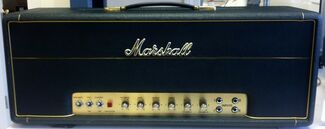
- "Just scored a '69 SLP 100." [371]
- "There's a 0.68uF cap on the second triode." [372]
- "The power supply sags more in a 100W. On our reference 100W Plexi the supply sag is almost double that of our 50W." [373]
- "All the pots are log pots in our reference amp" and "I was puzzled by the pot tapers but they all look original. I then thought about it a bit and wondered if that's why Bogner uses log pots for his amps. His stuff is definitely Plexi-inspired. Or maybe all Marshall could find at the surplus electronics store that week was log pots. Who knows." [374]
- "Our reference 100W is a late 60s." [375]
- "It's a '69." [376]
- "1959 circuit." [377]
- "Marshall amps in those days were wildly inconsistent. There are conflicting reports of the tone stacks. Our reference amp has log pots. George Metropolous says most of the amps he's seen had log pots. Some people claim linear pots were more prevalent." [378]
- "Our reference 100W Plexi is sort of in between 1968 and 1969. It has an 820 ohm cathode resistor on V1B. Coupling cap is 2.2n. Feedback is 47K off the speaker jack (!!!). The model assumes a full stack w/ (2) 16-ohm cabs so that would equivalent to 8-ohm tap." [379]
- "Our reference Plexi 100 has log taper tone pots. If you want a more conventional 100W Plexi sound use the 1959SLP models." [380]
- "Our reference amp has a 560p treble cap and a 10A treble pot taper. Both components appear to be original. The tech who checked it out after I bought it said it was one of the best sounding 100W Plexis he'd ever heard. That tech just happens to be Alan Phillips of Carol-Ann Amps. So I modeled it to agree with the reference amp." [381]
- "The default tone stack for the Plexi 100W is Plexi 100W. The equivalent tone stack w/ linear mid and treble pots is Plexi. The Dumble tone stack is the same as Plexi except it is plate driven instead of cathode follower driven." [382]
PLEXI 100W JUMPED
PLEXI 100W NORMAL
PLEXI 2204 (1981 50W Marshall JMP 2204)
- "Based on a 1981 JMP 50W Master Volume head."
- "Everything on 10."
- "There were several versions of the "2204" Plexi. Our model is based on a 1981 2204 Master Volume JMP. It has a different circuit than a JCM800." [383]
- "The model is based on the Hi input of a 1981 50W Master Volume "2204" Plexi. There were two versions of the 2204. One was essentially a Plexi with a Master Volume. Similar to a 1987x but with some different values and voltages in addition to the MV. The other was virtually identical to a JCM800. The model is the Plexi version. Mine is an '81 and doesn't have cascaded gain stages." [384]
- "It's a 1981 "CSA" 2204." [385]
- "It's a Master Volume Plexi. Turn the MV up to get more distortion. Or put a pedal in front like people did in those days." [386]
- "There were two versions of the 2204. One was a "Plexi" with a master volume. The other was essentially a JCM800 in a smaller chassis. The JCM800 version is more common." [387]
PLEXI 50W 6550 (1972 50W Marshall Plexi)
High Treble Channel
PLEXI 50W 6CA7 (50W Marshall Plexi)
Models:
- Single channel
- Jumpered channels
- "That's based on my favorite Plexi. I have several but this particular one has 6CA7s and 82K grid resistors(!). Usually the grid resistors are 220K. (...) Cuts the bias excursion nearly in half." [388]
PLEXI 50W 6CA7 JUMPED
PLEXI 50W HIGH 1 (1967 50W Marshall Plexi)
PLEXI 50W HIGH 2
- "Similar to Plexi 50W High 1 except the second triode stage has a 0.68uF cathode bypass capacitor. The second bypass capacitor was added in the early 70’s and gives a slightly brighter tone."
- "There's a 0.68uF cap on the second triode." [389]
- "Our reference 50W Plexi has a 68nF presence cap and the presence network is JCM800-style." [390]
- "Plexi High 2 has a 0.68uF cap on V2A and the mixing resistor for the normal channel removed." [391]
- "I removed the virtual resistor because it sounds better to me that way. This was a common mod for people who only used the High input." [392]
PLEXI 50W JUMPED
PLEXI 50W NORMAL
- "There's a 0.68uF cap on the second triode." [393]
- "The topology of that model does not support a bright cap and the actual amp has no bright cap." [394]
PLEXI STUDIO 20 (Marshall SV20H)

Jumpered channels of Marshall Studio Vintage 20 (20W version of 1959 Super Lead Plexi)
Cab:
- original: Celestion V-Type
- DynaCab match: 4x12 1960TV
See 1959SLP
Power tubes: EL34
- "The schematic doesn't show it but there's a cathode bypass cap on one of the triode stages." [395]
- "It's a cool little amp. It's very loud though. It's not really a "bedroom amp" IMO. Good for smaller gigs, rehearsals, etc." [396]
PORTA-BASS (Ampeg Portaflex bass amp)
Single channel model
Cab:
- original: SVT cab with one or more 10”, 12” or 15” Eminence speakers
- DynaCab match: 1x15 Portabass
Gain, Volume, Bass, Mid, Treble, Mid Frequency (not modeled), input pad (not modeled), compression (not modeled), limiter (not modeled), Ultra Hi switch, Ultra Lo switch (not modeled)
Power tubes: 6L6
See SV Bass
PRINCETONE 5F2 (Fender Tweed Princeton, 5F2-A)

Single channel model
Cab:
- original: Fender 1x10 (C10n)
- DynaCab match: 1x8 Princetone
Volume, Tone
Power tubes: 6V6
PRINCETONE AA964 (silverface Fender Princeton without reverb, AA964)
Single channel model
Cab:
- original: Fender 1x10
- DynaCab match: 1x10 BF Princetone
Volume, Bass, Treble
Power tubes: 6V6
- "Based on a Fender AA964 Princeton. This particular amp is an early CBS “Silverface” but still using pre-CBS design and components."
PRINCETONE REVERB (1966 blackface Fender Princeton with reverb, AA964)

Single channel model
Cab:
- original: Fender 1x10
- DynaCab match: 1x10 SF Princetone
Volume, Bass, Treble, Reverb (not modeled)
Power tubes: 6V6
- "A Princeton Reverb has an extra gain stage due to the reverb recovery. Hence it has more gain." [397]
PVH 6160 BLOCK (Peavey "Block Letter" EVH 5150)

Models:
- Rhythm channel, Crunch switch engaged
- Lead channel
Cab:
- original: Peavey 4x12 (Sheffield 1200)
- DynaCab match: 4x12 5153
Pre Gain, Post Gain (Master), Low, Mid, High, Resonance, Presence, Bright switch (Rhythm channel only), Crunch switch (Rhythm channel only)
Power tubes: 6L6
- "I have a "holy grail" Block Letter 5150 (supposedly). It sounds way better than most 5150s for some reason which is a good thing for you guys. I think it's partly due to the fact that it has a bias mod so it's biased a bit warmer than a stock version." [398]
- "Another technique is to use negative feedback to the grid. This is done in 5150-based designs which makes the stage clip even harder. The last stage of a 5150 basically looks like a diode clipper. The harder the clipping the more overtones that are created and the better the tone cuts. Without those overtones your sound is lost in the mix." [399]
- (Peavey 5150 vs 6505) "There are differences. The input gain network is different and the coupling cap after the second triode stage is a different value." [400]
PVH 6160 BLOCK CRUNCH
PVH 6160+ CLEAN (Peavey 6505+ / EVH 5150-II)

Models:
- Clean channel, Bright switch off
- Clean channel, Bright switch on
- Crunch channel, Bright switch off
- Crunch channel, Bright switch on
- Lead channel
Cab:
- original: Peavey 4x12 (V30)
- DynaCab match: 4x12 5153
Rhythm channel: Pre (gain), Bright switch (6dB at 2kHz), Crunch switch, Low, Mid, High, Post (Master), Resonance, Presence
Lead channel: Pre (gain), Low, Mid, High, Post (Master), Resonance, Presence
Power tubes: 6L6
- "Chris Quigley's 6505 was the reference amp. It's my amp now. It's a very good sounding one." [401]
- (channel 1) "Someone was looking for that amp model recently so I dug our 6505+ out and was surprised at how nice that channel sounds." [402]
- "A 6505+ is identical to a 5150 except it has no bright cap. Use the 5150 model and turn off the bright switch." [403]
- "The Bright switch on clean and crunch channels does not engage a capacitor on the drive potentiometer as is typical but instead disengages a treble cut circuit."
PVH 6160+ CLEAN BRIGHT
PVH 6160+ CRUNCH
PVH 6160+ CRUNCH BRIGHT
PVH 6160+ LEAD
RECTO1 ORANGE MODERN (MESA Dual Rectifier, 2 channels)

Models:
- Recto1: original 2-channel Rectifier, Orange channel, Modern mode
- Recto1: original 2-channel Rectifier, Orange channel, Vintage mode
- Recto1: original 2-channel Rectifier, Red channel, Modern mode
- Recto2: later 3-channel Rectifier, Orange channel, Modern mode
- Recto2: later 3-channel Rectifier, Orange channel, Vintage mode
- Recto2: later 3-channel Rectifier, Red channel, Modern mode
- Recto2: later 3-channel Rectifier, Red channel, Vintage mode
Cab:
- original: Mesa 4x12 (V30)
- DynaCab match: 4x12 Recto Straight
Gain, Master, Bass, Middle, Treble, Presence
Power tubes: 6L6
- "The reason you're hearing the highs rolled off is because the Master is too high. As you increase the Master the highs get muffled. 7.02 for the Recto Master is ridiculous and will sound like crap." [404]
- "Note that the Orange Modern and Red Modern models have no negative feedback and therefore the Presence control is a Hi Cut control." [405]
- "A typical Recto cabinet has a resonant frequency a little over 100 Hz." [406]
- "The unique thing about a Dual Recto tone stack is that the Presence control is part of the tone stack. So the Recto tone controls also interact with the presence control." [407]
- "Rectos don't have a Depth control and even if they did it wouldn't do anything in Modern Red mode since that mode has no negative feedback. When you put a Recto into Modern Red mode it opens a relay which removes the NFB." [408]
- "Real Rectos are bassy/fizzy beasts but that tone works great for certain genres." [409]
- "If you are using the Modern modes be very careful with the MV. If you turn it up too high it will flub out really quick. If in doubt reduce the MV. Compensate with the Level control." [410]
- "The Modern mode in Rectos has no negative feedback so there's a huge bass boost from the speaker impedance. Fortunately you can reduce this by reducing the LF Resonance on the Spkr tab which is something you can't do with the real amp without trying different speakers or cabinet." [411]
- "Depth works by varying the negative feedback at low frequencies. There is no NFB in the Modern Red mode so the Depth knob won't do anything." [412]
- "All passive tone controls interact and all the Axe-Fx tone stacks replicate this behavior. The unique thing about a Dual Recto tone stack is that the Presence control is part of the tone stack. So the Recto tone controls also interact with the presence control." [413]
- "If you are using the Modern mode then it's all about the Spkr page. Since that mode has no negative feedback the speaker resonance has a tremendous effect on the sound. Adjust LF Res, Freq and Q to get desired response." [414]
- "Another thing with the Modern modes is that the power amp distorts early (again since there is no negative feedback and, therefore, the power amp has a lot more gain). At 9:00 on the Master the power amp is distorting (it's probably a linear taper pot for the ol' "Wow, this amp is loud bro!"). (...) Another thing is that if you put ANYTHING in the loop of a Recto it changes the tone significantly. Even just a short cable. All the models were made with the loop off. And another thing is that Rectos changed a lot. I have three of them and they all sound completely different. One of them has a different value Gain pot than the others. One of them has a different value bright cap than the one with the same Gain pot. Since the gain pot and bright cap interact this makes a HUGE difference. Experiment with the Bright Cap value. The Recto1 models are based on our Rev. F (IIRC, whatever the desirable ones are). The Recto2 models are based on the latest version." [415]
- "We have three of them, a single and two duals." [416]
- "If you want that Recto crunch but not so flubby and fizzy try the SOLO models." [417]
- "A Recto is not a Mark series amp. Totally different preamp topology. A Recto preamp is very similar to a SLO100." [418]
- (amp model closest to the MESA Roadster) "Recto 2." [419]
- "The Rectifier preamp is almost identical to an SLO100." ... "There's a treble cut on the tone stack and a some minor changes to the power amp and power supply but it's basically a ripoff. The schematics are readily available for both so anyone interested can see for themselves. Personally I hate the 39K resistor. It biases the stage much too cold for my tastes. It prevents blocking distortion but there are better ways to do it IMO. The FAS Modern model is similar but biases the stage more towards the center." [420]
- "Using the loop on a modern 3-channel rectifier changes the tone pretty dramatically (we model the amp with the loop bypassed). There are several reasons for this:
- The source impedance to the power amp is changed.
- There is a treble peaker on the Output pot. Presumably this was done to counteract treble loss in the loop.
- An extra highpass filter is present due to the loop send stage. The corner frequency is around 30 Hz. That's low but it does affect subharmonics due to intermodulation. I would've made the capacitor around 1uF." [421]
- "Recto2 is based on a new 3-channel Dual Rectifier. Recto1 is based on the original 2-channel." [422]
- "I have three Rectos: an old Single Rectifier, an old (Rev. G maybe) Dual Rectifier and a new Dual Rectifier. They all sound completely different. The old Dual is the best sounding of the bunch." [423]
- "The MV taper of the model is authentic so just like the real amp the power amp starts to clip very early. With the real amp there's audible feedback (as in it gets insanely loud) but with the model you don't get that and humans have this weird thing where they don't like knobs to deviate from noon. I've debated changing the taper or adding a pad between the preamp and power amp but, in the end, I decided to keep things authentic." [424]
- "You have to be very careful with the Master Volume. A Recto will start saturating the power amp in Modern mode at VERY low MV settings. Once the power amp starts clipping the tone will change. With digital products I often see people set the MV higher than they would on the real amp because there are no sonic repercussions (i.e., pissing off the wife/neighbors, knocking Grandma's urn off the mantel, etc.). If an emulation sounds darker or more midrangey than the real amp try turning down the MV. If it's a good emulation you should find a point (around 1-2) where you can hear the power amp start to saturate. Go up/down from there to get the desired power amp overdrive." [425]
- (Recto1) "Our OG Dual Rectifier has a 10A MV taper. The model uses 20A which is the same taper as the Recto2. (...) Other than that the model is in very good agreement with the amp." [426]
- "The Red channel has no negative feedback so the response is highly dependent upon the impedance curve. Vintage has quite a bit." [427]
- "On the amp the MV is around 9 o'clock (as loud as I dared to go and not get divorced). I had to set the model to 1.2 to get the same response. Above that and the power amp starts clipping and the highs get reduced. This is to be expected given the different taper between the amp and the model." [428]
- (about the non-working Presence control on the two-channel Dual Rectifier's Orange channel) "These situations always present a dilemma:
- Option 1: Remove the presence control and deal with "Why u no hav presence control on the Recto1 Orange Modern model. The real map has one."
- Option 2: Put a presence control on there that doesn't do anything and deal with "Hey idiots, the presence control on the Recto1 Orange Model is broken."
- Option 3: Put a presence control on the model that actually does something but defaults to a value (in this case 5.0) that matches the amp's native behavior. We chose Option 3." [429]
- A Dual Rectifier's preamp is a similar to an SLO100 except for a few differences. Otherwise they are very similar down to the topology and component values. The power amps are very similar EXCEPT in Modern mode. In Modern mode there is no negative feedback. The polite thing to say is that a Dual Rectifier was inspired by an SLO100. [430]
- The gain pot is 250K vs. 1M
- There's a treble roll-off network on the output of the tone stack (this is a big one)
- There are two cathode followers in series on an SLO100 (fx loop send and fx loop return)
RECTO1 ORANGE NORMAL
RECTO1 RED
RECTO2 ORANGE MODERN (MESA Dual Rectifier, 3 channels)
RECTO2 ORANGE VINTAGE
RECTO2 RED MODERN
RECTO2 RED VINTAGE
REVV GEN GREEN 1 (REVV GENERATOR 120 MKIII)

Models (MKIII revision A): [431]
- Green channel, Drive switch: off
- Green channel, Drive switch: blue
- Green channel, Drive switch: red
- Purple Gain channel, Aggression: least (green)
- Purple Gain channel, Aggression: tight (blue)
- Purple Gain channel, Aggression: fat (red)
- Red Gain channel, Aggression: least (green)
- Red Gain channel, Aggression: tight (blue)
- Red Gain channel, Aggression: fat (red)
Cab:
- original: Revv 4x12 (V30)
- DynaCab match: 4x12 Friedman V30
Gain, Bass, Mid, Treble, Level, Master, Presence, Depth. Options on Green and Purple channels: Wide / Drive / Bright. Options on Purple and Red channels: Aggression / Bright / Cut / Fat
Power tubes: 6L6
- "Revv is a great amp. Sort of a Marshall/SLO vibe but more open. Really well designed and built." [432]
- "The Revv actually has an MV that makes sense. Instead of driving the power amp into oblivion at around 3, power amp overdrive doesn't start happening until you turn the knob up quite a bit." [433]
REVV GEN GREEN 2
REVV GEN GREEN 3
REVV GEN PURPLE 1
REVV GEN PURPLE 2
REVV GEN PURPLE 3
REVV GEN RED 1
REVV GEN RED 2
REVV GEN RED 3
RUBY ROCKET (Paul Ruby Rocket)

Models:
- Bright switch: on
- Bright switch: off
Cab:
- original: 1x12 (Alnico, G12M)
- DynaCab match: 1x12 Div13 CJ
Volume, Bass, Treble, Cut, Bright switch
Power tubes: EL84
- "The Ruby Rocket is not the same as an actual Trainwreck Rocket. There are topology differences and the amps don't sound the same." [434]
- "Ruby Rocket is based on a Paul Ruby Rocket which is based on a TW Rocket but with some notable differences." [435]
- "The Bright switch changes a coupling cap and the treble cap in the tone stack. This cuts the bass, shifts the midrange and lowers the gain slightly. That's why there are two separate models. Otherwise you would just engage the Bright switch under the Treble knob."
- "The Ruby Rocket has a bright switch but it's actually a channel select (selects the bright channel)."
RUBY ROCKET BRIGHT
SHIVER CLEAN (Bogner Shiva 20th Anniversary)

Models:
- Clean channel
- Lead channel
Cab:
- original: Bogner 1x12 or 2x12 (Classic 80, V30)
- DynaCab match: 2x12 Lead 80
Clean channel: Volume, Bass, Treble, Bright switch. Shared: Master, Presence, Excursion, Boost switch (not modeled)
Lead channel: Gain, Volume, Bass, Middle, Treble, Shift EQ (not modeled), Bright switch, Mode switch (not modeled). Shared: Master, Presence, Excursion, Boost switch (not modeled)
Power tubes: KT88
- "People think Bogners are dark but they really aren't. The reason they seem that way is the pot tapers. Most people assume knobs should be set somewhere around noon. If you do this on a Bogner it's like turning the treble way down on a Marshall. Close your eyes and adjust the tone controls with your ears. Don't be afraid to turn them way up or way down." [436]
- "Human nature is to put the knobs near noon. We are reticent to deviate much from noon. Amp designers exploit this and use different tapers to change the sound of their amps WITH THE KNOBS AT NOON. A prime example are Bogner amps. Everyone says "Bogner amps are dark". No they aren't. But he uses a Log10A taper for the treble pot. It's a standard Marshall tone stack. Usually a linear taper pot is used for the treble. The treble knob at 5.0 (noon) on a Bogner is equivalent to the treble knob at 1.0 on a Marshall. People put the knob at 5.0 and go "wow, this amp is dark". No it isn't. If you turned the treble up to 8 or 9 it would sound a lot like a Plexi but humans are reticent to turn the knobs to extremes. Amp designers know this and exploit it to give their amps a "signature sound"." [437]
- "The original Shiva models were based on a borrowed amp. We now have a 20th Anniversary Shiva (with KT88s) and the new models are based on that amp. We did notice that this amp has less gain than the one used originally but the model is faithful to the amp." [438]
- "Bogner's are notoriously "slow" due to the low B+ voltage. Main reason I can't get along with them. You can try increasing the Variac." [439]
- "Most amps use a linear taper for the treble pot. Bogners use a log taper. So when the knob is at noon on a Bogner it's similar to 8 o'clock on most amps." [440]
SHIVER LEAD
SOLO 88 CLEAN (Soldano X88R preamp)

Models:
- Clean channel
- Rhythm channel
- Lead channel
DynaCab match: 4x12 Solo 100
Gain, Bass, Middle, Treble, Volume, Bright switch (Clean and Rhythm channels only)
Power tubes: same as SLO-100 model (6L6)
- "Solo 88 RHY is based on an X88R since the rhythm channel of an X99 is identical to an SLO-100."
- “We have two X88s and they sound and measure quite different. They're both OG versions. Ultimately I found one had a quality in the low end that I liked better so I went with that.”
SOLO 88 LEAD
SOLO 88 RHYTHM
SOLO 99 CLEAN (Soldano/Caswell X99 preamp)

Models:
- Clean channel
- Lead channel, Bright off
- Lead channel, Bright on
DynaCab match: 4x12 Solo 100
Gain, Bass, Middle, Treble, Volume, Bright switch
Power tubes: same as SLO-100 model (6L6)
- "The rhythm channel of an X99 is identical to a SLO 100." [441]
- "Power amp: same as SLO100." [442]
- "The bright cap on the X99 Clean is not across the Drive pot. The exposed "Bright Cap" is across the Drive pot, the X99 clean channel does not have one." [443]
SOLO 99 LEAD
SOLO 99 LEAD BRIGHT
SOLO 100 CLEAN (Soldano SLO-100)

Models:
- Normal channel, Clean mode
- Normal channel, Rhythm mode
- Overdrive channel
Cab:
- original: Soldano 4x12 (Eminence)
- DynaCab match: 4x12 Solo 100
Gain, Bass, Middle, Treble, Master, Presence, Bright switch (Normal channel only), Depth (with Depth mod)
Power tubes: 6L6
- "Cold-biased stages are where there's a very large cathode resistor so the operating point is close to the supply rail. For example, the SLO 100 has a 39K cathode resistor on the cold-biased stage." [444]
- "The SLO-100 is the loudest amp I've ever used. It feels like there's a small nuclear explosion going off inside when ever you hit a power chord. It's a wicked amp but not something I would recommend for anything but large gigs. If you like the SLO-100 model you might want to try the Recto models too. It's not widely known but the Rectifier preamp is a derivative of the SLO-100. Some minor changes but the basic topology is identical."
- "I have a really good SLO-100. An original black faceplate version. Pristine condition. That amp was one of the primary amps used in the G2 modeling development. It was by studying that and a really nice JCM-800 that I finally figured out the secret to cathode follower." [445]
- "Mine doesn't have the depth mod but I used the values from the schematic I have and I believe the schematic is correct." [446]
- "SLOs are brittle at low volumes. When you crank them up it smooths out. The problems is at cranked volumes they can kill small animals."
- "The key to an SLO100 is to run the MV high so that the mids thicken up. Otherwise it's a shrill mess. In certain contexts with the right IR it can be a cool sound." [447]
- "Note that the knobs on '5' on the Axe-Fx correspond to '6' on an SLO because they go to 11. 'Noon' on an SLO isn't actually the knobs at half-way. The range of the knobs is like 8:00 to 6:00 as opposed to 7:00 to 5:00. They're biased clockwise." [448]
- "Another caveat when comparing amps: many times the knobs aren't "centered". IOW if you put the Treble knob at noon it isn't actually at 50%. You can see this by turning the knob all the way down and all the way up. It may not be symmetrical. This happens when the pots don't have a flat spot and/or the pot is rotated within the mounting hole. Or in the case of an SLO100 it is intentional. On an SLO100 all the way down is around 8:00 and all the way up is 6:00 so 50% is around 1:00 not noon." [449]
- "Many people find SLOs too bright. The "Warren Haynes" mod is a popular mod to reduce the brightness."
- "Those amps are all designed to get their character from power amp distortion. If you don't push the power amp all you are hearing is the preamp which is voiced to be trebly. The power amp then compresses the highs and the sound gets fatter."
- "If you want that Recto crunch but not so flubby and fizzy try the SOLO models. They're much brighter so I turn the treble down quite a bit." [450]
- "SLO 100s are NOT smooth amps. They are nasty, aggressive things that you have to crank the MV." [451]
- "A Recto is not a Mark series amp. Totally different preamp topology. A Recto preamp is very similar to a SLO100." [452]
- "The Rectifier preamp is almost identical to an SLO100." [453]
- "They're pretty awesome amps but to sound great you have to crank 'em and they're ear-splitting loud." [454]
SOLO 100 LEAD
SOLO 100 RHYTHM
SPAWN NITROUS 1 (Splawn Nitro)

Models:
- Overdrive channel, OD-1 (Rhythm) mode
- Overdrive channel, OD-2 (Lead) mode
Cab:
- original: Splawn 4x12 (G12M, G12-65, V30)
- DynaCab match: 4x12 Lerxst
Resonance, Presence, Bass, Middle, Treble, Master, Gain
Power tubes: KT88
- "Based on a Splawn Nitro with KT-88 power tubes."
SPAWN NITROUS 2
SPAWN Q-ROD OD1-1 (Splawn Quickrod)

Models:
- Overdrive channel, Rhythm mode, 1st gear ("Plexi")
- Overdrive channel, Rhythm mode, 2nd gear ("hot-rodded JCM 800")
- Overdrive channel, Rhythm mode, 3rd gear ("super hot-rodded 800")
- Overdrive channel, Lead mode, 1st gear
- Overdrive channel, Lead mode, 2nd gear
- Overdrive channel, Lead mode, 3rd gear
Cab:
- original: Splawn (G12M, G12-65, V30)
- DynaCab match: 4x12 Friedman GB
Presence, Bass, Middle, Treble, Volume, Gain, Mode
Power tubes: EL34
- "The reason Splawns sound weird is because the tone stack is plate driven. You lose the cathode follower compression and the high source resistance of the plate alters the tone stack frequency response. The plate driven tone stack in the Splawn reduces the highs considerably. You can see this is you run Tone Stack Calculator for the Marshall tone stack and increase the source resistance." [455]
- "OD2 switches in a cathode bypass cap which increases the gain of that stage." [456]
- "The Quick Rod is a bit odd in that the Drive pot is linear taper. Most amps use an audio taper pot. This means that at noon the amp is nearly at full gain. Not sure why they did it that way but it is what it is." [457]
SPAWN Q-ROD OD1-2
SPAWN Q-ROD OD1-3
SPAWN Q-ROD OD2-1
SPAWN Q-ROD OD2-2
SPAWN Q-ROD OD2-3
SUHR BADGER 18 (Suhr Badger 18)


Badger models:
- Badger 18
- Badger 30
Cab:
- original: Suhr 1x12 or 2x12 (V30)
- DynaCab match: 1x12 Hot Kitty
Bass, Middle, Treble, Gain, Power (controls Power Scaling, not modeled), Drive (acts as Master with Power at 10)
Power tubes: EL84 (Badger 18), EL34 (Badger 30)
- "The Badgers are very different amps. If you are used to hot-rod Marshall tones the Badgers won't be your "thing". These are edge-of-breakup amps. No negative feedback so they are loose and can be farty with certain pickups. They are "players" amps for guys who rely on technique and riding the volume knob." [458]
- "The Badgers were MIMIC'd with power scaling at full. The knobs are a bit confusing on a Badger. The knob closest to the input jack is labeled "Gain". It is equivalent to the Drive knob in the Axe. The knob labeled Drive is the Master Volume." [459]
- "The controls on the Badger are a bit confusing. Master Volume is labeled Drive. You have the Drive at 10 which means your power amp is at full blast. This can make the bass muddy. Turn the Drive down." [460]
- "The worst amp in this regard is the Badger 18. The cathode resistors are very large and the amp shifts into Class B operation early causing a spitty, buzzy distortion quality. This amp, however, is liked by many so that just goes to show that some people like that. It's like fuzz pedals. Some people like that spitty sound." [461]
- "The Badger doesn't have a Bright switch." [462]
SUHR BADGER 30 (Suhr Badger 30)
SUPER VERB NORMAL (1964 Fender Super Reverb, AB763)

Models:
- Normal channel
- Vibrato channel
Cab:
- original: Fender 4x10 (C10R, C10Q, P10R)
- DynaCab match: 4x10 Bassguy RI
Volume, Bass, Middle (Vibrato channel only), Treble, Bright switch, Reverb (not modeled), Vibrato (not modeled)
Power tubes: 6L6
- "I modeled the Super with V1 pulled as most people pull V1 so the amp has more grunt. Turn down the MV to make it cleaner."
- "The Super Reverb model is based on the amp with V1 removed (which is a common mod). This increases the level into the power amp by about a factor of two." [463]
- "The Super Reverb model is "Diaz Modded". IOW, I pulled V1. This gives the amp a lot more gain so it's not surprising you're getting breakup at around 1.5. You can un-mod the model by turning down the MV Trim to around 0.5." [464]
- "A Pro Reverb is basically identical to a Super Reverb except for the speakers (and faceplate)." [465] And: "The Blackface Pro Reverb, model AA165, was virtually identical to the AB763 Super Reverb except for the speakers and tone stacks. If you use the Super Verb model and set the Tone Stack type to Blackface you'll basically have a Pro Reverb. Set the Mid control fairly high to emulate the fixed 6.8K mid resistor. I'd say around 7 or 8." [466]
- (blackface) "Not a huge change with the Silverfaced versions. They're a little cleaner and brighter but the topology is the same. Some minor circuit changes here and there. Same transformers. The biggest change, IMO, was changing the PI resistors to 47K which gives you a little less gain in the PI." [467]
- "The Super Reverb is really just a 50W version of a Twin Reverb with different speakers." [468]
- (Bright cap) "It's only 120pF so it's subtle." [469]
SUPER VERB VIBRATO
SUPERTWEED (custom model)
Named "FAS Supertweed" in ICONS: Fullerton.
Custom Fractal Audio model
DynaCab match: 1x12 Deluxe Tweed
Power tubes: 6L6
- (design) "Original." [470]
SUPREMO TREM (Supro 1964T)

Cab:
- original: Supro 2x12
- DynaCab match: 1x12 AC20
Volume, Tone
Power tubes: 6973
- "They're simple amps with minimal tone shaping." [471]
SUPRO BLACK MAGICK (Supro 1695T Black Magick)

Cab:
- Supro 1x12
- DynaCab match: 1x12 Black Magick
Volume, Tone, Tremolo
Power tubes: 6973
- "They're simple amps with minimal tone shaping." [472]
- "The combo version has a Jensen P12Q so the 1x12 Deluxe Tweed Dyna-Cab would be a good match." [473]
SV BASS 1 (Ampeg SVT bass amp)

SVT models:
- SV Bass 1: model prior to the change in firmware Ares 2.05 and later
- SV Bass 2: channel one of a 1970 Ampeg SVT with 6550 power tubes and the midrange switch in position 3
On the Axe-Fx II (firmware Ares) these models are reversed [474]
Cab:
- original: SVT 8x10
- DynaCab match: 8x10 SV Bass
Volume, Treble, Midrange, Bass, Master, Midrange switch, Ultra-Hi switch (= Bright), Ultra-Lo switch (not modeled)
Power tubes: 6550
James tonestack [475]
SV BASS 2
TEXAS STAR CLEAN (MESA Lone Star Classic)

Models:
- Clean channel
- Lead channel
Cab:
- original: Mesa 2x12 (C90)
- DynaCab match: 2x12 Texas Star
Gain, Drive (Lead channel), Treble, Mid, Bass, Presence, Master, Voicing (not modeled)
Power tubes: 6L6
- (firmware 24.00) "Global MV controls have been added as the Channel MV in these amps affect the tone (and interacts with the Presence control)."
TEXAS STAR LEAD
THORDENDAL MODERN (custom model of MESA Dual Rectifier)

Models:
- Modern mode
- Vintage mode
The AM4 does not have these models.
Power tubes: 6L6
See Recto
- "The old Recto models weren't terribly accurate. When G3 came out the models were accurate but Fredrik contacted me and said something like "ahhhhh, I loved the old Recto model". So I took the old Recto models and made them "Thordendal" models." [476]
THORDENDAL VINTAGE
TREMOLO LUX (blackface Fender Tremolux, AA763)

Models:
- Normal channel
- Vibrato channel
Cab:
- original: Fender 2x10
- DynaCab match: 2x12 Super 6G4
Vibrato channel: Volume, Bright switch, Treble, Bass, Tremolo effect (not modeled)
Power tubes: 6L6
TRIPLE CREST 2 (MESA Triple Crown TC-100)

Models:
- Low gain channel
- High gain channel
Cab:
- original: MESA cab with V30 speakers
- DynaCab match: 4x12 USA Mc90
Gain, Treble, Mid, Bass, Normal / Tight switch (not modeled), Presence, Reverb effect (not modeled), Master, attenuator (not modeled)
Power tubes: EL34
- “The actual amp’s “Tight” switch engages a built-in Tube Screamer circuit which can be replicated using a Drive block or the Amp block’s internal Boost feature.” [477]
- "The clean channel is like every other Mesa clean channel: a Blackface Fender copy." [478]
- "The clean channel uses the same built-in tube screamer as the other channels. There's a single fixed tube screamer circuit at the input of the amp. It can be switched in via relays which are controlled by the channel switches." [479]
- "A Mesa Triple Crown has a built-in Tube Screamer set clean on the input." [480]
- "The Triple Crest models are based off a Mesa Triple Crown which is "derived from" a Fender Tonemaster." [481] (this refers to a 90's analog Fender Custom Shop Tone Master, not the modern digital modeler)
TRIPLE CREST 3
TUBE PRE (generic tube preamp model)
Custom Fractal Audio model of a generic tube preamp
DynaCab match: 1x12 G12T-100
Power tubes: 5881 (power amp disabled)
- "The Vintage tone stack is a passive EQ model but it has a flat response when the controls are at noon. If you want "active" EQ you need to set the type to Active." [482]
- "If you only need power amp modeling, for example when using an external pre-amp through the Axe-Fx, use the Tube Pre model. It uses the Vintage tonestack which is flat when the tone controls are at noon."
- "The "Vintage" tone stack is flat. The Tube Pre model uses the Vintage tone stack." [483]
TWO STONE J35 (Two-Rock Jet 35)

Models:
- Lead mode, Preamp Bypass (PAB): off
- Lead mode, Preamp Bypass (PAB): on (bypassed tonestack)
Cab:
- Two Stone 2x12 (G12-65)
- DynaCab match: 4x12 Rumble EV12L
Treble, Mid, Bass, Gain, Master, Lead Gain, Pull Bright, preamp bypass switch
Power tubes: 6L6
- "It's very smooth but there's this unique chirp or something that I've never heard in an amp before. When you hit the note there's this blast of high end that rapidly decays so it has an almost vocal quality. The frequency shaping is very different than most other amps." [484]
- "The Two Rock is the most unique amp I've ever modeled. Almost like a violin but with this really cool chirp on the pick attack." [485]
TWO STONE J35 PAB
USA BASS 400 1 (MESA Bass 400 bass amp)

Models:
- Bass Shift: off
- Bass Shift: on
Cab:
- original: Mesa bass speaker cabinet
- DynaCab match: 1x15 Heart Key
Bass, Middle, Treble, Pull Bright, Bass Shift, Treble Shift (not modeled), 7-band GEQ, Master, Volume
Power tubes: 6550
The Fat switch in the model performs the same function as the Treble Shift function on the original amp.
USA BASS 400 2
USA JP IIC+ GREEN (MESA/Boogie JP-2C)

Models:
- Green: channel 1
- Red: channel 3
- Red: channel 3, Shred mode
- Yellow: channel 2
- Yellow: channel 2, Shred mode
Cab:
- original: Mesa 1x12 (C90, V30)
- DynaCab match: 4x12 Recto Straight
Channel 1 (Mark IIC+ Clean): Gain, Master, Presence, Treble, Mid, Bass, Mid/Boost switch (not modeled)), graphic EQ, Reverb effect (not modeled)
Channel 2 (Mark IIC+ Gain/Shred) and Channel 3 (Mark IIC+ Gain/Shred): (Pull) Gain, Master, (Pull) Presence, Presence Shift, Treble, Mid, Bass, graphic EQ, Shred mode switch
Power tubes: 6L6
- "The JP amp has a fixed input gain control. The "Gain" control on the amp is actually an Overdrive control. If you use Authentic controls there is no Input Gain on "Gain"." [486]
- "Presence Shift is Presence pull. Tone stack effectively has fat switch on." [487]
- (difference between the "JP Green" and "USA Clean") "JP has less gain and a much larger midrange potentiometer." [488]
- "JP himself gave the models his stamp of approval." [489]
- "JP (Green) has less gain (than USA Clean) and a much larger midrange potentiometer." [490]
- "Those are great amps. The particular amp used for the models was John Petrucci's personal recording amp. I didn't want to give it back and offered to buy it from him but he wouldn't sell it." [491]
- "It's not that the Graphic EQ isn't the same, the TAPERS are not the same. On the real amp the controls do virtually nothing until you get near the ends of the range. If you move a slider to, say, 3/4 of its range it does almost nothing. If you were to set the model's slider to the same position you would get significantly more boost. I didn't model the nonlinear slider behavior because IMO it's a design flaw. Graphic EQs should have a nice, linear-in-dB response. Otherwise the graphic EQ is very accurate. The frequency and Q behavior is spot-on. If you have pulled the presence knob on the amp you have to activate the Presence Shift on the model. Otherwise they will sound VERY different. Presence shift gives a much more focused sound. I always use the Presence Shift. You can't compare the amp with a switch engaged to the model without the equivalent switch engaged. Of course it will sound different. The tapers of the other controls should be very close including the Presence and Master Volume. (...) JP himself was very impressed with the model and the model was matched to his PERSONAL head that he sent me." [492]
- "I thought that Shred mode is the same as the Red mode on the Triaxis which is just a treble boost on the output when, in fact, it's a clean boost on the input similar to a Tube Screamer but without the treble rolloff." [493]
- (fixed internal gain) "Yellow is 2.9. Red is 5.7." [494]
- "JP2C doesn't have a depth knob. If a knob isn't present in the Authentic menu then it may not do anything in the Ideal menu." [495]
- "USA JP models have a fixed Input Drive so when switching to the models the Input Drive is reset to the default value. The Input Drive knob is not visible in the Authentic menu." [496]
- "A JP IIC+ is not a Mark IV. They sound different. The biggest difference is in the behavior of the Presence Shift. With the Presence Shift on the JP IIC+ will be very similar to the Mark IV with its Presence Shift on. With the Presence Shifts off they are very different sounding." [497]
- "All these amps have the same basic circuit with minor differences. The only unique thing I've encountered in all my tests is the function of the Presence Shift pull on the JP2C. It's different than the pull shift on the other Mark amps." [498]
- "The Mark series graphic EQ sucks. I know some people want authenticity but it's simply a bad design." [499]
- "The "Gain" control on a Mark V is equivalent to the Overdrive control on a Mark II/IV. The actual gain control on a Mark V is fixed (same as the JPIIC+). In the Axe-Fx you can actually change the Gain control using the Ideal tone controls. You'll see that when choosing the model it will be initialized to a value (4.4 for the Mark V)." [500]
USA JP IIC+ RED
USA JP IIC+ RED SHRED
USA JP IIC+ YELLOW
USA JP IIC+ YELLOW SHRED
USA METRO BLUES (MESA Subway Blues)

Single channel model
Cab:
- Mesa 1x10 (Eminence Black Shadow)
- DynaCab match: 1x10 Metro Blues
Volume, Bass, Mid, Treble, FAT switch, Reverb effect (not modeled)
Power tubes: EL84
- "The Subway Blues model was completely redone. It will likely sound different than before." [501]
- "The reference amp is the later, single input version. The Fat switch replicates the amp's Fat switch." [502]
USA MK IIC+ (MESA/Boogie Mark IIC+)

Models:
- Lead Master, Pull Bright engaged
- Lead Master, Pull Bright off
- Lead Master, Pull Deep engaged
- Lead Master, Pull Deep off
Cab:
- original: Mesa 1x12 (C90, EVM)
- DynaCab match: 4x12 Recto Straight
Volume (pull: Bright), Treble (pull: Shift = Fat), Bass (pull: Shift, not modeled), Middle, Presence, Master rhythm (pull: Deep), Lead Drive and Master Lead (pull: Bright)
Power tubes: 6L6
- "The Mark series have lots of mids because the tone-stack is "pre". You can move it to post but it will change the feel. The pre- position is what gives you that singing lead tone and sustain. As with the real thing, the rule of thumb is to set the bass pretty low. You can add it back in with EQ after. The kids all do the "V" EQ but I use very little EQ. I happen to like lots of mids as it makes the tone fit in the mix better." [503]
- "The model was based on an early non-SimulClass version. I updated the model to be consistent with the later SimulClass version which most people prefer. The mode in the Mark V is based on the later SimulClass version." [504]
- "The mode in the Mark V is based on the later SimulClass version." [505]
- "If you want the sound of the non-SimulClass version set Triode 1 Plate Freq to 1350 Hz." [506]
- "The Pull Bright on the Volume knob is the classic "Bright Cap" which engages a capacitor across the potentiometer. This is already modeled in the Axe-Fx via the Bright Switch. The Pull Bright on the Lead Master knob engages a 0.22uF cap on the cathode of the last triode in the overdrive circuit. As there is no switch for this in the Axe-Fx it requires a separate model. Cathode caps are very common in tube amps. If the value is large the stage has more gain and the response is relatively flat. If the value is small the stage has more gain at higher frequencies. Amp designers use cathode caps to shape the frequency response. Caps in the range of 0.1 to 1.0 uF are commonly used to reduce bass response. A cathode cap works by decreasing the amount of negative feedback through shunting higher frequencies to ground. This reduced negative feedback increases the gain (and reduces linearity). FWIW the Axe-Fx is the only modeler of which I'm aware that actually models triodes using a feedback technique. Other modelers use static waveshapers. The Axe-Fx triode models incorporate feedback so if there is a virtual cathode cap the stage is less linear in addition to having more gain." [507]
- "The IIC+ does not have a gain boost and doesn't need one. There is plenty of gain. The Pull Deep switch engages a large cathode cap on the final triode stage. With Pull Deep off there is actually a shelving response into the power amp (bass is reduced)."
- (to emulate Pull Shift on the Bass) "Put a Tilt EQ before the amp block with a frequency of 320 Hz and a gain of -3 dB. Set the Level to +3 dB." [508]
- "I have a Mark IIC+, a Mark IV, a Mark V and a Triaxis. They're all completely different. Mesa always says things like "sounds the same as a IIC+" but the circuits are different and, probably most important, the knob tapers are completely different." [509]
- "The key to a good Boogie sound, IMO, is the Fat Switch. This is the treble Pull Shift on the IIC+ and the Pull Fat on the Mark IV. Mesa knew this and the Lead 2 modes on the Triaxis all had the treble shift engaged by default."
- "I always used the Fat switch with the real amp." (IIC+) [510]
- "On a Mark IV (at least on our reference amp) all three controls have a Log10A taper. On a Mark V the tapers are different so you get more midrange and treble for the same settings. Channel 3 on a Mark V is virtually identical to the Mark IV Lead channel except for the pot tapers." [511]
- "The IIC++ amp model is the same as the IIC+ with different tapers." [512]
- "The tone stack on a Boogie is pre-distortion. As you increase gain you want less bass into the distortion stages so the idea is you turn the bass down. In later versions of the Boogies (TriAxis for example) they changed the taper so that noon was equivalent to 1 on earlier models because people are reticent to move controls very far from noon for some weird reason." [513]
- "I begrudgingly dragged the amp out of storage today (as it weighs a metric ton) and repeated the measurements and did some A/B tests. As expected the models are extremely accurate. That being said it is a bear to dial in. Here are some tips:
- The old version of the model incorrectly referenced the Mark IV tone stack. These tone stacks are identical except for the taper of the mid pot. The IIC+ has a linear pot and the Mark IV has a Log10 pot. I had it backwards in my earlier comments. My guess is that Mesa found that turning the midrange down sounds best (and it does) so they changed the pot taper to do this automatically since noon on a Log10 pot is equal to a 1.0 on a linear pot.
- Commensurate with (1) I found myself turning the midrange down as well as the bass and turning the treble up.
- Turn the bright switch on. Every bit of information I've found says that people typically used the Pull Bright on the Volume knob. This is equivalent to the Bright switch under the Treble control on the model. I always turn it on and I've set it on by default for Q2.03.
- USE THE EQ. The tone stack is pre-distortion which is atypical for a high-gain amp. Tone stacks are almost always post-distortion. Since the tone stack is pre-distortion you need to do your post distortion tone shaping using the EQ. The tone controls set the feel and the distortion texture, the EQ shapes the final tone. I like to do a gentle V-curve.
- These were my settings for a killer high-gain tone: Model: USA IIC+ / Input Drive: 8.1 / Overdrive: 9-10 / Bass: 1.0 / Midrange: 1.8 / Treble: 8.9 / Presence: 4.5 / MV: 4.0 / Level: -20 dB / Bright Switch ON / 80 Hz: 4.8 / 240 Hz: 2.6 / 750 Hz: -4.5 / 2200: -0.2 / 6600: 0." [514]
- "Treble Shift on the Tone page of USA IIC+ models is an alias of the “Fat” control found on the Preamp page and performs the same function." (firmware 22)
- "The Mark series graphic EQ sucks. I know some people want authenticity but it's simply a bad design." [515]
- "The "Gain" control on a Mark V is equivalent to the Overdrive control on a Mark II/IV. The actual gain control on a Mark V is fixed (same as the JPIIC+). In the Axe-Fx you can actually change the Gain control using the Ideal tone controls. You'll see that when choosing the model it will be initialized to a value (4.4 for the Mark V)." [516]
- (Bass: 1, Mids: 5, Treble: 8, Presence: 4.5, Volume 1: 7.5, Overdrive: 6, Vol bright: on, Lead bright: on, Treble shift: off, cranks the 80hz slider 7-8 db and yanks the 750 maybe 7-8 db) "THIS is how you dial in a Mark IIC+. Almost exactly how I would dial one in when I was gigging. Turning the bass almost all the way down and cranking the treble is key." [517]
USA MK IIC+ BRIGHT
USA MK IIC+ DEEP
USA MK IIC+ DEEP BRIGHT
USA MK IIC++ (custom model of MESA/Boogie IIC+)
Previously: METALLICA USA IIC++
This is not a model of Hetfield's own "crunchberries" amp, nor a model of a IIC+ with the IIC++ mod. It's the IIC+ model with different tapers. This was requested by Metallica's engineers after the main IIC+ models were updated, and it's part of Metallica's live sound.
See USA IIC+
- (Metallica engineers) "This model is part of our live sound. This amp was removed when the new MKII models were added and firmware updated. I asked if it could be ported for Q3 as I was having a difficult time migrating to the updated firmware and retaining our earlier work." [518]
- "The IIC++ amp model is the same as the IIC+ with different tapers." [519]
- "The model isn't just different tapers. It's based on one of Metallica's actual amps." [520]
- "They provided us with certain unique details and Cliff created the model. I was on site at Metallica HQ during this process." [521]
USA MK IV LEAD / RHYTHM (MESA/Boogie Mark IV)

Models:
- Rhythm 1 channel (previously: USA Clean model)
- Rhythm 2 channel
- Lead channel, Voicing: Harmonics, Pull Bright engaged
- Lead channel, Voicing: Mid Gain, Pull Bright engaged
- Lead channel, Voicing: Harmonics, Pull Bright off
- Lead channel, Voicing: Mid Gain, Pull Bright off
Cab:
- original: Mesa 1x12 (C90, V30)
- DynaCab match: 4x12 Recto Straight
Gain, Treble, Bass, Mid, Presence, Master, graphic EQ, Pentode/Triode switch, Class-A/Simul-Class switch, Voicing switch (Mid Gain / Harmonics), Variac
Rhythm 1 channel: Pull Bright
Rhythm 2 channel: Pull Fat, Presence Shift
Lead channel: Lead Drive, Pull Bright, Pull Fat, Presence Shift
Power tubes: 6L6
- # "The Mark series have lots of mids because the tone-stack is "pre". You can move it to post but it will change the feel. The pre- position is what gives you that singing lead tone and sustain. As with the real thing, the rule of thumb is to set the bass pretty low. You can add it back in with EQ after. The kids all do the "V" EQ but I use very little EQ. I happen to like lots of mids as it makes the tone fit in the mix better." [522]
- "The MK V is basically a compendium of previous Mesa amps. There may be minor differences in tone due to circuit layout but nothing a few tweaks to the EQ can't fix." [523]
- “A Mark V is a greatest hits of the Mark IV and IIC+. You already have all those models.” [524]
- "Having owned multiple Mark IV's, multiple Triaxis's and a variety of other Boogie products, I can tell that the Mark series in general are a bitch to dial in. Once you figure them out though they are great amps. IMO, the key to a MKIV is to use the TMB to get the feel and the EQ to get the tone."
- "If it isn't Mid Gain then it's Harmonics." [525]
- "The Depth knob is inactive on that amp model. The real amp doesn't have one either." [526]
- "Fat and Presence shift work as the real amp." [527]
- "USA Clean is based on the MKIV." [528]
- "With the presence control at noon it's roughly neutral. Turn it down and you are actually boosting bass and reducing treble." [529]
- "I have a Mark IIC+, a Mark IV, a Mark V and a Triaxis. They're all completely different. Mesa always says things like "sounds the same as a IIC+" but the circuits are different and, probably most important, the knob tapers are completely different." [530]
- "The key to a good Boogie sound, IMO, is the Fat Switch. This is the treble Pull Shift on the IIC+ and the Pull Fat on the Mark IV. Mesa knew this and the Lead 2 modes on the Triaxis all had the treble shift engaged by default."
- "There isn't any way to run the virtual power tubes in triode mode... but you can change the Power Tube Type to "300B" which is a triode. When you run a pentode (or beam tetrode) in triode mode you connect the screen to the anode which effectively defeats the screen. This lowers the output impedance of the plate significantly which, in turn, lowers the output impedance of the amp itself making the voltage output less dependent on the speaker impedance. Using the 300B tube type should get you pretty close." [531]
- (about the GEQ) "The range of the sliders is the same as the amp. The taper is not. The amp is much more abrupt since it uses linear taper (should use 'S'-taper)." [532]
- (about the difference between the "JP Green" and "USA Clean") "JP has less gain and a much larger midrange potentiometer." [533]
- (simulate Class-A mode) "Turn Power Tube Grid Bias all the way up." [534]
- "The tone stack on a Boogie is pre-distortion. As you increase gain you want less bass into the distortion stages so the idea is you turn the bass down. In later versions of the Boogies (TriAxis for example) they changed the taper so that noon was equivalent to 1 on earlier models because people are reticent to move controls very far from noon for some weird reason." [535]
- "A JP IIC+ is not a Mark IV. They sound different. The biggest difference is in the behavior of the Presence Shift. With the Presence Shift on the JP IIC+ will be very similar to the Mark IV with its Presence Shift on. With the Presence Shifts off they are very different sounding." [536]
- "Mark V is the same thing as a Mark IV w/ a few extra features. They sound virtually identical." [537]
- "The amp uses linear taper sliders. The ideal taper for this type of circuit is S-taper. S-taper will give you approximately linear-in-dB. The Axe-Fx III is precisely linear-in-dB." [538]
- "The Mark series graphic EQ sucks. I know some people want authenticity but it's simply a bad design." [539]
- "The "Gain" control on a Mark V is equivalent to the Overdrive control on a Mark II/IV. The actual gain control on a Mark V is fixed (same as the JPIIC+). In the Axe-Fx you can actually change the Gain control using the Ideal tone controls. You'll see that when choosing the model it will be initialized to a value (4.4 for the Mark V)." [540]
- "The circuit didn't change in the new ones, they just changed the taper of the bass pot. The Triaxis is like this too. With the control at noon it's like the old ones with the control around 9 o'clock or so." [541]
- "The MK V has a fixed gain control. They replaced the pot with resistors. So when you select the model it sets the gain to the preset value." [542]
- Fractal Audio's MKIV probably is a revision B. [543]
- The main difference between Rev A and Rev B is C23 is removed on the Rev B. Set Triode 1 Plate Frequency to 2200 Hz to simulate Rev A. This is for the Lead Channel. The most significant difference between the two is the Rhythm 2 channel. [544]
USA MK IV LEAD BRIGHT
USA MK IV LEAD MID GAIN
USA MK IV LEAD MID GAIN BRIGHT
USA MK IV RHYTHM 1
USA MK IV RHYTHM 2
USA MK V GREEN (MESA/Boogie Mark V)

Info to be added.
USA MK V RED IIC+
USA MK V RED IIC+ Bright
USA MK V RED MKIV
USA MK V RED MKIV Bright
USA MK V RED XT
USA MK V RED XT Bright
USA PRE CLEAN (MESA TriAxis preamp)

Models:
- Rhythm Green
- Lead 1 Red (TX-4 board)
- Lead 2 Green
- Lead 2 Red
- Lead 2 Yellow
DynaCab match: 2x12 Lead 80
Drive, Lead Drive (Lead channel), Treble, Middle, Bass, preamp Presence, P.A. Prince (Rhythm and Lead 2), Presence Shift (Lead 2), Dynamic Voice EQ (not modeled)
Power tubes: same as USA Lead model (6L6)
- "I used a Triaxis for, shoot, I dunno, over a decade before designing the Axe-Fx. I have two of them. So I'd say I'm pretty familiar with the tones. To my ears (and my measurement equipment), the Axe-Fx models are spot-on."
- "I can nail the sound of my Triaxis now by setting it (Bright) around 9:00 - 10:00." [545] And: "10 on the Triaxis would be 0 dB on the Bright parameter. Anything below 10 is equivalent to less than noon on the Bright parameter. The "Presence" control on a Triaxis is always a hi cut, it never boosts. The Bright parameter is not an exact match to the Triaxis Presence control though. It is a fixed shelving filter. The Triaxis Presence control is passive so the center frequency changes with the amount of cut. It also changes the load on the plate which distorts the frequency response a bit too. The Presence parameter should be set to 5.00, which is neutral (see the manual for details)."
- "I have a Mark IIC+, a Mark IV, a Mark V and a Triaxis. They're all completely different. Mesa always says things like "sounds the same as a IIC+" but the circuits are different and, probably most important, the knob tapers are completely different." [546]
- "The key to a good Boogie sound, IMO, is the Fat Switch. This is the treble Pull Shift on the IIC+ and the Pull Fat on the Mark IV. Mesa knew this and the Lead 2 modes on the Triaxis all had the treble shift engaged by default."
- "Mesa claims it's based on the IIC+ but it's different. The bright cap is different, the mid resistor is much greater, the source impedance of the drive "pot" is different, etc., etc, etc." [547]
- (firmware Quantum 7) "The USA Pre models now all use a MarkIV power amp model. The 2:90 power amp is basically the same as a MarkIV and does have a presence shift but it's accessed through a jack on the back (Voicing)." [548]
- "I gigged with a Triaxis for years. I never put Dynamic Voice above 1.0. Despite it's name, DV is just an EQ. It's the 5-band graphic EQ from the mark series with the potentiometers replaced by LDRs. It's really just a bunch of EQ presets and it interpolates between them as you increase the value." [549]
- "I have two of them. Both with the Lead 1 Red board." [550]
- "On our reference Triaxis (both of them) the Presence control doesn't do anything for the Clean and LD1 modes. The model's Presence knob is therefore the Power Amp Presence." [551]
- "That's how our reference amps work. They are the later models with the TX4 board (different LD2 Red). When using the LD1 modes the Presence control doesn't do anything and is as if the control were at 10." [552]
- "The tone stack on a Boogie is pre-distortion. As you increase gain you want less bass into the distortion stages so the idea is you turn the bass down. In later versions of the Boogies (TriAxis for example) they changed the taper so that noon was equivalent to 1 on earlier models because people are reticent to move controls very far from noon for some weird reason." [553]
- "Based on the Lead 1 Red mode of a Mesa Triaxis preamp with the TX-4 board."
- In "Cygnus" amp modeling firmware the Lead models have an authentic Preamp Presence control (not in the Lead 1 model).
- "I gigged a Triaxis for years and I would have the knobs pretty much at noon (5.0). The Triaxis is a Mark IV preamp under the hood but with very different tapers on the "pots". I.e., with BMT at 5.0 on the Triaxis the MKIV would be something like 1.0, 6.0, 6.0. I'm just going by memory here but the point being that the bass control on the Triaxis doesn't need to be turned way down like you would on a Mark series." [554]
- "The Triaxis used LDRs as variable resistance elements. There were resistor strings that were used to set the LDRs but those resistors weren't in the signal path." [555]
- "The circuit didn't change in the new ones, they just changed the taper of the bass pot. The Triaxis is like this too. With the control at noon it's like the old ones with the control around 9 o'clock or so." [556]
USA PRE LD1 RED
USA PRE LD2 GREEN
USA PRE LD2 RED
USA PRE LD2 YELLOW
VIBRA-KING (custom Fender Vibro-King)

Models:
- Fat switch: on
- Fat switch: off
Cab:
- original: Fender 3x10
- DynaCab match: 4x10 Bassguy RI
Volume, Treble, Bass, Middle, Fat switch, Tremolo, Reverb effect (not modeled)
Power tubes: 6L6
- "The model is based on the custom version which has higher plate voltages which causes more overdrive on the power tubes."
VIBRA-KING FAT
VIBRATO LUX (1962/1963 brownface Fender Vibrolux, 6G11)

Bright channel model
Turn off Bright for Normal channel
Cab:
- original: Fender 2x10 or 1x12
- DynaCab match: 1x12 Vibrato Lux
Vibrato channel: Volume, Bass, Treble, Vibrato effect (not modeled)
Power tubes: 6L6
- "Finished modeling my '63 Vibrolux today." [557]
- "Early Dire Straits tone is a Vibrolux (Vibrato Lux model). The Vibrato Lux model is based on the same model and year amp used on the eponymous album. There's a cab in there too." [558]
- "It's a Vibrolux. That IR is from my personal 1962 Vibrolux. This is the amp used on Dire Straits eponymous album." [559]
- "It's a Brownface." [560]
- "Our reference amp is the same model Mark Knopfler used on the Dire Straits eponymous album. Match made in heaven with a Strat." [561]
- "The closest to a Brownface Deluxe would be the Vibrolux model (Vibrato Lux). Tone stack is completely different though. I would try changing it to Vintage." [562]
VIBRATO VERB (Fender Vibroverb)

Models:
- Vibrato Verb: old model ported from the Axe-Fx Ultra (not included on the AM4)
- Vibrato Verb AA: Cliff’s own 1964 blackface Vibroverb with AA763 circuit
- Vibrato Verb AB: AB763 circuit
- Vibrato Verb SRV: Custom Reissue
Cab:
- original: Fender 1x15 (Jensen C15N, JBL D130, Eminence)
- DynaCab match: 1x15 Vibratoverb
Volume, Bass, Treble, Bright switch, Reverb effect (not modeled), Tremolo effect
Power tubes: 6L6
- "The Transformer Matching value for the CS model is based on the output transformer in the actual amp. Legend has it that SRV used a Bassman transformer which would lead to significant overmatching. To replicate this increase Xfrmr Match to around 1.8."
- "Some different component values in the AA vs. AB." [563]
- "The 1x15 Vibroverb is a D130." [564]
- (SRV) "For the amp model you want to use the Vibrato Verb Custom. Stevie pulled the normal channel triode out of his amp which increases the gain and changes the bias point of the vibrato channel. With the new Vibroverb Dyna-Cab I can get eerily close to the Couldn't Stand the Weather album tone." [565]
- (SRV) "It is called Vibrato Verb Custom in the Axe-Fx. It's modeled after a VibroVerb with the normal channel's preamp tube removed. This roughly doubles the gain of the Vibrato channel." [566]
VIBRATO VERB AA (1964 blackface Fender Vibroverb, AA763)
VIBRATO VERB AB (Fender Vibroverb, AB763)
VIBRATO VERB SRV (Fender Vibroverb Custom Reissue)
Regarding the following WRECKER models:
- "The secret to a Trainwreck is the output transformer. The impedance ratio is about twice that of other amps. I.e. typical 50W Marshall has a primary impedance of about 3200 ohms. A Trainwreck is about 6500 ohms. The causes the power tubes to clip much sooner." [567]
- "Real Trainwrecks are very spitty amps. This is because the last stage heavily overdrives the phase inverter. 7.02 is faithful to the actual amps whereas previous firmwares were more idealized. As was indicated in the release notes you can dial out this behavior by decreasing the PI Bias Shift. If you set it to zero it will be like 6.xx." [568]
- Cliff's Tech Note: "A real Trainwreck Express is a fizzy, spitty amp. Some people like this. The same people who like fuzz pedals and that quasi-half-wave rectified sound. Personally I like more clarity. The reason the Express is like this is primarily due to the last triode stage before the phase inverter (PI). This stage is biased very cold and drives the PI very hard due to the lack of any limiting resistor (grid stopper) between the triode and PI. The lack of a grid stopper resistor and large coupling capacitor create significant bias excursion (blocking distortion). It appears the designer attempted to minimize the bias excursion by biasing the triode cold which limits its positive excursion and therefore limits the PI grid conduction. Despite the cold bias point the PI grid is still heavily overdriven resulting in massive blocking distortion. The Axe-Fx allows you to reduce the amount of block distortion via the PI Bias Excursion parameter. Simply turn this down and the spittiness will go away. You can then also rebias the triode via the Preamp Bias parameter. Values closer to zero result in a more symmetric waveform." (...) "Turn PI Bias Excursion to 0. Set Preamp Bias to -0.15 or so. [569]"
- "The reason they clean up when you back off the volume is because the OT is so overmatched. It's about twice the optimum value." [570]
- "That's what amps do. You don't hear it through a guitar cab typically but using close-mic'd IRs it's more noticeable. You can reduce it by turning on the Plate Suppressor diodes. Trainwrecks have plate suppressor diodes for just this reason." [571]
- "That's blocking distortion and a "feature" of Trainwrecks." [572]
- "They're player's amps. They're meant for use with low-output pickups and a light touch. If you use a Dimarzio Dick Crusher pickup and a mason's hammer as a plectrum you're not going to get good results." [573]
WRECKER EXPRESS (Trainwreck Express)

Models:
- Wrecker Express: Bright switch in center or top position
- Wrecker Express Bright: Bright switch in bottom (brightest) position
Cab:
- original: Marshall 4x12 (G12-M25)
- DynaCab match: 4x12 Friedman GB
Power tubes: EL34
Volume, Bass, Mid, Treble, Presence, three-position Bright switch (center: off, top: clarity and sparkle, bottom: jangly highs)
- "The real amp is a nasty thing. Very spitty as one would expect given the lack of a grid stopper resistor between the last triode stage and the PI." [574]
- "Got out the reference amp and it sounds the same. For all the hoopla surrounding Trainwrecks they're actually pretty bad designs. Tons of blocking distortion in the PI. If you don't want all that blocking distortion turn down PI Bias Excursion." [575]
- "Turning down PI Bias Excursion yields the ultimate Trainwreck. Sounds much better than the real amp. I also adjusted the Preamp Bias so it wasn't so off-center." [576]
- "The only difference (between the two Express models) is the Bright Cap. An Express (at least mine) has a three-position switch: Off, 100 pF, 500 pF. The amp block only supports Off and On and I figured people wouldn't know the fine details so a separate model seemed the easiest solution. Of course you can vary the Bright Cap but you'd have to know that the real amp has two caps, etc." [577]
- "That amp exhibits a lot of blocking distortion (in the phase inverter) due to its design. You can reduce this via either the PI Bias Excursion or Master Bias Excursion parameters. Another option is to use the FAS Express model which puts some resistors between the last triode stage and the PI to reduce the bias excursion." [578]
- "I got out my Trainwreck Express and compared it to the model last night and it's spot-on. Nasty, spitty, Neil Young-esque blocking distortion and all." [579]
WRECKER EXPRESS BRIGHT
WRECKER LIVERPOOL (Trainwreck Liverpool)
Models:
- Liverpool: Bright switch in center or top position
- Liverpool Bright: Bright switch in bottom (brightest) position
Cab:
- original: Marshall 4x12 (G12-M25)
- DynaCab match: 4x12 Friedman GB
Volume, Bass, Mid, Treble, Presence, three-position Bright switch (center: off, top: clarity and sparkle, bottom: jangly highs)
Power tubes: EL84
- "Just because a power amp is "Class A" doesn't mean it can't have negative feedback. True that the majority do not but this particular amp has quite a bit of NF." [580]
- "Uses a Vox-style phase inverter." [581]
- (Tech Note) "Applies to the Liverpool because the preamp is almost identical to the Express." [582]
WRECKER LIVERPOOL BRIGHT
WRECKER ROCKET (Trainwreck Rocket)
Single channel model
Cab:
- original: Marshall 4x12 (G12-M25)
- DynaCab match: 4x12 Friedman GB
Volume, Treble, Bass, Cut
Power tubes: EL84
- "The Rocket has a different preamp (than the Express) with the tone stack before the PI. This reduces the signal level substantially and lessens the amount of blocking distortion." [583]
